Quote of the day, 6 December: Iain Matthew, OCD

On a cold night in early December, [Saint John of the Cross’s] chaplaincy in Avila was raided. The young man was taken away for interrogation and chastisement. Then he disappeared.

On hearing of this arrest by friars opposing her reform, Teresa feared the worst. She wrote to King Philip: ‘I would be happier if [he] had fallen into the hands of Moors – they might show [him] more pity.’

But for once, her personality failed to produce results.

Unknown to his friends, John was being taken across the freezing Sierra Guadarrama to the city of Toledo. There he was incarcerated first in a jail, then in a tiny closet, with little or no light, and left.

Toledo can be very cold in winter, asphyxiating in summer. For John, solitary confinement was to mean malnutrition, regular flogging (causing wounds, which stayed with him for years), putrid clothing, and lice.

With this went a kind of psychological torture. His captors apparently feigned conversation at the door of his cell, leaving their phrases to foment in his mind. They hinted that he would get out in a coffin. They said the reform—his life’s work—had fallen apart.

All this does seem to have affected John’s mind. As he ate his scant ration, he had to cope with the fear that it was poisoned. He had to cope, too, with the constant insinuation (the walls of his dungeon told him this if nobody else did) that he was a rebel—he, whose religious culture was built on obedience. And he confessed that what pained him deeply was the worry that Teresa and the others would think he had deserted them.

It was all happening together: physical and emotional abuse; a whirl of anxiety in his mind; and, in his relationship with God, darkness. At the time when, if ever, he needed to feel the divine presence, his God seemed distant, even alien, and John felt himself a stranger. His later writings will bear out what contemporary witnesses suspected: ‘During the time they had him in prison, he suffered great inner dryness and affliction’; ‘at times [the Lord] withdrew and left him in inner darkness along with the darkness’ of his cell.’

Father Iain Matthew, O.C.D.

The Impact of God, chapter 2

Matthew, I 1995, The Impact of God: Soundings from St. John of the Cross, Hodder and Stoughton, Ltd, London.

Featured image: Toledo con nieve is a photograph from Spain by Javi. It comes from Adobe Stock (Asset ID 407750521).

#iainMatthew #prison #stJohnOfTheCross #stTeresaOfAvila #torture

Quote of the day, 12 March: St. John of the Cross

Physical escape was not, for John, the ultimate issue. What happened in Toledo was larger than the human conflict which occasioned it.

Legally, John was not the most significant target among the reformed friars. His comrades could in fact carry on quite well without him, judging from Teresa’s exasperated plea, “I don’t know why it is that nobody ever seems to remember this saint!” [Letter 250]. Besides, if one removes some of the unnecessary brutality, his punishment was standard for recalcitrant friars, according to ecclesiastical legislation of the time.

Yet more was at stake than the human conflict. John himself was to interpret this episode as a sharing in the sign of Jonah—‘swallowed by the whale’, he described it in a letter [Letter 1].

When he later wrote of the deepest transformation that God works in a person (the night of the spirit), he used the same terms. It is as if “she were swallowed by some sea beast, and felt herself being digested in its lugubrious belly . . . It is a blessing for her to be in this sepulchre of dark death, for the resurrection of the spirit for which she hopes” [The Dark Night II.6.1; cf. Jon 2:1–3; Mt 12:40].

Three days in the belly of the earth: that was the meaning he gave to his imprisonment. He was being granted a share in the dying and rising of Jesus.

Father Iain Matthew, o.c.d.

Chapter 2, Echoing the Impact (excerpt)

Note: On the night of 2–3 December 1577, St. John of the Cross was kidnapped from the monastery of the Incarnation in Ávila and taken to the Carmelite monastery in Toledo. There, he was imprisoned for nine months in a small, airless cell—a space so cramped that, as St. Teresa later wrote, “small though he was in stature, he could hardly stand erect in it.” His captors sought to break his spirit, but instead, his suffering deepened his mystical insight. In this “cruel captivity” (as Edith Stein describes it), John found himself in a darkness akin to Jonah’s three days in the belly of the whale. Alone, without comfort, and barely able to pray, he endured an experience of spiritual trial that profoundly shaped his theology of the dark night of the soul. Edith Stein further recounts that his prison “had neither window nor air vent other than a slit high up on the wall,” forcing him to stand on a stool and catch a sliver of reflected sunlight just to pray his breviary. It was in this desolation and abandonment that John composed some of his most sublime poetry. Like Jonah, he waited for deliverance from his captivity.

Matthew, I 1995, The Impact of God: Soundings from St. John of the Cross, Hodder and Stoughton, Ltd, London.

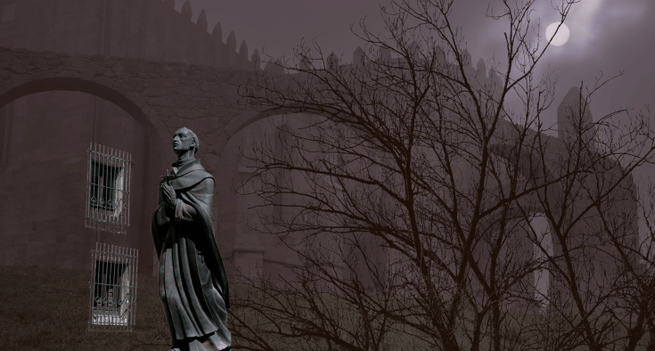
Featured image: Collage featuring the bronze sculpture of St. John of the Cross in Ávila, Spain. Photograph by José Hernaiz. Source: Adobe Stock. Created by Carmelite Quotes using Adobe Express.

#darkness #IainMatthew #prison #sign #StEdithStein #StJohnOfTheCross #StTeresaOfAvila #Toledo