Little Fuzzy by H. Beam Piper was first published in 1962 and was nominated for a Hugo Award in 1963. It’s not hard to understand its popularity: The titular “Fuzzies” are an adorable alien species, the story travels along at a good pace, and the clash between big business and the little band of pro-Fuzzy prospectors and naturalists is entertaining and ultimately satisfying. But the book is also thought-provoking in its exploration of what it means to be sapient and how humans interact with other sapient species.
As one character notes, “Anything that talks and builds a fire is a sapient being, yes. That’s the law. But that doesn’t mean that anything that doesn’t isn’t.”
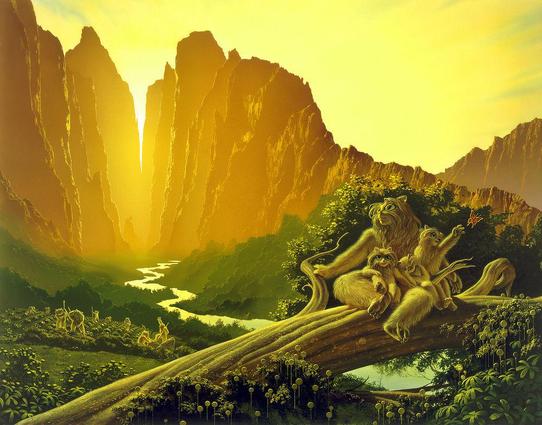
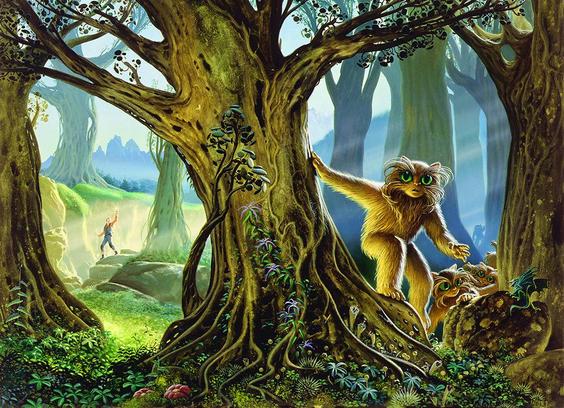
The Fuzzies are silken-furred, large-eyed, and doll-sized in appearance and curious and childlike in their behaviour. They arouse in their first human friends a protective (and possessive) instinct, particularly in Jack Holloway, who has the honor of being their first contact with homo sapiens. Jack is in his seventies, living out in the wilds of Zarathustra and mining for valuable sunstones. There are hints that he’s come to the planet to escape some messy mistakes (and possibly a drinking problem), but he’s an intelligent, if idiosyncratic, character with a formidable reputation who takes great delight in interacting with his visitors, Little Fuzzy and family, and they quickly make themselves at home with him.
However, Zarathustra is a class-III uninhabited planet owned by the Zarathustra Company, which is farming, mining, and settling the planet at an incredible (and lucrative) rate. Should a sapient native species be discovered there, the planet would be reclassified and the company’s ownership would be made void. So when the first news of Jack’s visitors reaches the company, they’re quick to send their own scientists out to disprove any claims of significant intelligence.
The picture of Fuzzy intelligence is built up by degrees within the story, largely through Jack’s interactions and observations, but human treatment of the potentially sapient race remains questionable throughout the book. They are intelligent tool-makers capable of surviving in a dangerous eco-system in which they appear to be food for a number of larger predators (not least of which are the imaginatively named “damnthings” and “harpies”). They are inquisitive, and it is thanks to this quality that they learn that humans (as represented by Jack) are generally a safe bet—Jack gives them food, new tools, and toys and tolerates them bedding down in his cabin, so what’s not to like? They are treated, however, like little children at best and, at worst, like pet dogs. Early on, even Jack catches himself putting a bowl of water down for Little Fuzzy “as he would for a dog” and instead supplies a cup. There is an element of consternation in almost every interaction between humans and Fuzzies, perhaps more so because the argument for their sapience occurs at the same time that Fuzzy dolls and hats are being made and people are owning and naming their Fuzzies as if they are the “fur-bearing animals” that the company claims them to be.
Little Fuzzy remains an entertaining story that encourages the reader to question how humanity sees and behaves towards other intelligences. Since 1962, we have been surprised again and again by what we have learned about the intelligence of the animals we share our planet with, from elephants and octopuses, to crows and bees—reminding us, hopefully, to continue to challenge our assumptions and justifications.
This book is now in the public domain and can be read for free on the Internet Archive’s Open Library or Project Gutenberg websites.
https://seattlein2025.org/2025/05/16/fantastic-fiction-check-your-assumptions-at-the-door-h-beam-pipers-little-fuzzy/
#HBeamPiper #LittleFuzzy
 Walt
Walt Michael Whelan
 lokatzi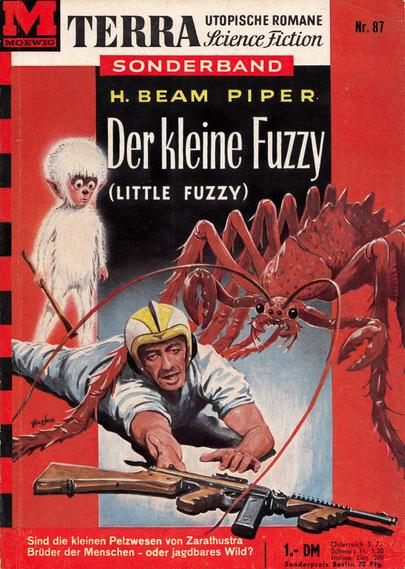
 Seattle Worldcon 2025


 Seattle Worldcon 2025