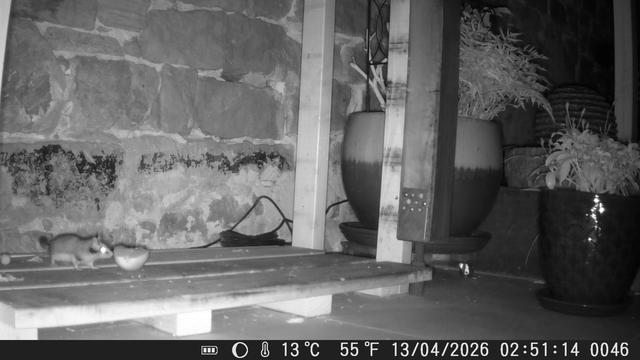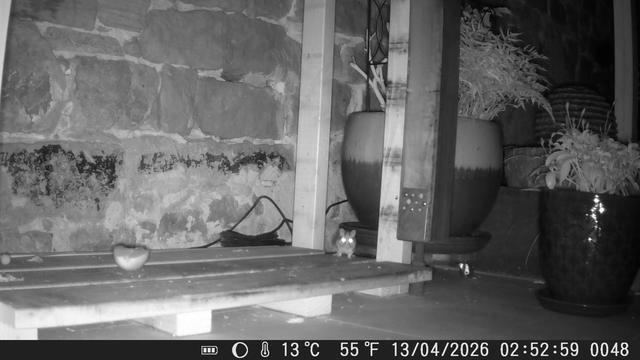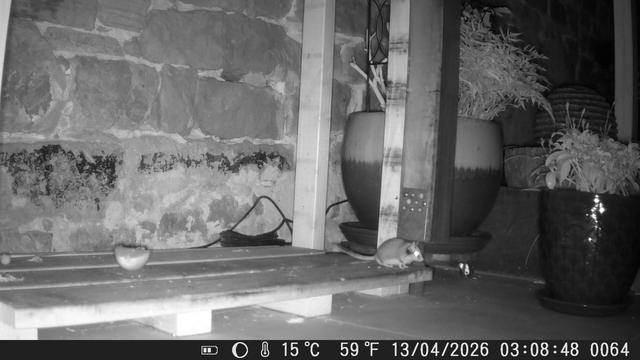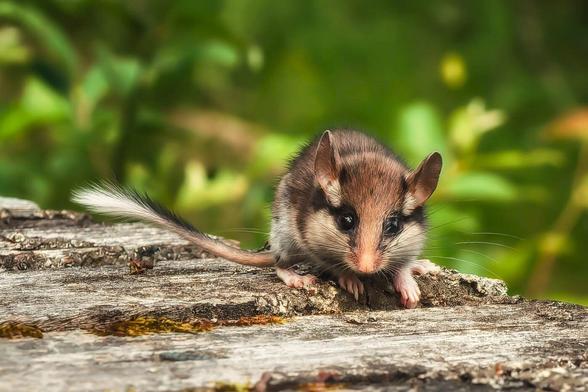
These snesky little critters, the garden dormouse, are excellent climbers, as they spend most of their lives in (oak) trees, which is handy as there are plenty around us. They do like moving into attics or roofspaces for the winter though and can wreak havoc with loft insulation, so while they are very cute, we try to keep them out of the house as best possible. They are also very stealthy - a few years ago, I caught one about to rummage in the recycling bag, hanging upside down above it on the thin steel rod used to openthe skylight!

#Eliomysquercinus
#GardenDormouse
#Auvergne
#France

The #gardendormouse too is particularly vulnerable to agricultural poisons, due to its characteristics. Unlike other Estonian #rodents, the #dormouse hibernates.It curls up and sleeps for up to half a year. Those animals that hibernate must accumulate fat reserves to survive the winter.
As the species also feeds on #insects, toxins can accumulate in its fat tissue that way. During #hibernation, these toxins begin to get released from the fat and can prove fatal

https://news.err.ee/1609762491/scientists-hope-to-bring-distinctive-garden-dormouse-back-to-estonia

Scientists hope to bring distinctive garden dormouse back to Estonia

The University of Tartu in conjunction with Tallinn Zoo and the Lutreola conservation foundation have launched a project which aims to bring back to Estonia the garden dormouse.

Eesti Rahvusringhääling | ERR

What does the #gardendormouse have in common with the Devil’s Claw, a plant, and the hygrophorus penarius, a mushroom? They are only, or mainly, found in Germany. Consequently, they are so-called #NationalResponsibilitySpecies (NRS), or species for which Germany is especially responsible. Alongside numerous individuals, nature conservation organizations and groups, the Federal Agency for Conservation takes care of #speciesprotection and #biodiversity.

https://www.deutschland.de/en/topic/environment/species-protection-in-germany-three-projects

Commitment to species protection

Biodiversity conservation is a global challenge. In Germany the Federal Agency for Conservation is in charge of this field of work.

deutschland.de

#Flea parasitism can affect the fitness of the host. Whether #ectoparasites and diseases play a role in the decline of the #gardendormouse (Eliomys quercinus) was one of the questions investigated in a project on the species. We searched for fleas in garden dormouse summer nests and on 24 specimens in Germany.
#dormouse #bilch #Gartenschläfer

https://www.researchgate.net/publication/392698520_Fleas_from_garden_dormice_Eliomys_quercinus_and_their_nests_in_Germany

#Biodiversity is decreasing worldwide, and early indicators are needed to identify endangered populations before they start to decline in abundance. In mammals, body mass (BM) is regarded as an indicator of fitness, and its loss is used as an early warning signal preceding population decline. The #gardendormouse (Eliomys quercinus) is a small mammalian #hibernator that has disappeared from over 50% of its former range in the last decades.
#dormouse

https://www.researchgate.net/publication/390991780_Reduced_Body_Mass_in_a_Highly_Insectivorous_Mammal_the_Garden_Dormouse-Ecological_Consequences_of_Insect_Decline

I came across this little goblin (Eliomys quercinus) on my last hike.

#gardendormouse #nature #naturephotography #wildlife