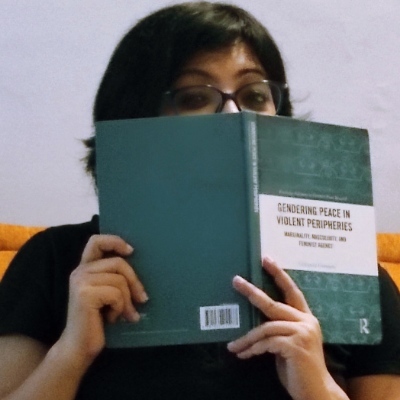
 Uddipana Goswami
Read it here: https://fulbrighternetwork.com/news/1290362
#Fulbrighter #Fulbright #fulbrightscholar #FeministPeace #academicchatter


Snapshots presents Uddipana Goswami on her new book 'Gendering Peace in Violent Peripheries'
I met countless women in the conflict zone who lived through different forms of prolonged, everyday violence – both political and interpersonal – and survived. They do not know their stories of survival and triumph are inspirational. Could you tell us about your new book Gendering Peace in Violent Peripheries: Marginality, Masculinity, and Feminist Agency?? Gendering Peace in Violent Peripheries: Marginality, Masculinity, and Feminist Agency is the first in Routledge's Advances in Feminist Peace Research series. It studies operations of gendered power in multi-ethnic, conflict-habituated geopolitical peripheries. It uses Assam and Northeast India – which is at the confluence of East, South, and Southeast Asia – as a specific location for studying these operations. The aim, in studying these conflict-habituated societies, is to analyze the obstacles to achieving positive, organic peace based on cooperation and mutual healing. In the shifting and relational margins of such peripheral societies, power and agency are constantly negotiated and in flux. Notions of masculinity are redefined in an interlaced environment of militarization, hyper-masculinization, and gendered violence. These interconnections inform victimhood and agency among the most vulnerable marginalized constituencies – namely, women and migrants. By centering the marginalized in its inquiry, the book identifies the tools used to perpetuate an endless cycle of violence that makes conflict a habit – a way of life. It does so with the aim of enabling resistance against these tools from within multi-ethnic societies embroiled in protracted conflicts. Such resistance must be based on reflexivity and strategic, cautious radicalism. This involves critically interrogating the inherent connections (which the book establishes) between engendered pasts and feminist futures; local changes and global contexts; as well as between small, incremental changes and big shifts impacting entire societies, nations, and global orders. How did your experiences as a Nehru-Fulbright postdoctoral fellow influence this book? I had done most of my fieldwork as an independent researcher before I applied for the Nehru-Fulbright fellowship: the fellowship gave me the much-needed critical distance from my immersive research besides significant physical distance from my research location (which is also home for me). During my Fulbright grant period at the University of Pennsylvania, my work was enriched by conversations with, feedback from, and cross-fertilization of ideas with interdisciplinary scholars and practitioners across the US. In particular, my faculty associate at the University, Prof Annette Lareau, and Dr Demie Kurz at the Gender, Sexuality, and Women's Studies Program helped me navigate the writing process as I adjusted to life and living in a foreign country. The Greater Philadelphia - Delaware Valley chapter of the Fulbright Association, and its president Dr Frances Novack, also played a huge role in helping me acclimatize to the country and build the academic, intellectual, and creative networks that informed and enriched the discussion in the book. My Fulbright grant coincided with Donald Trump’s presidency in America. This gave me the opportunity to witness the fissures within and between communities, and on occasion, to experience the underlying structural and cultural violence first-hand. I applied this experience to studying the ethnic fragmentation and violent confrontations in the specific context of my own research. This helped me reflect on the universality of social injustice and violence against marginalized communities. My book is richer because of this broader perspective. Are there any particular feminist thinkers and campaigners who have inspired your own intellectual endeavours? There are several feminist scholars whose writing and critical engagement with peace and war inspire my own intellectual endeavors as a feminist peace researcher: they are appropriately cited in the bibliographies of my books and research papers. But they are not the ones who drew me into this disciplinary field: I connected with their ideas after I met countless women in the conflict zone who lived through different forms of prolonged, everyday violence – both political and interpersonal – and survived. They do not know their stories of survival and triumph are inspirational; the quiet, unassuming ways in which they go about transforming the conflicts that they are engulfed in and the meaningful, organic peace that they build for their conflict-habituated societies made me undertake the research for this book. I tell some of their stories in my book, but my own story is shaped by the lessons I draw from them. These are the women who would not die: you can read a story I wrote about them for Rutgers University’s Institute for Research on Women. About Uddipana Uddipana Goswami is a writer and feminist peace researcher with a PhD in conflict studies. She is author of 6 books including an academic monograph, Conflict and Reconciliation: The Politics of Ethnicity in Assam (Routledge 2014) and a collection of short stories set against the violent conflicts in Northeast India, No Ghosts in This City (Zubaan 2014). Her latest book Gendering Peace in Violent Peripheries: Marginality, Masculinity, and Feminist Agency (Routledge 2023) derives from her Fulbright postdoctoral research at the University of Pennsylvania, USA. She is currently working on her next short story collection based on women’s stories of violence, survival, solidarity, and strength. A former journalist and editor, Uddipana worked with several multinational and hyperlocal media groups, from National Geographic Channel to Seven Sisters Post. As an academic, she teaches/has taught at the Tata Institute of Social Sciences (India), Guwahati College (India), University of Pennsylvania (USA), Curtis Institute of Music (USA), and Johns Hopkins University (USA). Details at: www.uddipana.in | Twitter: @mon_jajabori | Insta: @mon.jajabori | Facebook: www.facebook.com/uddipana.g Gendering Peace in Violent Peripheries: Marginality, Masculinity, and Feminist Agency is available to buy from Routledge. You can save 20% with the discount code ESA22.