Frau Holle
Good afternoon on this grey, cold day in the Peak District. It truly is grim today – barely daylight, damp, misty, the kind of cold that makes you wonder how people survived here for thousands of years without kettles and teabags – just what you’d expect this close to midwinter.
Usually, I’d dig out an article for the solstice – Something warm and cosy – a brief history and some suggestions for celebrating Yule for the more ‘Pagan’ inclined readers. But the internet is already full of them and this time of year has many more interesting festivals and folklore to offer – although I will still probably cover aspects of Yule and Saturnalia and the better known midwinter festivities, today we are going all sacred femme.
So.. take a few minutes for yourself, pull up a Yule log, grab a cup of tea and join me for a little festive chitchat about Frau Holle.
Frau Holle is truly one of the most fascinating figures in European folklore. She is steeped in mystery, myth, and cultural significance. She exists as a powerful archetype, blending elements of the divine feminine, the supernatural, and the maternal. Her roots are deeply embedded in Germanic mythology, and her presence has persisted through centuries, manifesting in fairy tales, regional traditions, and even modern neo-pagan practices. Yet most people have never heard of her.
At her core, Frau Holle is a figure of duality. She embodies both nurturing and stern qualities, acting as a protector and punisher, a bringer of abundance and an enforcer of justice. Her dual nature reflects the ancient belief in balance and reciprocity within the natural and moral order of the world. To truly understand her, we must delve into all her many facets – her roles as goddess, folk tale character, and seasonal spirit.
If you’ve heard of her, it would probably be from the Grimm Brothers’ fairy tale ‘Mother Holle’. In this story, she appears as a benevolent old woman living in a magical realm beyond a well. She rewards a diligent, kind-hearted girl with gold and punishes her lazy, selfish stepsister by covering her in pitch. This tale reinforces themes of morality and labour, presenting Frau Holle as a guardian of virtue and justice. Yet, even this simple narrative hints at something deeper – a connection to the cycles of life and the sacredness of work.
Frau Holle’s association with spinning is particularly significant. Spinning was a vital skill for women in pre-industrial societies, tied not only to survival but also to cultural identity and spiritual practice. In folklore, spinning often serves as a metaphor for fate, with threads representing the lifelines of individuals. Frau Holle’s role as a spinner places her in a lineage of goddesses such as the Norse Norns, who weave the destiny of all beings. We’ll cover the Norns at a later date.
It’s no coincidence that her realm is accessed through a well – a well represents a liminal space that connects the earthly world with the divine.
In older mythological contexts, Frau Holle likely originates as a Germanic goddess connected to the earth, fertility, and the cycles of nature. Her winter associations, particularly snowfall, link her to the seasonal rhythms of death and rebirth. In regions where she was venerated, snowfall was often described as Frau Holle shaking out her feather bed, a poetic image that ties her to both domestic life and the grandeur of the natural world. This act of shaking out feathers also symbolises the release of life-giving energy, ensuring the land remains fertile for the coming spring.
As Christianity spread through Europe, many pagan deities were either demonised or reimagined as folkloric figures. Frau Holle is an excellent example of this transformation. Stripped of her divine status, she became a fairy tale character or a seasonal spirit, yet her core attributes remained intact. The blending of pagan and Christian traditions allowed her to survive in the collective memory, even if her worship faded.
In folk traditions, Frau Holle is often connected to the Twelve Nights – the period between Christmas and Epiphany. This time was seen as liminal, when the veil between worlds thinned, and the dead roamed the earth. Frau Holle, as a psychopomp, was believed to lead the Wild Hunt during this time, gathering the souls of the departed. Her connection to the dead ties her to older chthonic deities and reinforces her role as a guardian of the natural cycle of life and death.
In some regions, Frau Holle was also associated with water, wells, and springs, further highlighting her role further as a life-giving force. Wells were often seen as sacred spaces, gateways to the otherworld, and sites of ritual offerings. The blending of her attributes, spinning, snow, water, and the dead, re-enforces the aspects that speak to her complexity and her enduring relevance.
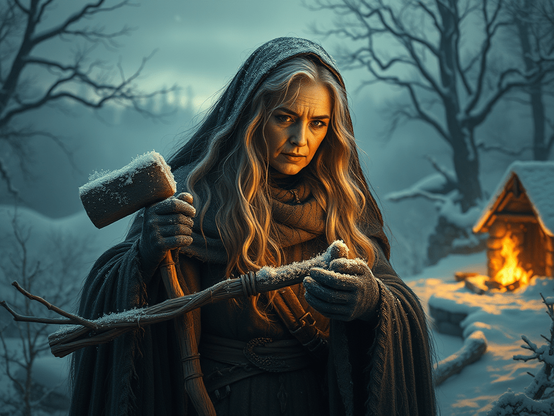
Frau Holle’s duality is reflected in her appearance across traditions. In some stories, she is depicted as a kind and loving figure, offering rewards to those who demonstrate virtue. In others, she is stern and even frightening, punishing those who fail to meet her standards. Her dual nature reflects the harsh realities of life in pre-modern societies, where survival depended on both hard work and the capriciousness of the natural world.
The persistence of Frau Holle in modern times speaks to the power of folklore to adapt and endure. While she may no longer be worshipped as a goddess, she remains a potent symbol of feminine power, moral justice, and the cyclical nature of existence.
Contemporary neo-pagan and Heathen practices sometimes embrace Frau Holle as a representative of ancestral wisdom and seasonal rhythms, honouring her through rituals, offerings, and storytelling.
Her story continues to resonate because it taps into universal human experiences – the need for balance, the value of work, and the desire to connect with something greater than ourselves.
Honouring Frau Holle can be a deeply meaningful way to connect with ancestral traditions, the cycles of nature, and the divine feminine. You could set up a small space in your home dedicated to Frau Holle. Include symbols of her domain, such as feathers (for her connection to snow), spinning tools like spindles or wool, and images of wells or water. Candles, particularly white ones, can represent her role as a bringer of light in the dark season. Add winter greens, such as holly or evergreen branches, to connect her to the natural world.
If you live in a region where it snows (I’m looking at you, Canada), take a moment to appreciate the snowfall as a blessing from Frau Holle. Spend time outside observing its beauty, or even collect a bit of snow to use as sacred water on your altar if you have one. If it doesn’t snow where you are, consider shaking out a feather pillow or blanket to symbolise her act of releasing snow upon the earth.
Frau Holle rewards diligence and kindness, as seen in her fairy tale. During the season, honour her by helping others, volunteering, or being generous with your time and resources. Balance these acts of kindness with dedicated work on personal projects or household tasks, keeping in mind her appreciation for effort and care.
As a protector of domestic life, Frau Holle can be celebrated through acts of hearthcraft and home-keeping. Bake traditional winter treats, prepare hearty meals, or engage in seasonal crafts. Cleaning and organising your home during this time can also be a way to invoke her energy and create a welcoming space for the new year.
If you have access to a natural spring, well, or other water source, you can leave small offerings to honour Frau Holle. Coins, flowers, or bread are traditional offerings in many water-related traditions. If visiting a water source isn’t feasible, you could pour fresh water into a bowl on your altar as a symbolic act.
Engage in spinning, knitting, weaving, or other fiber arts to connect with Frau Holle’s role as a spinner. If you don’t know how to spin, simply learning about the craft or appreciating its history can be a way to honour her. Consider making small handmade items as gifts or offerings.
Frau Holle is closely associated with the Twelve Nights (also known as the Rauhnächte) between Christmas and Epiphany. Use this liminal time to connect with her energy by reflecting on the past year, setting intentions for the year ahead, and engaging in divination or dreamwork. Keeping a dream journal during this time is particularly appropriate, as Frau Holle is said to have ties to the otherworld and the subconscious.
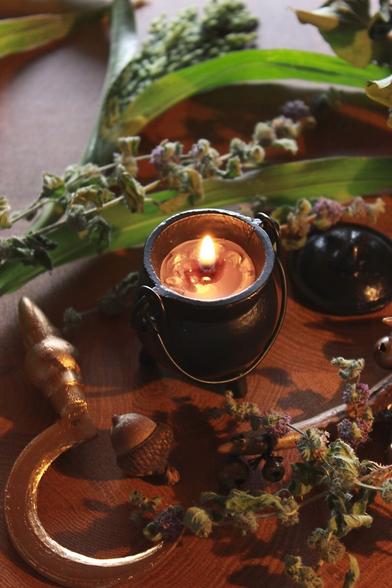
The hearth is a sacred space in Frau Holle’s domain. If you have a fireplace, lighting a fire in her honour is a meaningful act. Alternatively, light a candle in your home, dedicating its warmth and light to her. As the flame burns, meditate on her qualities of protection, justice, and renewal.
Share her stories with family or friends, share this post if you like, keeping her myth alive in modern times. Reflect on the lessons embedded in her tales, such as the importance of fairness, hard work, and the cycles of nature. Storytelling can be a powerful way to pass down her legacy and foster a sense of connection to your heritage – and it’s free and fun to do.
Prepare a simple offering of food, such as bread, porridge, or baked goods, and place it outside as a gesture of gratitude to Frau Holle – you’ll also be helping the wild bird out. This practice ties into older traditions of leaving offerings for household spirits or deities during the winter months.
Create snowflake ornaments, feather charms, or other seasonal decorations to honour her presence. These can be hung in your home as a reminder of her connection to the winter season and her protective influence.
It’s time for me to get back doing festive chores now. And it’s kind of nice knowing that for some, the mundane little tasks we undertake many times a day – washing a cup, writing a card, baking a pie – can be a nod to ancient traditions that honour long forgotten deities.
❄️
#ancestralWisdom #divination #divineFeminine #domesticMagic #dreamwork #fiberArts #FolkloreStudies #FrauHolle #GermanicMythology #hearthcraft #neoPaganism #paganRituals #Rauhnächte #sacredWells #seasonalCycles #seasonalOfferings #SeasonalTraditions #snowSymbolism #spinningGoddess #storytelling #traditionalFestivities #TwelveNights #WildHunt #winterFolklore #winterRituals #winterSolstice #Yule
 Exposé Online
 Monedula
 maexchen1
 Kirst Mason D'Raven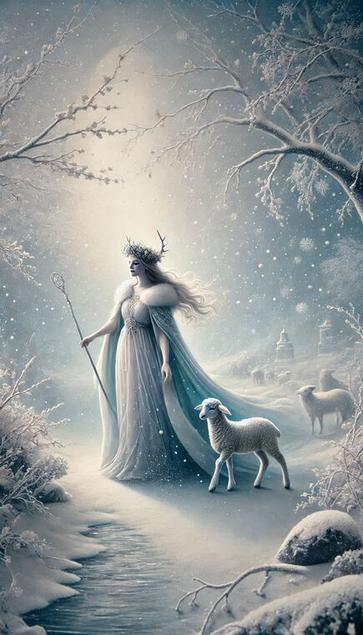
 Erbse // Hollenkraut





 kontainerlove

