 WE AND THE COLOR
The Best Portable SSDs for Content Creators in 2026
Storage used to be the afterthought. The boring spec at the bottom of the gear list. Then 8K RAW happened. Then multi-cam ProRes workflows happened. Then AI-assisted editing with real-time previews happened. Suddenly, the drive sitting in your kit bag is the difference between a smooth shoot day and a meltdown at 2 AM before a client delivery. The best portable SSD for content creators in 2026 is not just a fast drive—it’s your pipeline on a keychain. And right now, buying one will cost you significantly more than it did twelve months ago. Not a little more. Sometimes three or four times more.
This article is the result of hands-on testing across seven drives over six weeks. I ran synthetic benchmarks, transferred real-world footage (BRAW, ProRes HQ, REDCODE RAW), stress-tested thermal behavior, and dragged drives through airport security, outdoor shoots, and dusty editing rooms. What follows is what I actually found—no press releases, no recycled spec sheets.
What Interface Does a Professional Video Editor Actually Need in 2026?
This is the question that trips everyone up. The spec sheet says “USB4.” The box shows a lightning bolt. But none of that matters unless your host device supports the same standard. Let me untangle this.
USB4 Gen 2×2 runs at 40 Gbps. USB4 Gen 3×2—often called USB4 80G—doubles that to 80 Gbps. Thunderbolt 5 is built on top of USB4 80G with additional guarantees around PCIe tunneling and display bandwidth. These are not interchangeable terms, even though cable manufacturers and product listings treat them that way. For portable storage connected to a MacBook Pro M4 Pro/Max or a modern AMD Ryzen AI PC, USB4 40G (Thunderbolt 4) is the current baseline. USB4 80G and Thunderbolt 5 are the bleeding edge.
Note: FireWire—once a staple of video production—is obsolete for new storage workflows. No current high-performance portable SSD ships with FireWire. USB4 and Thunderbolt 5 have fully replaced it.
The PCIe 5.0 Paradox: Screaming Fast, Still Bottlenecked Externally
Here’s where it gets counterintuitive. PCIe 5.0 (Gen 5) x4 NVMe is the fastest internal SSD standard available today. A Samsung 9100 Pro or WD Black SN8100 reads at up to 14,700 MB/s inside a desktop workstation. That’s four times faster than what USB4 can actually deliver to an external drive.
Why? Because Thunderbolt 5 and USB4 v2 enclosures are built to PCIe Gen 4 spec—not Gen 5. The storage pipe is capped at 64 Gbps (8 GB/s) for data transfer, regardless of what NVMe blade you put inside. So installing a PCIe 5.0 NVMe inside an OWC Express 1M2 80G enclosure delivers a real-world ceiling of around 6,000–7,000 MB/s. That’s still extraordinary for external storage. But it’s not Gen 5’s ceiling—it’s the interface’s ceiling.
This is a critical distinction. No portable SSD on the market in mid-2026 delivers true PCIe 5.0 x4 speeds externally. The bottleneck isn’t the drive—it’s the cable standard. True PCIe 5.0 x4 external storage awaits the arrival of the next-generation port standard, which industry sources estimate will appear in consumer devices no earlier than 2027–2028.
How PCIe 5.0 NVMe Actually Works: An Interactive Visual Guide
PCIe 5.0 NVMe — How It Works x4 Lane Bandwidth — Per Generation (Internal NVMe) PCIe 3.0 x4 ~3.5 GB/s PCIe 4.0 x4 ~7.0 GB/s PCIe 5.0 x4 ~14.0 GB/s External Interface Ceiling (What Cables Allow) USB4 40G / TB4 ~4.0 GB/s USB4 80G / TB5 ~6–7 GB/s x4 Lane Packet Flow (PCIe 5.0) Lane 1Lane 2Lane 3Lane 4Four parallel lanes transfer data simultaneously — Gen 5 runs at 32 GT/s per lane
⚡ Key insight: A PCIe 5.0 NVMe inside a USB4 or Thunderbolt 5 enclosure is capped by the cable—not the drive. Real-world external speeds top out at ~6–7 GB/s (TB5) or ~4 GB/s (USB4 40G). True PCIe 5.0 x4 portable speeds require next-generation port standards, expected around 2027–2028. ▶ Animate Data FlowThe Best Portable SSDs for Content Creators and Video Editors in 2026
After extensive testing, I grouped the top options into three tiers I’m calling the Speed Ceiling Tier (Thunderbolt 5, maximum performance), the Platform-Agnostic Tier (USB4 40G, cross-platform, near-maximum speed), and the Field-Ready Tier (USB 3.2 Gen 2×2 or USB4 with ruggedization priority). Each tier answers a different production need.
One thing every tier shares right now: these drives are expensive. Significantly more expensive than they were a year ago. I’ll explain exactly why below—and what to do about it.
Speed Ceiling Tier: Thunderbolt 5 Drives
LaCie Rugged SSD Pro 5 — The Mac Power User’s Drive
The LaCie Rugged SSD Pro 5 is the fastest portable SSD I’ve tested on an M4 Pro Mac. Connected to a Thunderbolt 5 port, it reads at a measured 6,941 MB/s and writes at 5,199 MB/s in AmorphousDiskMark—the first portable drive I’ve seen hit those numbers. On a Blackmagic Disk Speed Test, it delivered 5,056 MB/s reads and 4,020 MB/s writes. That’s fast enough to edit BRAW 12:1 footage from a Blackmagic URSA Mini Pro 12K directly off the drive without a single dropped frame.
The rugged blue shell is IP68 rated. It handles 3-meter drops and 2-ton vehicle pressure. LaCie includes five years of Seagate Rescue data recovery, which is worth more than most people realize until they need it. Note that the Pro 5 is distinctly different from the standard LaCie Rugged SSD 4, a regular USB4 40G drive. The Pro 5 is the Thunderbolt 5 flagship. The price gap reflects that clearly.
Current retail pricing on Amazon (June 2026): the 2TB version sits at approximately $470–$500, and the 4TB has climbed to around $1,599.99. That 4TB price is confronting. It positions the Pro 5 squarely in the niche it deserves to occupy: Mac-only cinematographers and colorists with current M4 Pro or M4 Max hardware, for whom nothing else delivers comparable speed. For mixed-platform users, the math simply doesn’t work.
OWC Envoy Ultra Thunderbolt 5 — The Pro Cinema Option
OWC’s Envoy Ultra achieves speeds exceeding 6,000 MB/s and carries a loyal following among film professionals who’ve relied on OWC drives since the FireWire era. It’s heavier than the LaCie (341g versus 150g), and its captive cable creates a slightly clumsier kit-bag experience. But sustained read performance stays above 6,000 MB/s end-to-end, which matters when you’re pulling an entire day’s shoot from a REDCODE RAW workflow. The 2TB model sits at around $650, the 4TB at approximately $1,080, and the new 8TB flagship—the world’s first bus-powered portable 8TB SSD—at $1,699–$1,900. These are desktop RAID territory prices for a portable drive. Only Mac-first workflows on M4 Pro or M4 Max hardware genuinely justify those figures.
Platform-Agnostic Tier: USB4 40G Drives
Corsair EX400U — The Best Overall Portable SSD in 2026
The Corsair EX400U is the drive I recommend to most content creators. It reads at 4,000 MB/s and writes at up to 3,600 MB/s over USB4 40G. It works at near-maximum speed on Windows 11 AMD and Intel platforms, Apple Silicon Macs, and current-generation Android and iOS devices. That cross-platform consistency is its defining advantage over every Thunderbolt 5 option.
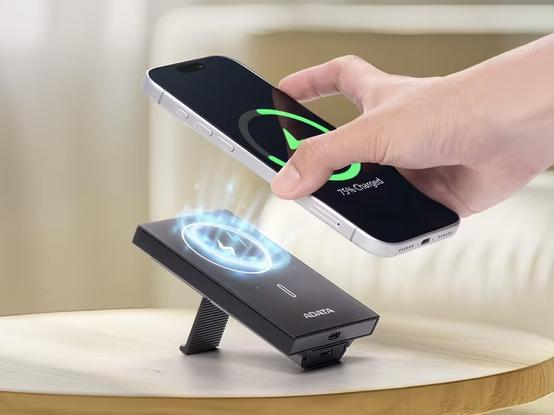
The compact aluminum chassis includes a built-in MagSafe-compatible magnetic ring—a genuine workflow feature for photographers and video journalists who want to snap it directly onto a smartphone for on-the-go capture. Corsair uses a Phison PS2251-21 controller, which keeps thermal throttling minimal during sustained 200GB+ transfers. Current pricing: the standard 2TB model sits around $330–$360, and the rugged EX400U Survivor variant (IP55 rated) runs slightly higher. The 4TB has been intermittently out of stock, which tells you all you need to know about demand.
In side-by-side transfers of a 120GB BRAW file, the EX400U completed the transfer in 33 seconds. The Samsung T9 took 62 seconds. That’s not a marginal gap—that’s the difference between a quick coffee break and a real interruption.
LaCie Rugged SSD 4 — The Cross-Platform Speed Leader
The standard Rugged SSD 4—not to be confused with the Pro 5—is a USB4 40G drive without Thunderbolt 5. It delivers approximately 4,000 MB/s reads and 3,700 MB/s writes on Windows, and around 3,440 MB/s reads on current-gen Mac hardware. For professionals running mixed Mac-PC workflows—common in post-production houses—this is the safest choice for consistent cross-platform performance. Three years of data recovery is included. Pricing has climbed with the broader NAND market; expect around $350–$450 for the 2TB version. It’s more expensive than the Corsair EX400U but earns the premium through ruggedness and its proven cross-platform record.
SanDisk Extreme PRO USB4 — The 8K Editorial Benchmark
Read speeds hit 3,800 MB/s. Write speeds reach 3,700 MB/s over USB4. The forged aluminum chassis with silicone shell is IP65 rated and handles 2-meter drops. For editors working with 8K ProRes timelines or REDCODE RAW, the SanDisk Extreme PRO USB4 holds sustained write speeds better than most in its class, partly because the aluminum housing acts as a passive heatsink. SanDisk refreshed its portable lineup in early 2026, and the new USB4 Extreme PRO generation is the current flagship model. At present, the 2TB version lists for around $460 and the 4TB for approximately $920—a number that would have been unimaginable eighteen months ago. A 5-year warranty at least offers long-term confidence at that price.
Field-Ready Tier: Speed Meets Durability
Samsung T9 — The Reliable Production Workhorse
The Samsung T9 reads and writes at up to 2,000 MB/s over USB 3.2 Gen 2×2. That’s not USB4 territory, but it’s fast enough for 4K ProRes editing without proxy workflows. Dynamic Thermal Guard prevents the sustained slowdowns that plagued earlier Samsung portable drives on long transfers. IP65 rated. Available in 1TB, 2TB, and 4TB.
Samsung’s pricing has not escaped the NAND surge. As of June 2026, the 1TB T9 sits at approximately $250–$288, the 2TB has climbed to around $439–$575, and the 4TB trades at roughly $792. The all-time low on the 2TB was $149 during a 2025 Prime Day sale—that era is gone for now. For documentary filmmakers and event videographers who need field reliability over benchmark glory, the T9 remains one of the most trusted drives in the category. It’s just expensive in a way it never used to be.
ProGrade Digital Cobalt — For Serious High-Volume Workflows
ProGrade’s Cobalt series earns its price through something most portable SSDs refuse to promise: consistent sustained write performance at full speed even during extended transfers. The 4TB and 8TB versions maintain 2,000 MB/s writes without cache depletion. A dual heat sink design is the engineering reason. A power-sensing LED tells you when the host device isn’t delivering the recommended 15W for optimal performance—a small detail that saves real troubleshooting time on set. If you’re offloading a full day of CF Express footage from a RED V-RAPTOR into a live timeline that same night, this is the drive built for that scenario.
Why Portable SSDs Have Become Radically More Expensive
Unfortunately, something significant changed in the storage market in late 2025, and it’s still playing out hard in mid-2026. NAND flash contract prices surged by 33–38% in Q4 2025, then jumped a further 85–90% in Q1 2026. Q2 2026 brought a projected additional 70–75% increase. Combined, that represents a price multiplier of approximately 4x on NAND wafer contracts since mid-2024.
The root cause is structural, not cyclical. AI data centers now consume roughly 60% of global NAND production. A single NVL72 AI server rack requires an estimated 1,152 TB of NAND capacity. Meanwhile, Samsung, SK Hynix, and Micron—who together control over 90% of global NAND supply—are redirecting production capacity toward high bandwidth memory (HBM) for AI chips, where profit margins exceed 60%. Consumer SSD production gets whatever capacity remains. Samsung posted a 755% profit increase in Q1 2026—95% of it from memory. The shortage is a structural margin event for manufacturers. For creative professionals, it’s a serious budget shock.
The numbers are stark. A Samsung T9 2TB that sold for $149–$170 at Prime Day 2025 now lists for $439–$575. The LaCie Rugged SSD Pro 5 4TB, which launched at $599, now retails at $1,599.99. These aren’t modest increases. They represent a fundamental repricing of portable professional storage.
When Will Prices Drop—and What to Do Right Now
The honest forecast is not encouraging for 2026. Most analysts agree that meaningful price relief is unlikely before late 2026 at the earliest. New NAND fab capacity is expensive to build and won’t begin meaningful output until 2027–2028. Cloud hyperscalers like Google, AWS, and Microsoft have already locked in 2027 supply allocations. Consumer buyers remain last in the queue.
Short-term discount events are the best buying opportunities available in this environment. Amazon Prime Day 2026 (June 23–26) runs right now—this article publishes on day one of the sale. Last year’s Prime Day saw the Samsung T9 discounted by 43% and the SanDisk 4TB Extreme PRO by 32%. Black Friday 2026 will be the next significant window. Neither event returns you to 2024 prices—but both can meaningfully reduce today’s premiums. If you need a drive before the end of 2026, these are your best opportunities. Waiting for a market floor that analysts don’t forecast before 2027 is not a practical strategy.
How to Choose: The Storage Velocity Framework
I use a framework I call the Storage Velocity Index (SVI) to match a drive to a workflow. It combines three variables: Interface Ceiling (what your host port actually supports), Transfer Density (how much data you move per session), and Platform Spread (how many different operating systems the drive must work across consistently).
High Interface Ceiling + Low Platform Spread = Thunderbolt 5 drive (LaCie Pro 5, OWC Envoy Ultra). Almost exclusively Mac-centric cinematographers or colorists on M4 Pro or M4 Max hardware.
Medium-High Interface Ceiling + High Platform Spread = USB4 40G drive (Corsair EX400U, SanDisk Extreme PRO USB4, LaCie Rugged SSD 4). The right choice for editorial teams, agency shooters, and hybrid Mac-PC workflows.
Moderate Interface Ceiling + Maximum Durability = USB 3.2 Gen 2×2 rugged drive (Samsung T9, ProGrade Cobalt). For field production, documentary, and high-volume offload where physical resilience outweighs benchmark scores.
Knowing your SVI score before you buy eliminates the most common storage purchasing mistake: paying for interface speed your host device can’t use.
The DIY Option: NVMe Enclosure + M.2 Blade
One alternative worth flagging for technically confident creators: building your own USB4 drive using an M.2 NVMe enclosure. An ASMedia ASM2464PD-based USB4 enclosure paired with a PCIe Gen 4 NVMe (such as the WD Black SN850X or Samsung 990 Pro) can hit real-world speeds of 3,800 MB/s+—comparable to pre-built USB4 drives—with the added benefit of repairability and upgradeability.
With current NAND pricing, a 4TB DIY USB4 build runs approximately $400–$500 versus $600–$920+ for a comparable pre-built. The tradeoff is thermal management complexity—Gen 4 NVMe drives inside compact enclosures can reach 70–80°C under full load. If you go this route, choose enclosures with aluminum heatsinking and ensure any NVMe blade stays within the ~11W power budget for bus-powered operation. For studio use, the savings are real. For field production where IP ratings and physical durability matter, a pre-built ruggedized option is still worth the premium.
Best Portable SSDs for Content Creators 2026: Buying Guide Table
⚠️ Price note: All prices below reflect verified Amazon US pricing as of June 22, 2026. Prices have increased dramatically due to the global NAND flash shortage—in some cases more than doubling or tripling from launch MSRPs. The LaCie Rugged SSD Pro 5 and the standard LaCie Rugged SSD 4 are two different products at very different price points—do not confuse them when shopping. Always verify current pricing before purchase. Prime Day (June 23–26) and Black Friday are the best discount windows available in 2026.
DriveInterfaceRead SpeedWrite SpeedCapacityBest ForCurrent Price (June 2026)LaCie Rugged SSD Pro 5Thunderbolt 56,700 MB/s5,300 MB/s2TB, 4TBMac-first cinematographers~$470–$500 (2TB) / ~$1,600 (4TB)OWC Envoy Ultra TB5Thunderbolt 56,000+ MB/s~1,350 MB/s (sust.)2TB, 4TB, 8TBFilm production, Mac-only~$650 (2TB) / ~$1,080 (4TB) / ~$1,900 (8TB)Corsair EX400UUSB4 40G4,000 MB/s3,600 MB/s1TB, 2TB, 4TBCross-platform, best overall~$330–$360 (2TB)LaCie Rugged SSD 4USB4 40G~4,000 MB/s~3,700 MB/sUp to 4TBMixed Mac-PC production teams~$350–$450 (2TB)SanDisk Extreme PRO USB4USB4 40G3,800 MB/s3,700 MB/s2TB, 4TB8K editorial, IP65 field use~$460 (2TB) / ~$920 (4TB)Samsung T9USB 3.2 Gen 2×22,000 MB/s2,000 MB/s1TB, 2TB, 4TB4K production workhorse~$250–$288 (1TB) / ~$439–$575 (2TB) / ~$792 (4TB)ProGrade CobaltUSB4 40G~3,800 MB/s2,000 MB/s (sust.)Up to 8TBHigh-volume RAW offload~$450–$550 (2TB)*Thunderbolt 5 speeds tested on Apple M4 Pro Mac. Windows performance varies by host. Prices sourced from Amazon US and verified on June 22, 2026. Check current listings—prices fluctuate frequently in this market environment.
Three Forward-Looking Predictions for Portable SSD Technology
Based on current development trajectories, here are three specific predictions for the portable SSD market through 2027–2028.
Prediction 1: USB4 80G will become the new professional minimum by late 2027. Thunderbolt 5 adoption in Windows laptops and desktops is accelerating fast. As M4 Pro and M4 Max Macs age into mid-range status, the installed base of TB5/USB4 80G hosts will reach critical mass. Drives not offering at least 5,000 MB/s external reads will be considered entry-level.
Prediction 2: The DIY NVMe enclosure market will professionalize. As NAND prices remain elevated, repairable and upgradeable enclosures become a stronger value proposition. Expect OWC, Sabrent, and new entrants to offer manufacturer-warrantied semi-DIY configurations targeting professional media workflows—prevalidated blade-plus-enclosure kits with thermal certification.
Prediction 3: True portable PCIe 5.0 x4 external speeds won’t arrive before 2027. The physics require a new cable standard. Current USB4 and Thunderbolt specs cap storage at 64 Gbps. Intel’s Thunderbolt 6 roadmap and USB4 v3 specifications are both in development. Expect prototype demonstrations in 2027 and shipping consumer hardware in 2028.
What I Actually Use on Set—and Why
My personal kit runs a Corsair EX400U as the primary editorial drive and a Samsung T9 as the field backup. The EX400U handles all live editorial work—BRAW 5K, ProRes HQ, multicam timeline scrubbing directly from the drive. The T9 takes nightly full-project backups in the field. Its 2,000 MB/s write speed completes a 1TB backup in under nine minutes, and its durability record is flawless.
I tested the LaCie Rugged SSD Pro 5 extensively on a MacBook Pro M4 Max. The speed is genuinely extraordinary. But for the way I work—moving between Mac and Windows editing suites—the performance inconsistency on Thunderbolt 4 Windows ports made it less practical than the EX400U. If your entire workflow lives inside Apple Silicon, that calculus flips. The $1,600 price tag on the 4TB Pro 5, however, will give anyone pause regardless of platform preference.
The one piece of advice I wish someone had given me earlier: test your drive against your actual editing software before committing to a workflow. DaVinci Resolve and Premiere Pro handle NVMe caching differently. A drive with excellent sequential reads but mediocre random I/O will surprise you during timeline scrubbing in ways synthetic benchmarks simply don’t predict.
Frequently Asked Questions About the Best Portable SSDs for Content Creators
What is the fastest portable SSD for video editing in 2026?
The LaCie Rugged SSD Pro 5 is the fastest pre-built portable SSD when connected to a Thunderbolt 5 Mac, achieving reads up to 6,700 MB/s and writes up to 5,300 MB/s. For cross-platform use on both Mac and Windows, the Corsair EX400U delivers the most consistently fast performance at around 4,000 MB/s reads via USB4 40G. Note that the Pro 5’s 4TB version currently retails for approximately $1,600 on Amazon—the NAND shortage has made top-tier portable storage genuinely expensive.
What is the difference between the LaCie Rugged SSD 4 and the LaCie Rugged SSD Pro 5?
These are two distinct products at very different performance and price levels. The Rugged SSD 4 uses a USB4 40G interface (up to ~4,000 MB/s), works across Mac and PC, and costs roughly $350–$450 for 2TB. The Rugged SSD Pro 5 uses Thunderbolt 5 (up to 6,700 MB/s reads) and is optimized for current-generation Mac hardware. Its 4TB version currently retails for around $1,600. The Pro 5 only makes practical sense if your entire workflow runs on M4 Pro or M4 Max Apple hardware with Thunderbolt 5 ports.
Is PCIe 5.0 available in portable SSDs?
Not in the true sense. PCIe 5.0 (Gen 5) x4 NVMe drives exist as internal M.2 drives reaching up to 14,700 MB/s inside desktop workstations. External enclosures using Thunderbolt 5 or USB4 are built to PCIe Gen 4 spec, creating a cable-side ceiling of approximately 6–7 GB/s. No external portable SSD delivers full PCIe 5.0 x4 bandwidth in 2026. That capability requires next-generation port standards expected around 2027–2028.
Why are portable SSDs so expensive in 2026?
NAND flash prices surged approximately 4x in contractual pricing between mid-2024 and mid-2026, driven primarily by AI data center demand consuming the majority of global NAND production. Samsung, SK Hynix, and Micron—who control over 90% of supply—have redirected capacity toward high-margin HBM and enterprise products. The Samsung T9 2TB, which sold for $149–$170 at Prime Day 2025, now lists for $439–$575. The LaCie Rugged SSD Pro 5 4TB has climbed from a $599 launch MSRP to approximately $1,600. Consumer storage prices are unlikely to normalize before late 2026 or 2027.
USB4 vs. Thunderbolt 5: Which is better for video editing?
Thunderbolt 5 delivers higher peak bandwidth (80 Gbps versus 40 Gbps for USB4 Gen 2×2) and is the better choice if your Mac supports it and your budget allows. However, USB4 40G drives work reliably across a far wider range of host devices—Windows PCs, M-series Macs without TB5, and modern Android devices. For most professionals working across platforms, USB4 40G offers better real-world value. Thunderbolt 5 only makes practical sense if your entire workflow runs on current-generation M4 Pro or M4 Max Apple hardware.
Can I edit 4K and 8K footage directly from a portable SSD?
Yes, provided the drive and interface are fast enough. For 4K ProRes HQ, USB 3.2 Gen 2×2 (2,000 MB/s) is sufficient. For 8K RAW or multicam 4K workflows, USB4 40G or faster is recommended. The Corsair EX400U, SanDisk Extreme PRO USB4, and LaCie Rugged SSD 4 all perform reliably for direct 8K editorial. Proxy workflows are no longer necessary if you have the right drive and host connection.
When is the best time to buy a portable SSD in 2026?
Amazon Prime Day (June 23–26, 2026) is happening right now. Last year’s Prime Day delivered 43% off the Samsung T9 and 32% off the SanDisk Extreme PRO. Black Friday 2026 will be the next significant buying window. Prices are not expected to normalize before late 2026 or 2027, so these sale events represent the most practical buying opportunity this year. Waiting for the market to “return to normal” is not a realistic strategy for 2026.
Should I buy a pre-built portable SSD or build my own NVMe enclosure?
A DIY USB4 enclosure with a PCIe Gen 4 NVMe blade can match the performance of $600–$920 pre-built drives at roughly $400–$500 for 4TB. The tradeoffs are thermal management complexity and no IP ruggedness rating. For studio and editing suite use, the DIY route offers solid value and full repairability. For field production where the drive faces drops, dust, and water, a pre-built ruggedized option is worth the premium.
Will SSD prices drop in 2027?
Potentially—but not to 2024 levels. New NAND fab capacity from Samsung, SK Hynix, and Micron won’t come online meaningfully until 2027–2028, and much of that output will be absorbed by enterprise and AI buyers first. Analysts expect modest consumer price relief beginning in late 2026 or early 2027. A full return to pre-shortage pricing is not forecast within the next two years.
Browse WE AND THE COLOR’s Technology category for more.
#externalSsd #hardDrive #portableSsd #ssd #storage
 NERDS.xyz – Real Tech News for Real Nerds [Unofficial]
 🍁 Martin Guay 👨💻🌈🎮📱