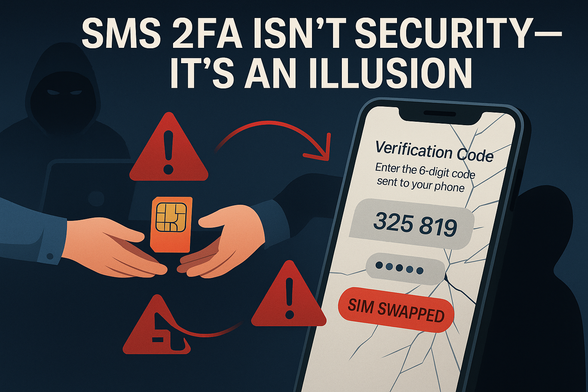
SMS 2FA isn’t security — it’s an illusion.

WWE star AJ Styles had two-factor authentication enabled.

It didn’t matter.

His X account was hijacked through a SIM swap — a common but devastating attack where hackers convince a mobile carrier to transfer your number to their SIM.

From there, they intercepted his 2FA codes and took control of his entire digital presence.
Racist tweets.
Crypto scam links.
Brand damage in real-time.

AJ later said:
“They stole my SIM card. Somebody at AT&T allowed it to happen.”

Let that sink in.

He did everything right — or so he thought.
But SMS-based 2FA didn’t protect him. It opened the door.

This isn’t rare.
It’s not bad luck.
It’s a broken system.

Here’s the hard truth:

- SMS 2FA can be socially engineered
- It depends on your mobile carrier’s weakest employee
- And once your number is stolen, every linked account is at risk

If you’re still using SMS for 2FA on high-value accounts — crypto, email, social, banking — you’re playing defense with a paper shield.

Here’s what to do instead:

- Use an app-based authenticator (like Authy or Google Authenticator)
- Better yet, use a physical security key (like YubiKey)
- Assume your number will be targeted — and plan accordingly

Because in 2025, SMS 2FA isn’t protection.
It’s a liability in disguise.
#Cybersecurity #SIMSwap #MobileSecurity #Efani

He lost $38,000 in one night.
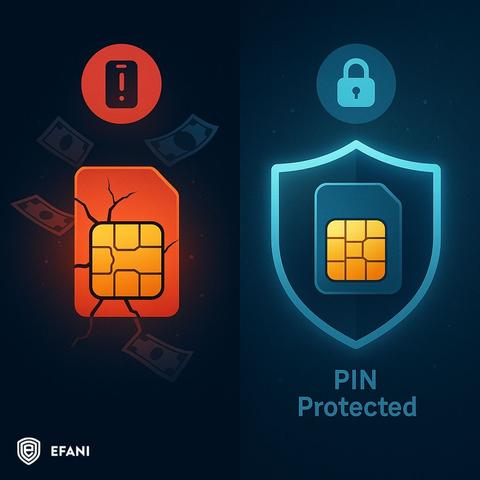
A simple PIN could’ve stopped it.

Justin Chan was a regular user — not a celebrity, not a billionaire, not someone with enemies.
But that didn’t matter.

A fraudster called his mobile carrier, pretended to be him, and transferred his phone number to a new device.
Once they had his number, they got his 2FA codes.
Then came the real damage — wire transfers, account breaches, and $38,000 drained across multiple platforms.

The entire attack took just 3 hours.
The recovery? It took months — and media intervention.

Here’s the kicker: Justin added a PIN to his cellular account only after the incident.
Had that been in place earlier, the attacker wouldn’t have been able to hijack his number so easily.

That’s the reality most people don’t realize:
Your phone number is a master key — and it’s often protected by nothing more than a customer rep and a few easy-to-guess personal details.

At @Efani, every SIM is PIN-locked by default. Because it only takes one call to lose everything — but just one setting to stop it.

The solution isn’t complicated.
But ignoring it can be costly.

#SIMSwap #CyberSecurity #MobilePrivacy #Efani

🚨 Another critical reminder: Even trusted VPN solutions can expose your systems if not properly secured.

Shelltrail researchers have uncovered three critical vulnerabilities in the IXON VPN client that could allow attackers to escalate privileges on both Windows and Linux systems. 🛡️

What happened:
- Three vulnerabilities (CVE-2025-ZZZ-01, CVE-2025-ZZZ-02, CVE-2025-ZZZ-03) have been identified.
- Attackers can achieve Local Privilege Escalation (LPE), gaining root or SYSTEM-level access.
- On Linux: Attackers exploit temporary OpenVPN config files in /tmp.
- On Windows: Race conditions allow malicious overwrites of temp files without needing an active VPN connection.

Why it matters:
- Industrial remote access systems depending on IXON VPN are particularly at risk.
- Exploitation could allow attackers full control over critical infrastructure systems.

Good news:
- IXON promptly responded and released version 1.4.4, securing how temporary files are handled.
- Users are strongly advised to update immediately and review IXON’s official security advisory (ADV-2025-03-17).

⚡ Key takeaway: Always monitor your remote access solutions for vulnerabilities — especially when your operations rely heavily on them.

Stay safe, stay updated. 🔒

#Cybersecurity #InfoSec #Efani

🛑 When your crosswalk starts quoting Elon Musk, something’s gone very wrong.

Over the weekend, hackers hijacked audio-enabled crosswalk buttons across Silicon Valley — replacing accessibility messages with AI-generated voices of Elon Musk and Mark Zuckerberg.

Pedestrians in Menlo Park and Palo Alto were met with bizarre, deepfake-style soundbites like:

“There’s absolutely nothing you can do to stop it.”
“I guess money can’t buy happiness… but it can buy a Cybertruck.”

🎯 The punchline? This wasn’t a high-level exploit.
Reports suggest the attackers likely used default credentials that had never been changed.

Let that sink in: public infrastructure, intended to serve the visually impaired, turned into an AI-powered street performance — all because of basic security negligence.

This is bigger than a viral moment:
– Public systems are routinely left exposed
– AI + deepfake tools are trivial to access
– And human oversight remains the weakest link

At @Efani, we believe that real security begins with the basics.
If you haven’t changed your device defaults — you’ve already been compromised.

#CyberSecurity #InfrastructureSecurity #Deepfake #AIThreats #Efani

🚨 Hardcoded API keys. No SSL validation. Vulnerabilities dating back to 2017.

Appknox researchers just uncovered 10 serious security flaws in the Android app of Perplexity AI — a popular research chatbot often praised for its accuracy. But in the race to ship fast, it seems security took a back seat.

According to the report, Perplexity's app contains:

Insecure network configurations
No SSL pinning — enabling impersonation attacks
Weak root/jailbreak detection
Susceptibility to StrandHogg and CVE-2017-13156
Exposure to clickjacking
CORS misconfigurations
Lack of bytecode obfuscation
Hardcoded Google API keys and access tokens

That last one is especially dangerous — it means attackers could bypass authentication and interact directly with the app’s backend.

🔐 The takeaway? Innovation is critical. But if it compromises user privacy and data integrity, it’s not worth the risk.

At Efani, we believe mobile apps — especially those powered by AI — must be built secure by design. Users deserve speed and safety.

📱 Appknox is advising Android users to uninstall the Perplexity app immediately until these issues are resolved.

Security should never be an afterthought.

#CyberSecurity #MobileSecurity #PrivacyFirst #Efani

This video discusses the growing threat of #simswap attacks, which can affect anyone with financial accounts, from bank accounts to crypto wallets.

Watch and learn how scammers can use SIM swapping to steal your funds and, more importantly, how #efani provides the solution to protect yourself.

Stay ahead in the evolving mobile security landscape! 📱🔒

Watch this video to learn what Mark Kreitzman says about common security myths and practical tips to protect yourself against SIM Swaps.

#MobileSecurity #SIMSwap #StaySecure #Efani

Exploring mobile security options and came across
@Efani - a service promising military-grade protection against SIM swapping and other security threats. Have you used #Efani? What are your thoughts? Would you consider subscribing for enhanced security? 📱 #MobileSecurity

Just fixed my @Efani dashboard issues, support was great. So now that I have access to my dashboard some notes for #Efani

TOTP Code generation shouldn't just be QR, you should also allow the string of text to be manually input. I had to use zbarimg to convert the QR code to text to input into my @yubico security key and vault for TOTP generation.
You should also add FIDO/WebAuthn support. TOTP has a single seed, so if stolen they have access. #infosec #Cybersecurity #SIMSwap #cellphone