 Francisco Rodriguez-Sanchez
1/ New paper on the structure of mutualistic #networks between individuals plants and frugivore species.
Last chapter of
https://elequintero.github.io/ PhD thesis
https://doi.org/10.1073/pnas.2402342122 #ecopubs
Short summary thread:
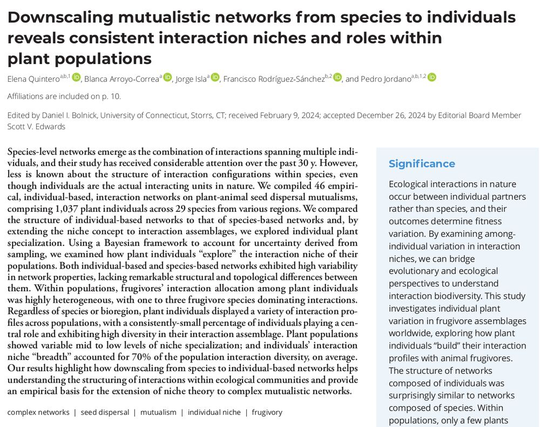
1/ New paper on the structure of mutualistic #networks between individuals plants and frugivore species.
Last chapter of
https://elequintero.github.io/ PhD thesis
https://doi.org/10.1073/pnas.2402342122 #ecopubs
Short summary thread:
New data paper in Ecology reporting >10000 #frugivory interaction events between 59 vertebrate species (46 birds, 13 mammals) and 339 plant individuals from 13 different plant species in Doñana, Southern Spain, obtained with #CameraTraps:
Trying to infer biotic interactions from species co-occurrence? Re-upping this paper that shows it's complicated...
Interesting preprint:
Tree diversity increases forest temperature buffering
"Species richness strengthened the attenuation of hot and of cold macroclimate air temperatures, with the cooling effect being more pronounced"
Code sharing increases citations but remains uncommon
https://doi.org/10.21203/rs.3.rs-3222221/v1
'We examine temporal trends in code sharing in ecology and evolution publications since 2010.
We find that scientists are overwhelmingly (95%) failing to publish their code.
We also find code sharing can considerably improve citations.'
Biologists increasingly rely on computer code, reinforcing the importance of published code for transparency, reproducibility, training, and a basis for further work. Here we conduct a literature review examining temporal trends in code sharing in ecology and evolution publications since 2010,...
Cool study on #coexistence published today in Science:
https://doi.org/10.1126/science.adg0727
They put many species pairs to coexist together. In most cases one species outcompeted the other
Yet all these species are actually coexisting in real communities: coexistence is an emergent phenomenon
Cool study using 18 yr of data from grassland biodiversity experiment shows that plant diversity buffers soil temperature throughout the year
Grasslands with more species show stronger cooling in summer (up to 5ºC) and warming in autumn (+1.5ºC)
Assessing and improving the transferability of global spatial prediction models https://doi.org/10.1111/geb.13635 #ecopubs
-Random cross-validation overestimates accuracy
-Spatial CV selecting reduced number of predictors improves accuracy
-Keep predictions within area of applicability
New preprint @ecoevorxiv claims that ">50% of statistically significant findings in the environmental sciences are actually not"
Species distribution models (SDMs) are increasingly applied across macroscales. However, assumptions of stationarity in species-environment relationships or population trends inherent to most SDM techniques are frequently violated at broad spatial scales. Bayesian spatially-varying coefficient (SVC) models can readily account for nonstationarity, yet their use is relatively scarce, due, in part, to a gap in understanding both the data requirements needed to fit SVC SDMs, as well as the inferential benefits of applying a more complex modeling framework. Using simulations, we present guidelines and recommendations for fitting single-season and multi-season SVC SDMs. We display the inferential benefits of SVC SDMs using an empirical case study assessing spatially-varying trends of 51 forest birds in the eastern US from 2000-2019. We provide user-friendly and computationally efficient software to fit SVC SDMs in the spOccupancy R package. While all datasets are unique, we recommend a minimum sample size of ${\sim}500$ spatial locations when fitting single-season SVC SDMs, while for multi-season SVC SDMs, ${\sim}100$ sites is adequate for even moderate amounts of temporal replication. Within our case study, we found 88% (45 of 51) of species had strong support for spatially-varying occurrence trends. We suggest five guidelines: (1) only fit single-season SVC SDMs with more than ${\sim}500$ sites; (2) consider using informative priors on spatial parameters to improve spatial process estimates; (3) use data from multiple seasons if available; (4) use model selection to compare SVC SDMs with simpler alternatives; and (5) develop simulations to assess the reliability of inferences. These guidelines provide a comprehensive foundation for using SVC SDMs to evaluate the presence and impact of nonstationary environmental factors that drive species distributions at macroscales.