I contributed a little bit to this methods paper now published in #eNeuro :
Adapt-A-Maze: An Open-Source Adaptable and Automated Rodent Behavior Maze System - my contribution is mostly about the automated, pneumatic door system, as you may know, doors are my thing 😉 🚪

First author Blake Porter from the #JadhavLab did a great job putting everything together in an easily-useable format and, for once, I will link to Bluesky with his nice thread on it: https://bsky.app/profile/blakep-neuro.bsky.social/post/3lms56kaj3k2x

If you ever try to implement it in your own lab, let me know!

#SpatialCognition #NeuroRat #Navigation

🚀New from Urban Lab in #eNeuro We used spatiotemporal clustering of single fUS voxels to map visual activity in awake mice. This high-resolution method precisely separates signals, revealing fine-grained activity patterns like never before🧠✨
https://doi.org/10.1523/ENEURO.0438-24.2025
Spatiotemporal Clustering of Functional Ultrasound Signals at the Single-Voxel Level

Functional ultrasound (fUS) imaging is a well-established neuroimaging technology that offers high spatiotemporal resolution and a large field of view. Typical strategies for analysing fUS data comprise either region-based averaging, typically based on reference atlases, or correlation with experimental events. Nevertheless, these methodologies possess several inherent limitations, including a restricted utilisation of the spatial dimension and a pronounced bias influenced by preconceived notions about the recorded activity. In this study, we put forth single-voxel clustering as a third method to address these issues. A comparison was conducted between the three strategies on a typical dataset comprising visually evoked activity in the superior colliculus in awake mice. The application of single-voxel clustering yielded the generation of detailed activity maps, which revealed a consistent layout of activity and a clear separation between haemodynamic responses. This method is best considered as a complement to region-based averaging and correlation. It has direct applicability to challenging contexts, such as paradigm-free analysis on behaving subjects and brain decoding. Significance Statement The application of spatiotemporal clustering at single-voxel resolution for functional ultrasound (fUS) signal analysis significantly enhances sensitivity in comparison to conventional methods, such as region-based averaging or event correlation. Conventional approaches frequently rely on predefined atlases or specific experimental conditions, which inherently restrict spatiotemporal resolution. In contrast, single-voxel clustering optimises the potential of fUS, facilitating the detection of intricate activity patterns throughout the brain without the necessity for prior assumptions. This approach enables more precise differentiation of hemodynamic responses and more reliable activity mapping. It is particularly advantageous in complex or paradigm-free studies, offering a high-resolution alternative to standard techniques.

eNeuro

For reference, here is eNeuro's current editor in chief, Christophe Bernard, writing about #eNeuro:

"eNeuro at Ten: Just Warming Up" (2024) https://www.eneuro.org/content/11/3/ENEURO.0113-24.2024.full

eNeuro at Ten: Just Warming Up

Dear friends, As we approach the tenth anniversary of eNeuro at the close of 2024, it strikes me that 10-year-olds are known for their boundless energy and insatiable curiosity. Much like a child at this pivotal age, eNeuro is far from settling down. Instead, we are just gearing up for the lively and exciting journey ahead. Remember when you were ten? Too old to be considered little, but too young to be taken too seriously. Ten-year-olds are notorious for their enthusiasm, their sudden spurts of growth, and their remarkable ability to never sit still. Likewise, eNeuro is buzzing with energy and a refusal to …

eNeuro
How does our ability to make an effort to avoid unpleasant situations and obtain rewards differ by gender? I explored this question with @BecketTodd and others in my first-author paper in #eneuro, based on my master's thesis. https://doi.org/10.1523/ENEURO.0239-22.2023
A 🧵:
Gender impacts the relationship between mood disorder symptoms and effortful avoidance performance

We must often decide how much effort to exert or withhold to avoid undesirable outcomes or obtain rewards. In depression and anxiety, levels of avoidance can be excessive and reward-seeking may be reduced. Yet outstanding questions remain about the links between motivated action/inhibition and anxiety and depression levels, and whether they differ between men and women. Here we examined the relationship between anxiety and depression scores, and performance on effortful active and inhibitory avoidance (Study 1) and reward seeking (Study 2) in humans. Undergraduates and paid online workers ( NAvoid = 545, NReward = 310; NFemale = 368, NMale = 450, MAge = 22.58, RangeAge = 17-62) were assessed on the Beck Depression Inventory II (BDI) and the Beck Anxiety Inventory (BAI) and performed an instructed online avoidance or reward-seeking task. Participants had to make multiple presses on active trials and withhold presses on inhibitory trials to avoid an unpleasant sound (Study 1) or obtain points towards a monetary reward (Study 2). Overall, men deployed more effort than women in both avoidance and reward-seeking, and anxiety scores were negatively associated with active reward-seeking performance based on sensitivity scores. Gender interacted with anxiety scores and inhibitory avoidance performance, such that women with higher anxiety showed worse avoidance performance. Our results illuminate effects of gender in the relationship between anxiety and depression levels and the motivation to actively and effortfully respond to obtain positive and avoid negative outcomes. Significance statement We must often take or withhold effortful action to avoid unpleasant outcomes or obtain rewards. Depression and anxiety can impact these behaviours’ effectiveness, but the roles of avoidance in depression and reward-seeking in anxiety are not fully understood. Gender differences in avoidance and reward-seeking have also not been examined. We present a task in which community participants with a range of anxiety and depression levels made or withheld button presses to avoid hearing an unpleasant sound or obtain a reward. Men deployed more effort than women in avoidance, and women with higher anxiety scores had lower avoidance performance than men. We illuminate gender differences in how depressive and anxiety scores impact our ability to avoid threats and obtain rewards.

eNeuro
RT @SfNJournals
New #eNeuro research from
@BrandonForys, @dr_stan et al. @UBC @UBCPsych @UBC_Psychiatry shows gender differences in how depression and anxiety levels influence our ability to avoid threats and obtain rewards.
http://eneuro.org/lookup/DOI/10.1523/ENEURO.0239-22.2023
Gender impacts the relationship between mood disorder symptoms and effortful avoidance performance

We must often decide how much effort to exert or withhold to avoid undesirable outcomes or obtain rewards. In depression and anxiety, levels of avoidance can be excessive and reward-seeking may be reduced. Yet outstanding questions remain about the links between motivated action/inhibition and anxiety and depression levels, and whether they differ between men and women. Here we examined the relationship between anxiety and depression scores, and performance on effortful active and inhibitory avoidance (Study 1) and reward seeking (Study 2) in humans. Undergraduates and paid online workers ( NAvoid = 545, NReward = 310; NFemale = 368, NMale = 450, MAge = 22.58, RangeAge = 17-62) were assessed on the Beck Depression Inventory II (BDI) and the Beck Anxiety Inventory (BAI) and performed an instructed online avoidance or reward-seeking task. Participants had to make multiple presses on active trials and withhold presses on inhibitory trials to avoid an unpleasant sound (Study 1) or obtain points towards a monetary reward (Study 2). Overall, men deployed more effort than women in both avoidance and reward-seeking, and anxiety scores were negatively associated with active reward-seeking performance based on sensitivity scores. Gender interacted with anxiety scores and inhibitory avoidance performance, such that women with higher anxiety showed worse avoidance performance. Our results illuminate effects of gender in the relationship between anxiety and depression levels and the motivation to actively and effortfully respond to obtain positive and avoid negative outcomes. Significance statement We must often take or withhold effortful action to avoid unpleasant outcomes or obtain rewards. Depression and anxiety can impact these behaviours’ effectiveness, but the roles of avoidance in depression and reward-seeking in anxiety are not fully understood. Gender differences in avoidance and reward-seeking have also not been examined. We present a task in which community participants with a range of anxiety and depression levels made or withheld button presses to avoid hearing an unpleasant sound or obtain a reward. Men deployed more effort than women in avoidance, and women with higher anxiety scores had lower avoidance performance than men. We illuminate gender differences in how depressive and anxiety scores impact our ability to avoid threats and obtain rewards.

eNeuro

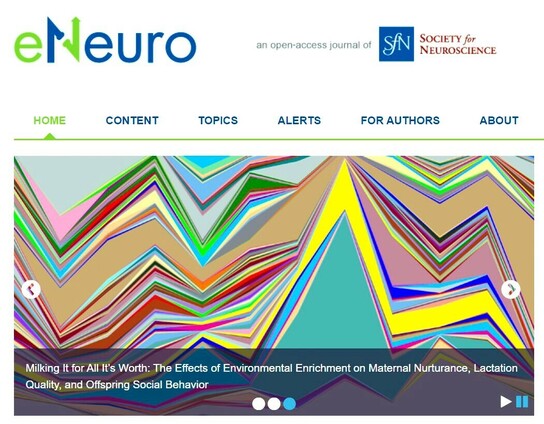
Not quite sure what to post first, so since it has such a nice color pop, sharing this funky microbiome promo picture that was used recently to feature our #eNeuro paper as a cover slide on the eNeuro.org website. Enriched rats on the left are more diverse than the standard housed on the right. Link to paper here: https://www.eneuro.org/content/9/4/ENEURO.0148-22.2022

Milking It for All It’s Worth: The Effects of Environmental Enrichment on Maternal Nurturance, Lactation Quality, and Offspring Social Behavior

Milking It for All It’s Worth: The Effects of Environmental Enrichment on Maternal Nurturance, Lactation Quality, and Offspring Social Behavior

Breastfeeding confers robust benefits to offspring development in terms of growth, immunity, and neurophysiology. Similarly, improving environmental complexity, i.e., environmental enrichment (EE), contributes developmental advantages to both humans and laboratory animal models. However, the impact of environmental context on maternal care and milk quality has not been thoroughly evaluated, nor are the biological underpinnings of EE on offspring development understood. Here, Sprague Dawley rats were housed and bred in either EE or standard-housed (SD) conditions. EE dams gave birth to a larger number of pups, and litters were standardized and cross-fostered across groups on postnatal day (P)1. Maternal milk samples were then collected on P1 (transitional milk phase) and P10 (mature milk phase) for analysis. While EE dams spent less time nursing, postnatal enrichment exposure was associated with heavier offspring bodyweights. Milk from EE mothers had increased triglyceride levels, a greater microbiome diversity, and a significantly higher abundance of bacterial families related to bodyweight and energy metabolism. These differences reflected comparable transcriptomic changes at the genome-wide level. In addition to changes in lactational quality, we observed elevated levels of cannabinoid receptor 1 in the hypothalamus of EE dams, and sex-dependent and time-dependent effects of EE on offspring social behavior. Together, these results underscore the multidimensional impact of the combined neonatal and maternal environments on offspring development and maternal health. Moreover, they highlight potential deficiencies in the use of “gold standard” laboratory housing in the attempt to design translationally relevant animal models in biomedical research.

eNeuro