 Eureka Jeans
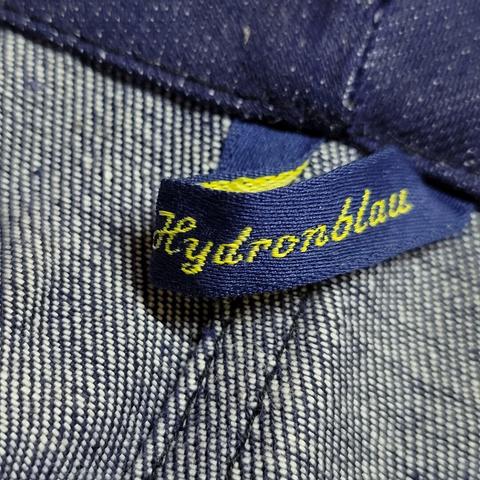
The more I explore the topic of hydron blue, the more intrigued I become!!
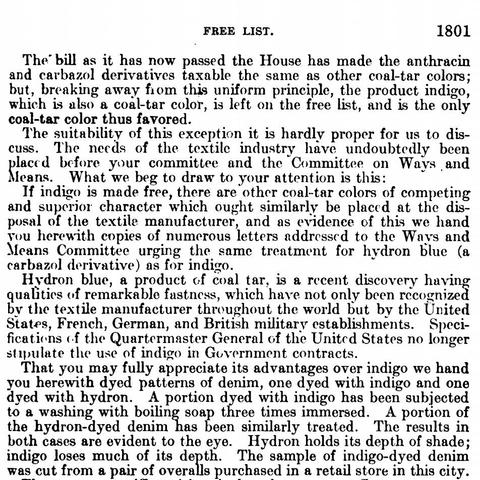
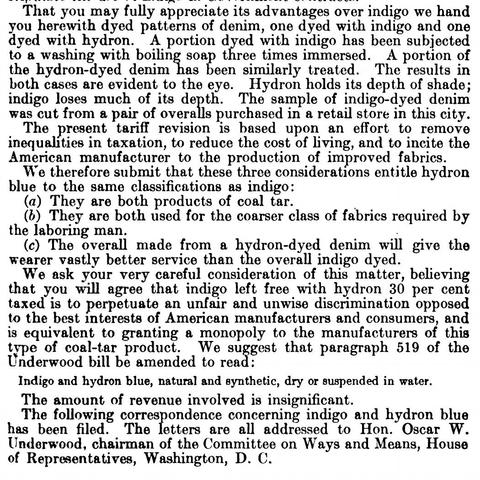
A lot of small print in these sections of Briefs and Statements Filed with the Committee on Finance of the United States Senate in 1913, but fascinating reading!
As I mentioned in my previous posts, a number of synthetic blue dyes were discovered in the late 1890s to early 1900s as products of coal-tar, including, among others, synthetic indigo and hydron blue. According to the brief submitted by the Cassella Color Co., the patent holder of hydron blue, all of these blue dyes were subjected to a 30% tariff, except for indigo, which was free of tariffs. This made hydron blue prohibitively expensive, even though it was considered superior to indigo and manufacturers wanted to use it for denim garments, as illustrated by the dozens of letters attached to the brief.
Just imagine if indigo had had the same 30% tariff. Hydron blue might have become the dye of choice because of its superior non-fading quality, and jeans might have never become the fashion item that we all love, ironically, for its main flaw -- its tendency to fade!
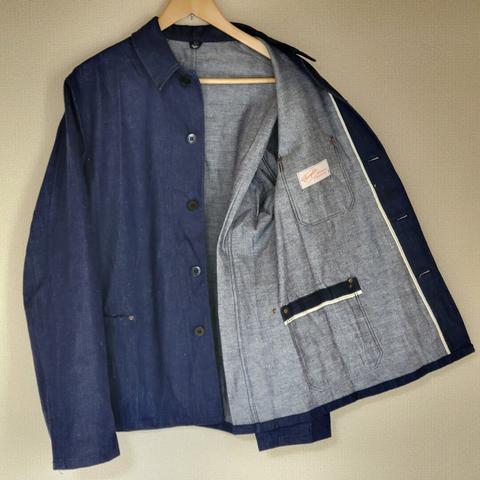
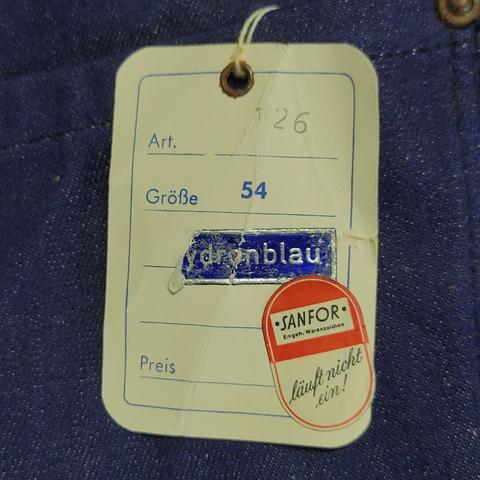
Knowing this makes me want to find hydron blue denim even more!
#hydronblue #indigo #dyestuff
A lot of small print in these sections of Briefs and Statements Filed with the Committee on Finance of the United States Senate in 1913, but fascinating reading!
As I mentioned in my previous posts, a number of synthetic blue dyes were discovered in the late 1890s to early 1900s as products of coal-tar, including, among others, synthetic indigo and hydron blue. According to the brief submitted by the Cassella Color Co., the patent holder of hydron blue, all of these blue dyes were subjected to a 30% tariff, except for indigo, which was free of tariffs. This made hydron blue prohibitively expensive, even though it was considered superior to indigo and manufacturers wanted to use it for denim garments, as illustrated by the dozens of letters attached to the brief.
Just imagine if indigo had had the same 30% tariff. Hydron blue might have become the dye of choice because of its superior non-fading quality, and jeans might have never become the fashion item that we all love, ironically, for its main flaw -- its tendency to fade!
Knowing this makes me want to find hydron blue denim even more!
#hydronblue #indigo #dyestuff