vk3kri
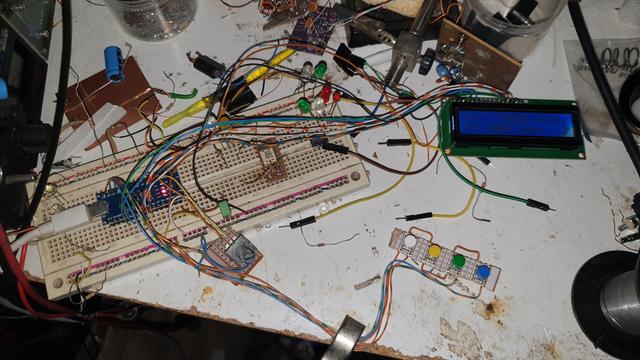
An early stage of the homebrew AD9833 sig gen. Using an Arduino nano and an AD9833/MC41010 DDS/attenuator module. I plan to trickle out status reports in a non-linear manner....
#electronics #diytestgear #siggen
#electronics #diytestgear #siggen

So the ad9833/MCP41010 siggen has actually been finished for a while. Its a bit of a tangled mess inside, but it works!
I measured the distortion at 0.15% or -56dB which is good enough for an agile sig gen on the bench( New side project - continue modifying the AWA G50 siggen I started on 30 years ago!)
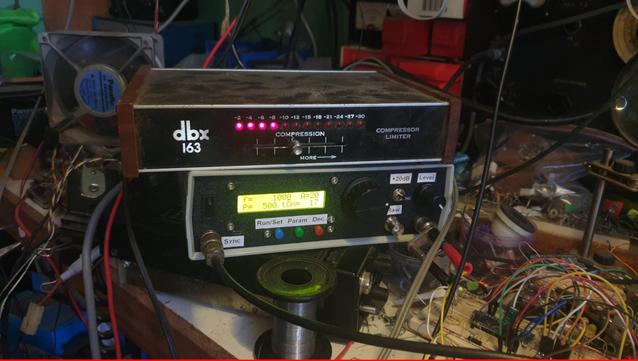
Photos show the siggen in pulse mode testing attack/release of dbx163.
I bet it will spend 99.9% of time generating a simple sine wave!

#electronics #diytestgear #siggen
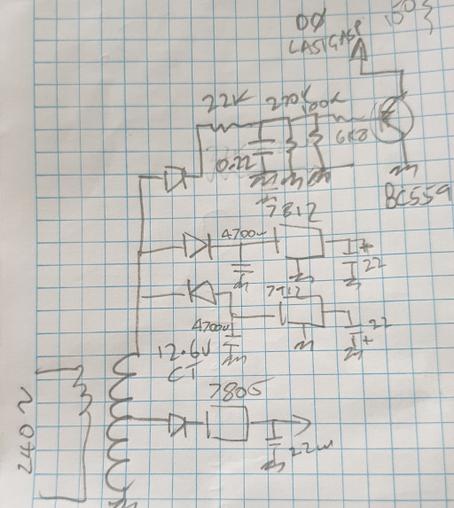
So I eventually entered the underworld (Under the house where the crate of transformers is ) and found another transformer, 12.6V CT 3.76VA Which doesn't get hot doing nothing, Using a voltage doubler cct it generates +/- 17V and +6.5V prior to the regulators.
6.5V seems a bit low for a 7805 , but it keeps regulating even with when I drop the mains input a bit. If its an issue I can replace the 1n4007 diode with a schottky which will give me an extra .4V
If you set the AD9833 to tri wave(bypasses sin rom) and frequency to zero, writing to one of the phase registers will allow you to use the AD9833 as a (not so simple) DAC. If you write a pseudo random sequence, you can get white noise!
uint32_t x =0x02;
…
for(i=0;i<32000;i++){
/* Algorithm "xor" from p. 4 of Marsaglia, "Xorshift RNGs" */
x ^= x << 13;
x ^= x >> 17;
x ^= x << 5;
AD.writePhaseRegister(0, x&0x0fff) ;
}
However the p-p output of the opamp will be 3.7V for a sin and 5V for a square which annoys me a bit. Because the digital pot is in the middle I used that to drop the level of the square wave so its comparable.
This works out to setting the pot at 24/255th for square waves
I can only ever see myself using a square wave with the straight sig gen function, not pulse, ramps etc, so losing most of the range of the pot to bring the level down isnt a problem
Next DDS/digital pot board issue -
The AD9833 data sheet proudly claims that it is 'capable of producing sine, triangular, and square wave outputs.'
This is True, but....
The sine and tri outputs swing between 38mV and 650mV on the output pin. The square wave is a digital output on the same pin which swings from basically Gnd to Vdd. There is no way the following op amp won't clip this , which sort of doesn't matter as it clips it to a square wave. cont ...
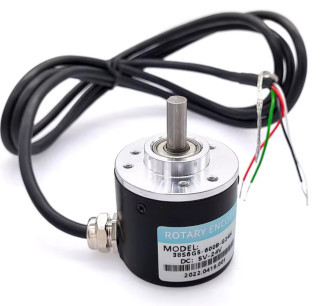
The optical shaft encoder was not without problems.
It turns out that the bearings are so good that an inbalance in the knob is enough to cause the knob to turn slightly when released in certain positions. The heavy side was opposite the pointer so it tried to turn the pointer upmost
Gluing a nut under the pointer side balanced the knob. Problem solved.