Quote of the day, 25 December: St. Edith Stein
We know not, and we should not ask before the time, where our earthly way will lead us. We know only this, that to those that love the Lord all things will work together to the good, and, further, that the ways by which the Saviour leads us point beyond this earth.
It is truly a marvellous exchange: the Creator of mankind, taking a body, gives us His Godhead. The Redeemer has come into the world to do this wonderful work. God became man, so that men might become children of God. One of us had broken the bond that made us God’s children; one of us had to tie it again and pay the ransom. This could not be done by one who came from the old, wild and diseased trunk; a new branch, healthy and noble, had to be grafted into it.
He became one of us, more than this, He became one with us. For this is the marvellous thing about the human race, that we are all one. If it were otherwise, if we were all autonomous individuals, living beside each other quite free and independent, the fall of the one could not have resulted in the fall of all. In that case, on the other hand, the ransom might have been paid for and imputed to us, but His justice could not have passed on to the sinners; no justification would have been possible.
But He came to be one mysterious Body with us: He our Head, we His members. If we place our hands into the hands of the divine Child, if we say our Yes to His Follow Me, then we are His, and the way is free for His divine Life to flow into us.
This is the beginning of eternal life in us. It is not yet the beatific vision in the light of glory; it is still the darkness of faith; but it is no longer of this world, it means living in the kingdom of God. This kingdom began on earth when the blessed Virgin spoke her “Be it unto me”, and she was its first handmaid.
And all those who have confessed the Child by word and deed before and after His birth, St. Joseph, St. Elizabeth with her son, and all those surrounding the crib, have entered the kingdom of God. The reign of the divine King showed itself to be different from what people had expected it to be when they read the Psalms and the Prophets. The Romans remained masters in the land; high priests and scribes continued to oppress the poor.
Those who belonged to the Lord bore their kingdom of heaven invisibly within them. Their earthly burden was not taken away from them; on the contrary, many another was added to it; but within them there was a winged power that made the yoke sweet and the burden light.
The same happens today with every child of God. The divine life that is kindled in the soul is the light that has come into the darkness, the miracle of the Holy Night. If we have it in us, we understand what is meant when men speak about it. For the others, everything that can be said of it is an incomprehensible stammering. The whole Gospel of St. John is such a stammering about the eternal light that is love and life.
God in us and we in Him, this is our share in God’s kingdom, which is founded on the Incarnation.
Saint Edith Stein
The Mystery of Christmas (1931 lecture), “Union With God”
Stein, E 1931, The mystery of Christmas: incarnation and humanity, translated from the German by Rucker, J, Darlington Carmel, Darlington UK.
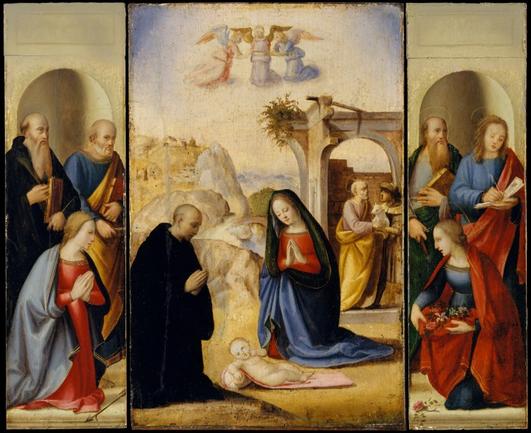
Featured image: The Nativity With Saints, Ridolfo Ghirlandaio (Italian, 1483–1561), oil on wood panel painting ca. 1514. Image credit: Metropolitan Museum of Art, New York (Public domain).
#Christmas #divineChild #incarnation #kingdomOfHeaven #StEdithStein
 Bryan King

 Carmelite Quotes