 ScienceActually
Bismuth is both the most diamagnetic element and one of the least thermally conductive metals known.
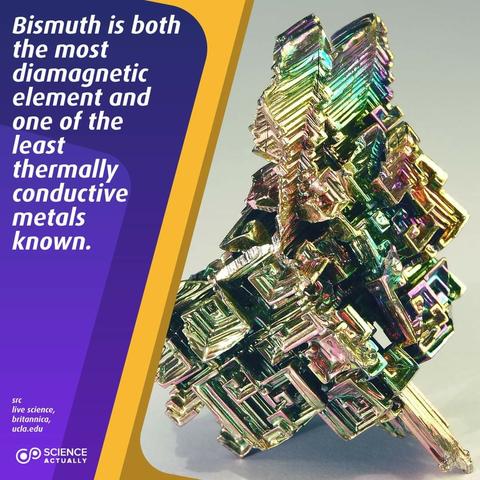
Bismuth is both the most diamagnetic element and one of the least thermally conductive metals known.
"Polarization-dependent #terahertz #magnetospectroscopy measurements revealed Zeeman splittings & #diamagnetic shifts, demonstrating a large #phonon #magnetic moment. Films in the topological phase exhibited phonon magnetic moment values that were larger than those in the topologically trivial samples by 2 orders of magnitude..the sign of the effective phonon g-factor was opposite in the two phases, a signature of the #topological transition according to our model"
"Our measurements do not indicate the presence of the Meissner effect, nor zero resistance, in our samples, leading us to believe that our samples do not exhibit superconductivity."
But this appears to be a new diamagnetic material!
Now, on peer-reviewed vs preprint: there is no guarantee that a peer review would have attempted reproduction. Vs an interesting preprint with reproducible process = fast science.
#lk99 #superconductor #diamagnetic #science
https://arxiv.org/abs/2308.03110

We successfully synthesized polycrystalline LK-99-like ceramic samples with a solid-state-sintering method. Powder X-ray diffraction shows that the main contents are $\mathrm{Pb_{10-x}Cu_x(PO_4)_6O}$ and $\mathrm{Cu_2S}$, consistent with recent reports [arXiv:2307.12037; arXiv:2308.01192]. In some small flaky fragments, we successfully observed ``half levitation'' atop a $\mathrm{Nd_2Fe_{14}B}$ magnet. Using magnetization measurements on such small pieces, as well as on a large piece which does not exhibit the half levitation, we show that the samples ubiquitously contain weak yet definitive soft ferromagnetic components. We argue that, together with the pronounced shape anisotropy of the small fragments, the soft ferromagnetism is sufficient to explain the observed half levitation in strong vertical magnetic fields. Our measurements do not indicate the presence of the Meissner effect, nor zero resistance, in our samples, leading us to believe that our samples do not exhibit superconductivity. The precise chemical composition and the physics behind the ferromagnetic component remain outstanding questions to be addressed in future research.
 katch wreck
 Osma A 🇫🇮🇺🇦