 Space.com: NASA, Space Exploration and Astronomy News [Unofficial]
Dark energy is still accelerating the expansion of the universe, and astronomers are relieved. 'Thankfully, we have averted this crisis'


Dark energy is still accelerating the expansion of the universe, and astronomers are relieved. 'Thankfully, we have averted this crisis'
A mysterious gamma-ray stream comes from the Milky Way's center. Could dark matter have something to do with it?
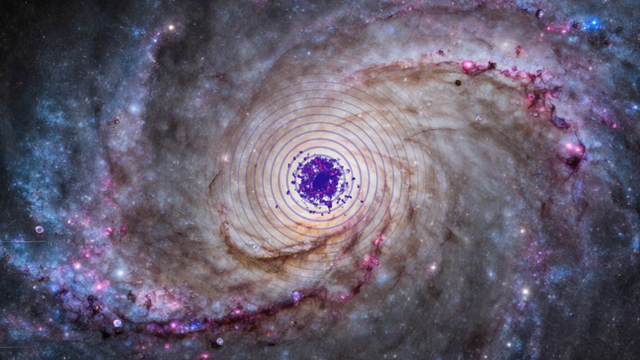

Supermassive black holes may be surrounded by dark matter clusters, new 'echo map' technique suggests

We still can't see dark matter. But what if we can hear it?


'Cannibal stars,' AI and the Rubin Observatory could shed light on the mystery of dark energy. Here's how


3 puzzles of our universe could be solved with this new dark matter theory


📄 The Rise of the Galactic Empire: Ultraviolet Luminosity Functions at …
Quicklook:
Pérez-González, Pablo G. et al. (2025) · The Astrophysical Journal
Reads: 559 · Citations: 71
DOI: 10.3847/1538-4357/adf8c9
🔗 https://ui.adsabs.harvard.edu/abs/2025ApJ...991..179P/abstract
#Astronomy #Astrophysics #Galaxies #DarkUniverse #GalaxyFormation
We present a sample of six F200W and three F277W dropout sources identified as 16 < z < 25 galaxy candidates using the deepest JWST/NIRCam data to date (5σ depths ∼31.5 mag at ≥2 μm), provided by the MIRI Deep Imaging Survey and the Next Generation Deep Extragalactic Exploratory Public survey. We estimate ultraviolet (UV) luminosity functions and densities at z ∼ 17 and z ∼ 25. The number density of galaxies with absolute magnitudes of −19 < M<SUB>UV</SUB> < −18 at z ∼ 17 (z ∼ 25) is a factor of 4 (25) smaller than at z ∼ 12; the luminosity density presents a similar evolution. Compared to state-of-the-art galaxy simulations, we find the need for an enhanced UV-photon production at z = 17─25 in M<SUB>DM</SUB> = 10<SUP>8.5−9.5</SUP> M<SUB>⊙</SUB> dark matter halos, provided by an increase in the star formation efficiency at early times and/or by intense compact starbursts with enhanced emissivity linked to strong burstiness, low or primordial gas metallicities, and/or a top-heavy initial mass function. There are a few robust theoretical predictions for the evolution of galaxies above z ∼ 20 in the literature; however, the continuing rapid drop in the halo mass function would predict a more rapid evolution than we observe if photon production efficiencies remained constant. Our z > 16 candidates present mass-weighted ages around 30 Myr, and attenuations A(V) < 0.1 mag. Their average stellar mass is M<SUB>⋆</SUB> ∼ 10<SUP>7</SUP> M<SUB>⊙</SUB>, implying a stellar-to-baryon mass fraction around 10% if the emissivity increases with redshift, or significantly higher otherwise. Three candidates present very blue UV spectral slopes (β ∼ −3) compatible with Population III young (≲10 Myr) stars and/or high escape fractions of ionizing photons; the rest have β ∼ −2.5 similar to the z = 10─12 samples.
 eblu
eblu
 NESbot EtcetEra
 #DarkUniverse
 adsdaily