Hernandez Hypothesis V2
https://zenodo.org/records/20125972
Updated with some of the latest available data.
#DarkEnergy
#Cosmology
THE HERNANDEZ HYPOTHESIS A Unified Phenomenological Model of Density-Dependent Vacuum Dynamics V2

We present a phenomenological framework in which quantum vacuum fluctuations are governed by local matter density, producing observable consequences across three physical regimes: cosmological expansion, galactic dynamics, and solar coronal heating. The central ansatz posits that the effective virtual particle recombination rate is exponentially suppressed by local baryonic matter density. This suppression operates through gravitational and electromagnetic channels, resolving the energy-scale conflict between cosmological and stellar applications. In cosmic voids, unimpeded vacuum fluctuations drive accelerated expansion via a dynamical effective cosmological constant, consistent with DESI 2024 results and the Running Vacuum Model of Moreno-Pulido and Solà Peracaula, which provides the QFT-in-curved-spacetime foundation for geometry-dependent vacuum energy. In galactic halos, density gradients source a Gross-Pitaevskii scalar field with ultralight quanta mass in the range 10^-22 to 10^-20 eV/c^2, situating the model within the fuzzy dark matter parameter space. In the low-density solar corona, magnetic energy converts continuously to plasma heat at a volumetric rate consistent with observed temperatures. This prediction produces a density-switch signature — heating anti-correlating with local density independently of field topology — distinguishable from the nanoflare model and testable with existing Parker Solar Probe and Solar Orbiter data. The framework is phenomenological; the suppression ansatz is motivated rather than derived from first principles. Directions for a QFT derivation within the RVM framework, CMB compatibility testing via axionCAMB, SPARC rotation curve fitting, and a specific Parker Solar Probe analysis protocol are outlined as priority future work.

Zenodo

#KnowledgeByte: Combining the #DarkEnergy Spectroscopic Instrument (#DESI) data with other experiments shows signs that the impact of dark energy may be weakening over time — and the standard model of how the #Universe works may need an update.

https://knowledgezone.co.in/posts/Is-Dark-Energy-Getting-Weaker-67f3f552da225d23b99cb17a

DESI completes largest high-resolution 3D map of universe to date

The Dark Energy Spectroscopic Instrument (DESI) has completed its originally planned five-year mission and mapped more than 47 million galaxies and quasars, and will continue observations into 2028 and further expand the map.

News
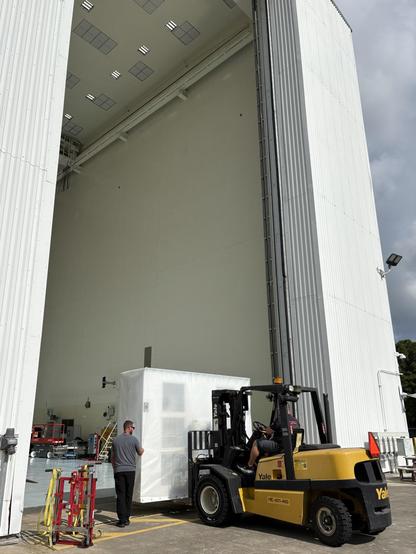
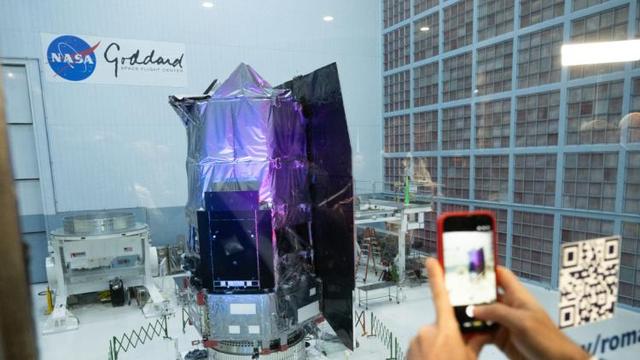
Key Support Equipment Arrives at Kennedy for Roman Space Telescope http://dlvr.it/TSKPxR #DarkEnergy #KennedySpaceCenter #LaunchServicesProgram

A DESI Milestone

Yesterday the Open Journal of Astrophysics published a paper by Porredon et al which will feature in the usual Saturday round-up. That paper, which is based on the First Data Release from the Dark Energy Spectroscopic Instrument (DESI) reminded me that I should mention that DESI recently reached an amazing milestone – it has now mapped the positions and redshifts of 47 million galaxies and quasars! There is a full press-release about this achievement here.

Here’s a little video showing how the survey works:

https://www.youtube.com/watch?v=6H3diAK_KIc

There are more videos and other graphics in the press release.

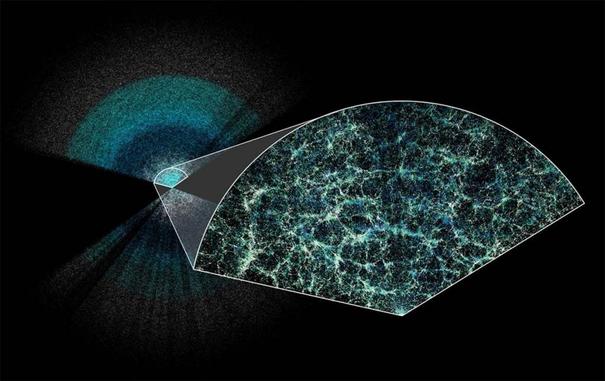
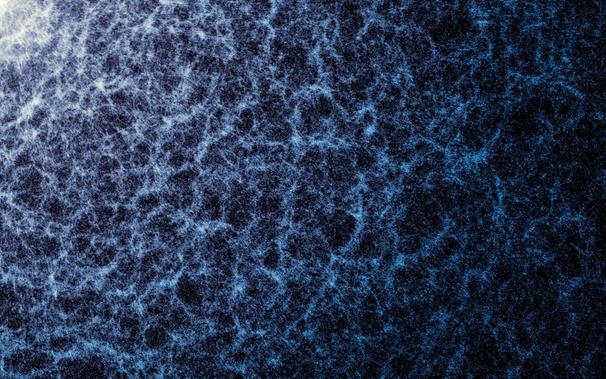
Here’s a nice picture showing a thin slice through the full survey that reveals the characteristic “cosmic web” of the large-scale structure of the Universe in all its glory:

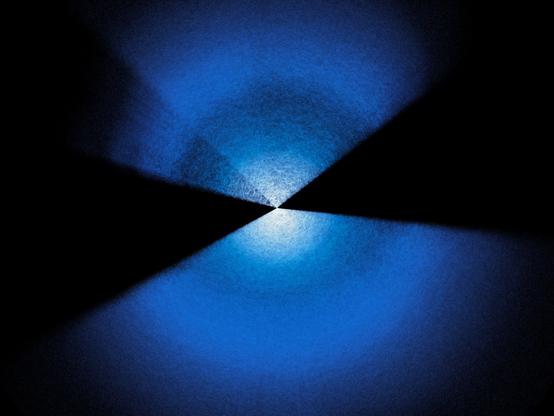
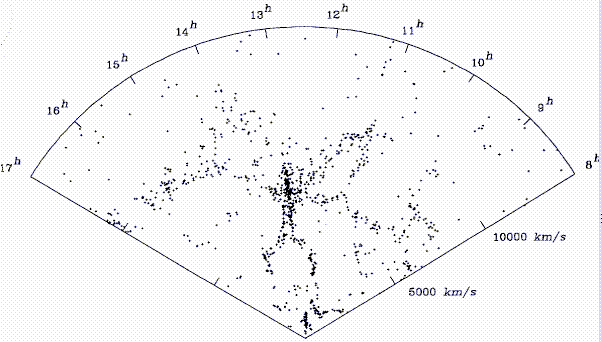
This progress is great, but it really makes me feel old. Forty years ago, in 1986, I had just started my PhD. The state-of-the-art galaxy redshift survey slice then is shown in this plot, from de Lapparent et al 1986 (ApJLett 302, L1), one of the first papers I read as a research student (I got it in 1985 as a preprint), which contains just 1,100 galaxies:

It is worth mentioning that although DESI has now covered its original target area, it will continue until 2028. You can never have too many galaxy redshifts!

#CosmicWeb #Cosmology #DarkEnergy #DarkEnergySpectroscopicInstrument #DESI #GalaxyRedshiftSurveys

Applied to graduate today. Still some pages left to go on my thesis, but it’s all booked and I can see the light.

Am I a masochist for wanting to do a PhD next?
#physics #gradschool #darkenergy

47M de galaxies d’un coup: DESI trace l’Univers en 3D… et si Einstein avait raté un détail? www.papergeek.fr/voici-la-plu... #Space #Science #Innovation #Astrophysics #AerospaceEngineering #DESI #DarkEnergy #Cosmology

Voici la plus grande carte en ...
Voici la plus grande carte en 3D de l’Univers jamais établie - PaperGeek

47 millions de galaxies, 20 millions d’étoiles, le tout couvrant 11 milliards d’années d’histoire cosmique. C’est en substance ce qu’a réussi à cartographier le Dark Energy Spectroscopic Instrument (DESI). Cartographier…

PaperGeek
Voici la plus grande carte en 3D de l’Univers jamais établie - PaperGeek

47 millions de galaxies, 20 millions d’étoiles, le tout couvrant 11 milliards d’années d’histoire cosmique. C’est en substance ce qu’a réussi à cartographier le Dark Energy Spectroscopic Instrument (DESI). Cartographier…

PaperGeek
Roman (NASA) arrive : télescope 100× plus large que Hubble, capable de scanner l’Univers entier en mode accéléré… et de traquer matière noire www.europe1.fr/technologies... #Space #Science #Innovation #Astrophysics #RomanTelescope #NASA #DarkEnergy #NewSpace

13 mètres de haut, vision infr...
13 mètres de haut, vision infrarouge... Découvrez Nancy Grace Roman, le nouveau télescope de la NASA et successeur d'Hubble

Nancy Grace Roman, le nouveau télescope de la NASA, est le digne successeur d'Hubble. Il sera lancé en septembre 2026, soit huit mois plus tôt que prévu. Europe 1 fait le point sur cette nouvelle technologie, qui permettra d'obtenir un "nouvel Atlas de l'Univers".

Europe 1
Roman (NASA) arrive : télescope 100× plus large que Hubble, capable de scanner l’Univers entier en mode accéléré… et de traquer matière noire
https://www.europe1.fr/technologies/13-metres-de-haut-vision-infrarouge-decouvrez-nancy-grace-roman-le-nouveau-telescope-de-la-nasa-et-successeur-dhubble-928946 #Space #Science #Innovation #Astrophysics #RomanTelescope #NASA #DarkEnergy #NewSpace
13 mètres de haut, vision infrarouge... Découvrez Nancy Grace Roman, le nouveau télescope de la NASA et successeur d'Hubble

Nancy Grace Roman, le nouveau télescope de la NASA, est le digne successeur d'Hubble. Il sera lancé en septembre 2026, soit huit mois plus tôt que prévu. Europe 1 fait le point sur cette nouvelle technologie, qui permettra d'obtenir un "nouvel Atlas de l'Univers".

Europe 1