Interesting to see publishers using generative AI for scholarly promotion. Springer automatically generated this short video about my book "Cultural Data Science", which introduces data analysis for art history. link.springer.com/book/10.1007... #DigitalHumanities #CulturalDataScience #ArtHistory

Interesting to see publishers using generative AI for scholarly promotion. Springer automatically generated this short video about my book Cultural Data Science, which introduces data analysis, image processing, and AI for art history and the visual humanities using tools like R and open museum datasets.

https://link.springer.com/book/10.1007/978-3-031-88130-5
#DigitalHumanities #CulturalDataScience #ArtHistory

Fall 2025 Cultural Data Analytics Open Lab Seminar starts Oct 13 with Meeyoung Cha (Max Planck Institute for Security and Privacy, Bochum) in person at Tallinn University — and via Zoom.
This semester features three ERC grant recipients among the speakers, including Andrew Piper, Laura Nelson, and Corinna Coupette.
https://cudan.tlu.ee/events/
#CulturalDataScience #DigitalHumanities #AIandSociety
Events

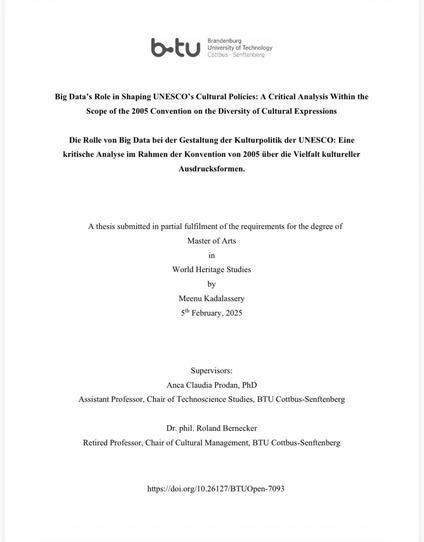
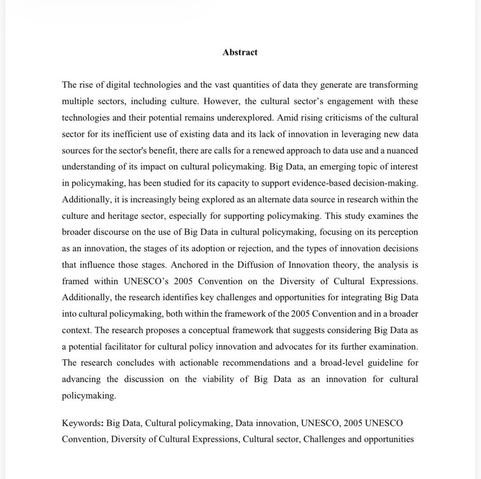
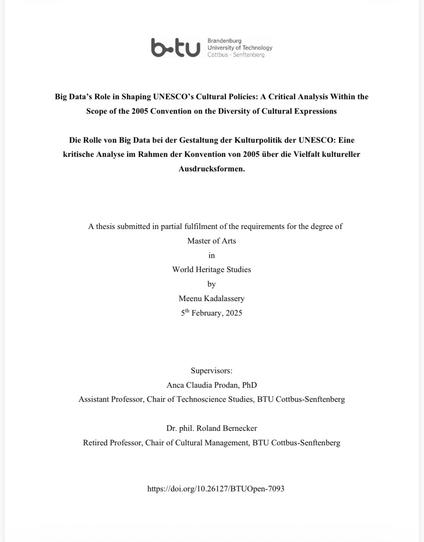
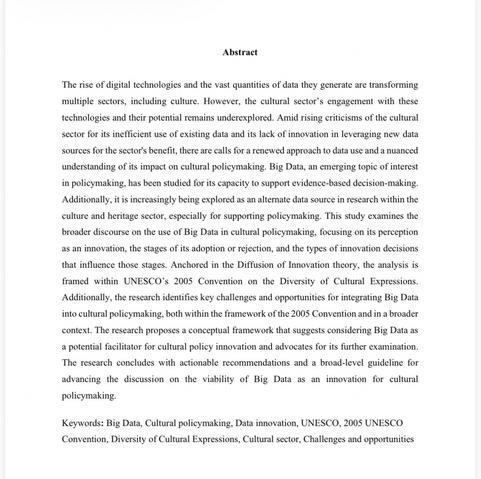
The study critically analyzes perceptions, adoption stages, and innovation decisions around Big Data in the cultural sector, identifies current gaps, and calls for renewed capacity building and best practice sharing.

No formal guidelines exist yet — but the study lays out a conceptual framework and offers actionable recommendations.

#CulturalPolicy #BigData #DigitalHeritage #UNESCO #DigitalHumanities #CulturalDataScience

The study critically analyzes perceptions, adoption stages, and innovation decisions around Big Data in the cultural sector, identifies current gaps, and calls for renewed capacity building and best practice sharing. #CulturalPolicy #DigitalHeritage #UNESCO #DigitalHumanities #CulturalDataScience
Künstliche Intelligenz verändert die Kunstgeschichte: von GANs und CLIP über neue Bildpraktiken bis zur digitalen Transformation der Forschung – KI ist Werkzeug, Thema und Herausforderung zugleich.
#DigitaleKunstgeschichte #KI #CulturalDataScience

In case you're wondering about this thread:
I'm currently researching additional resources to complement my book Cultural Data Science: An Introduction to R.
They’ll also be listed on my website alongside the publication:
https://link.springer.com/book/10.1007/978-3-031-88130-5

#CulturalDataScience #DigitalArtHistory #DigitalHumanities #RStats @kiru

Cultural Data Science

This book introduces basic concepts in data science, drawing from contextual examples in art history, visual computing, cloud computing, and microservices

SpringerLink

And another hint on my little project:
Museums Open Data – a searchable interface to explore open datasets from museums around the world.
Built to support digital research in the arts.
http://dev.harald-klinke.de/MuseumsOpenData/

#OpenData #DigitalArtHistory #CulturalDataScience #MuseumData

Museums Open Data Search

Explore and search museum open data with ease. Discover historical collections, artworks, and cultural artifacts.

And what about this:
Mapping Paintings visualizes the provenance of artworks across time and space. A compelling example of how art history and digital mapping come together.
https://www.mappingpaintings.org/

#DigitalArtHistory #ProvenanceResearch #CulturalDataScience #ArtHistory

Mapping Paintings

Explore the geography of documentary photography with Photogrammar – an interactive map of over 170,000 photographs from the FSA-OWI collection (1935–1944).
A powerful tool for visualizing history through data:
https://photogrammar.org/maps

#DigitalHumanities #VisualArchives #CulturalDataScience #PhotographyHistory

Photogrammar

Photogrammar is a web-based platorm for organizing, searching and visualizing the 170,00 photographs from 1935 to 1945 created by the United States Farm Security Administration and Office of War Information (FSA-OWI).