 Nicole Sharp
Drying Out Microbe-Filled Droplets
Ocean sprays, coughs, and sneezes are just a few of the ways that droplets full of bacteria and salt can get aloft on a breeze. How do these bacteria stay viable even as their droplet evaporates? That’s the question behind this video’s research.
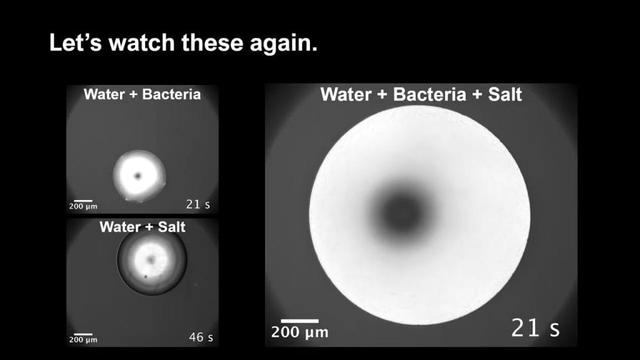
When a bacteria-laden droplet or a salt-laden droplet dries, the evaporating droplet’s contact area shrinks, leaving behind only a concentrated lump of bacteria or salt. But when droplets contain both salt and bacteria, the drying droplet’s contact line gets pinned, leaving a larger area stain. The bacteria’s presence seems to promote crystallization of the salt, which–in turn–traps water in isolated spaces, perhaps helping the bacteria stay viable longer. (Video and image credit: R. Ran et al.)
Animation of three droplets drying out. When all three components–water, salt, and bacteria–are in a droplet, the drying process looks very different. #2026gosm #aerosols #biology #contactLine #droplets #evaporation #flowVisualization #fluidDynamics #physics #pinning #science #sessileDrop