https://willpowerstudios.com/tech-lab/light-arms/
#electrical #diy #openTech #FashionTech #wearables #wearableTech
Sew-able Carbon Nanotube Thread Could Spin a Lot of Awesome
Plenty of people just plain dislike wearing jewelry, even (or especially) smart watches. Nevertheless, they'd like to have biofeedback like everybody else. Well, we watch-less ones have something to look forward to, because a group of graduate students at Rice University have created extremely strong conductive thread woven from carbon nanotubes, which can be sewn into standard athletic clothing and used as electrodes, antennas, or simply as ballistic protection.
At 22 microns wide, the original carbon nanotubes were too skinny to use as thread. Instead, the team braided together three bundles of seven 'tubes each using the type of machine that model boat builders use to make tiny rigging. Then they zig-zag stitched the threads into a shirt, which gives the stitches added flexibility. This thread maybe as strong and conductive as metal, but the fibers are soft and flexible, and most importantly, machine-washable. Between its strength and conductivity, this thread could have a long list of applications from military down to civilian. Check out the introduction in the video after the break.
For now, the shirt has to be pretty snug, but future garments could easily have higher concentrations of nano-threads in order to get a better signal. Good thing, because we're still carrying around our COVID nineteen -- aka the weight we've gained since the longest March of anyone's life, and never liked tight shirts anyway.
What else can carbon nanotubes do? Plenty, like keep 3D prints from delaminating.
Via New Atlas
#medicalhacks #wearablehacks #carbonnanotubethread #carbonnanotubes #conductivethread #ekg #heartmonitor

Skin-Mounted Wearable Bend Sensor Gets Close and Personal
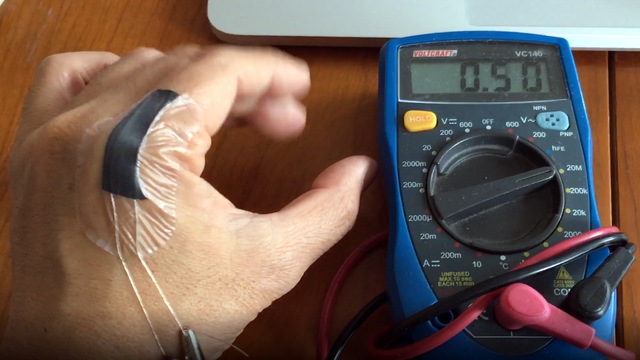
[Mikst] has been working on wearable electronics and sensors for a long time, and shared the results of a different kind of bend sensor that fits directly onto the skin. It's true that this kind of sensor design isn't re-usable, but it is also very simple and inexpensive. It's just a proof of concept right now, but we could see it or some of the other ideas [Mikst] tries, used in niche wearable applications where space is critical, like cosplay.
At its heart the sensor is made from two strands of conductive thread and a small strip of stretchy, conductive fabric common in wearable e-textiles. It is stuck directly to the skin using a transparent, non-woven medical adhesive dressing that is particularly good at conforming to contoured areas of the body. In this case, it is used to stick the stretchy piece of conductive fabric directly onto [Mikst]'s knuckle, where it responds to even small movements. You can watch a multimeter measuring the resistance changes in the video, embedded below.
We've seen [Mikst]'s work before in finding unusual solutions to e-textile problems, such as a three-conductor pivoting connection used to mount a wearable hall effect sensor.
#wearablehacks #bendsensor #conductivefabric #conductivethread #etextile #wearable
Flexible Prototyping for E-Textiles That Doesn’t Cost an Arm and a Leg
Let's face it: pretty much everything about e-textiles is fiddly. If wearables were easy, more people would probably work in that space. But whereas most circuit prototyping is done in two dimensions, the prototyping of wearables requires thinking and planning in 3D. On top of that, you have to figure out how much conductive thread you need, and that stuff's not cheap.
[alch_emist] has a method for arranging circuits in 3D space that addresses the harsh realities of trying to prototype wearables. There's that whole gravity thing to deal with, and then of course there are no straight lines anywhere on the human body. So here's how it works: [alch_emist] made a bunch of reusable tie points designed to work with an adhesive substrate such as felt. They laser-cut a set of acrylic squares and drilled a hole in each one to accommodate a neodymium magnet. On the back of each square is a small piece of the hook side of hook-and-loop tape, which makes the tie points stay put on the felt, but rearrange easily.
We love the idea of prototyping with felt because it's such a cheap and versatile fabric, and because you can easily wrap it around your arm or leg and see how the circuit will move when you do.
Not quite to this planning stage of your next wearable project? Magnets and conductive thread play just as well together in 2D.
#howto #wearablehacks #acrylic #conductivethread #magnets #prototyping #velcro