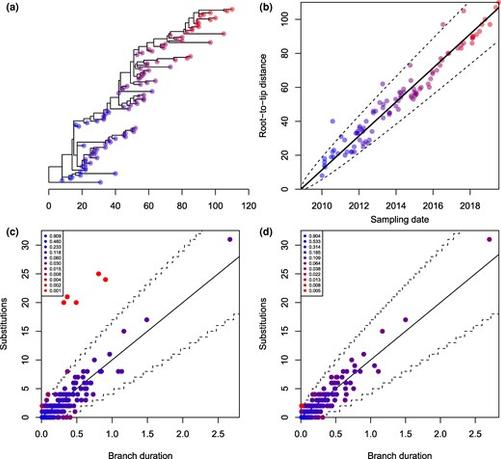
@sishuowang & Meade introduce phyloHessian to enable the use of complex mixture substitution models in molecular dating. Empirical analysis of ancient symbiont lineages leads to a revised understanding of their host association origins.
Robbins, Liu & Kelly present RECUR, a method for identifying recurrent amino acid substitutions from multiple sequence alignments that is fast, easy to use, and scalable to thousands of sequences.
Deng et al. present TreeProfiler, a tool for automated annotation and interactive exploration of hundreds of features along large gene and species trees, with seamless summarization of mapped traits at internal nodes.
Martí-Gómez et al. developed gpmap-tools, integrating models for inference, phenotypic imputation, and error estimation from multiplex assays of variant effect data or natural sequences in the presence of genetic interactions.
Anchieri et al. benchmark the inference of selection with aDNA-like time series datasets, showing that ApproxWF can accurately estimate selection with datasets of ∼100 individuals when selection is strong.
Ramos-González et al. present PharaohFUN, a web application designed for the evolutionary and functional analysis of protein sequences in photosynthetic eukaryotes, leveraging orthology relationships.
Malik et al. present the web-based Structome-AlignViewer, for evaluating structure-aware alignments through spatial mapping of alignment columns to protein structures, and quantitative confidence scoring.
Shankar et al. present the updated MicrobeTrace 2.0 as a next-generation, interoperable tool for genomic epidemiology and data-driven public health response.
In 1952, Alan Turing proposed that simple chemical reactions + diffusion could create spots, stripes, and spirals in nature. 70 years later, we're still finding his equations everywhere—from zebrafish stripes to cardiac arrhythmias. Math predicting biology at its finest.
In a new Review, Peede et al. overview the SMC model and extensions, discuss examples of discoveries made with the help of SMC-based inference, and comment on the assumptions, benefits, and drawbacks of various methods.