@inthehands There many ways of automating the process of classification, even when the number of features is very high (Decision Trees are one example). The current crop of machine-learning #classifiers are good at classification even when the important features (among all features) are not identified in advance. We can explain how these algorithms work, but not WHY they work in any particular example or in general. That means their suitability or reliability for any specific use case cannot be determined.
You are right. We can and should leave out the concept of “intelligence” entirely.
'A Comparative Evaluation of Quantification Methods', by Tobias Schumacher, Markus Strohmaier, Florian Lemmerich.
http://jmlr.org/papers/v26/21-0241.html
#classifiers #supervised #quantification
'An Optimal Transport Approach for Computing Adversarial Training Lower Bounds in Multiclass Classification', by Nicolas Garcia Trillos, Matt Jacobs, Jakwang Kim, Matthew Werenski.
http://jmlr.org/papers/v25/24-0268.html
#adversarial #regularization #classifiers
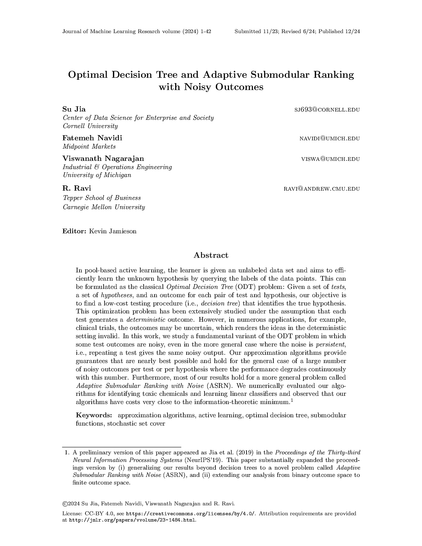
'Optimal Decision Tree and Adaptive Submodular Ranking with Noisy Outcomes', by Su Jia, Fatemeh Navidi, Viswanath Nagarajan, R. Ravi.
http://jmlr.org/papers/v25/23-1484.html
#adaptive #classifiers #optimal
Cost of false positives | Kellan Elliott-McCrea: Blog
Kevin Marks (q.v.) introduced me to Kellan’s Paradox of False Positives in Social Media, which predates the themes I explored in Billion Grains of Rice by 5+ years:
Imagine you’ve got a near perfect model for detecting spammers on Twitter. Say [that] Joe is (presumably hyperbolically) claiming 99% accuracy for his model. And for the moment we’ll imagine he is right. Even at 99% accuracy, that means this algorithm is going to be incorrectly flagging roughly 2 million tweets per day as spam that are actually perfectly legitimate.
https://laughingmeme.org//2011/07/23/cost-of-false-positives/
Via: https://bsky.app/profile/kevinmarks.com/post/3lefwdts3n225
⊞
'Estimating the Replication Probability of Significant Classification Benchmark Experiments', by Daniel Berrar.
http://jmlr.org/papers/v25/24-0158.html
#classifiers #replicability #hypothesis
'An Asymptotic Study of Discriminant and Vote-Averaging Schemes for Randomly-Projected Linear Discriminants', by Lama B. Niyazi, Abla Kammoun, Hayssam Dahrouj, Mohamed-Slim Alouini, Tareq Y. Al-Naffouri.
http://jmlr.org/papers/v25/22-1367.html
#classifiers #ensembles #en
'Non-splitting Neyman-Pearson Classifiers', by Jingming Wang, Lucy Xia, Zhigang Bao, Xin Tong.
http://jmlr.org/papers/v25/22-0795.html
#classifiers #classifier #classification