I had not made the connection before, but #Causal-Set-Theory has several profound connections to a resonant #spacetime metric, which of course is its own 'fine tuning' (& just so problems). 1 that jumped out in this video was the relegation to number to a minor role, compared to order (causality).

RE: https://bsky.app/profile/did:plc:i3kkr4gz3lj4sxvjb6mgxa2w/post/3mj653atzys2l
@paraw I've only been following #causalSetTheory from the sidelines, so don't quote me on this. However, my understanding is that
1. This is a partially ordered set, so there are pairs of vertices without either being in the future of the other (in physics, they would be "spacelike separated", i.e. not causally connected). Also I think it is allowed that pairs of distinct vertices are equivalent in terms of relations, i.e. 2 vertices have all the same future and past relations, but being distinct. I'm not sure if a situation like that would perhaps been penalized from imposing a physically motivated weighting function (maybe, this situation would correspond to some piece of spacetime "existing twice", which, however, might be fine on very small quantum scales)
2. The simulation paper I shared used labelled vertices, which makes the simulation simpler. In my understanding, in the original physical theory the vertices are not necessarily labelled and the order emerges dynamically, and can change during the simulation.
Under these conditions, a large uniform random partially ordered set most likely consists of 3 layers only. This is why one wants to impose some non-uniform weighting function in order to produce "longer" partially ordered sets which can sensibly be interpreted as a space time.
As is well known, the Einstein-Hilbert action of general #relativity, i.e. Einstein #Gravity, can not be "simply" turned into a #quantumFieldTheory in the usual perturbative way. Over the decades, this has given rise to dozens of proposed solutions, either by modifying the Einstein-Hilbert action (e.g. introducing a fourth derivative term), or by modifying quantum field theory (e.g. replace it by #stringTheory ), or by examining the possibility for fully non-perturbative quantum field theory (e.g. #asymptoticSafety studies via functional renormalization).
One of the approaches that somehow combines the first and second viewpoint is #causalSetTheory . There, one assumes that spacetime is fundamentally discrete, not like a lattice, but more like a random #graph and the edges in this graph represent causal relations (i.e. being in the future or past light cone). Viewed from afar, this might look like a 4-dimensional spacetime, but looked closely, there is only discrete structure. The edges (causal connections) do not only join nearest neighbours, but can reach far along the lightcone, this gives rise to non-trivial effects, and it makes it surprisingly hard to simulate such a causal set (I've tried that once, but without much success).
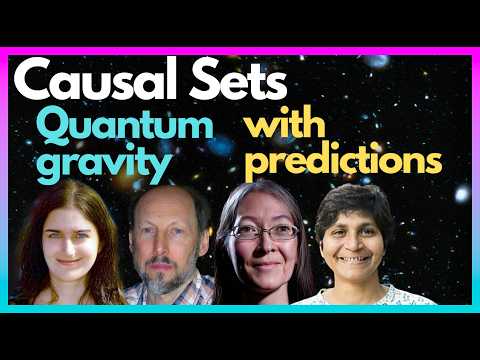
The causal sets community has produced a 1 hour video to explain these concepts to a general audience interested in #physics
https://www.youtube.com/watch?v=5EoZE1rOHAo
Causal Sets : The quantum theory that predicted dark energy

YouTube

"Ob der Weg zu einer möglichen Theorie der #Quantengravitation gerade sein wird, oder sprunghaft, wird sich erst weisen"

Spannend, aktuell und erstaunlich gut erklärt von Reinhard #Kleindl

#Relativitätstheorie #RicciKrümmung #CausalSetTheory #Raumzeit

https://www.derstandard.at/story/3000000280264/luecke-in-einsteins-relativitaetstheorie-wird-nach-ueber-100-jahren-geschlossen

Lücke in Einsteins Relativitätstheorie wird nach über 100 Jahren geschlossen

Die allgemeine Relativitätstheorie versagt bisher bei Brüchen in Raum und Zeit. Zwei Wiener Forscher kitten nun die Risse und ebnen so den Weg zur Quantengravitation

DER STANDARD