 EconomistaInsolvent
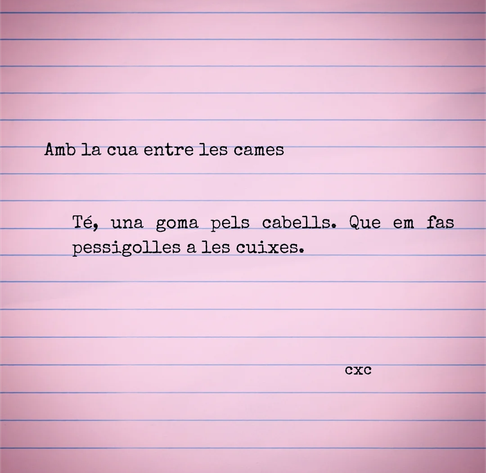
#microrelats #microcontes #escriure #escriureencatalà #relatsencatalà #uncontecadadia #dia1878 #amblacuaentrelescames #cabells #pessigolles
What are the features of predatory journal lists?
A recent Review in European Science Editing compares and contrasts the lists to better understand how useful each list is at characterizing unethical journal activity, and the value of the information they provide in helping authors and the academic community to easily identify such journals.
https://ese.arphahub.com/article/118119/
#AcademicJournals #PredatoryJournals #BeallsList #Cabells #Kscien #EuropeanScienceEditing #PredatoryPublishing #PublicationEthics
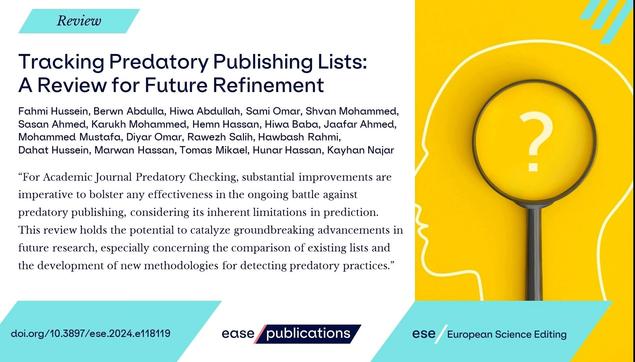
Although predatory publishers are increasingly recognized, universally accepted criteria for defining predatory journals are lacking. These journals challenge the scholarly community by blurring the line between legitimate and questionable publishing practices. Several lists and reports of predatory journals have been published, which offer valuable insights; however, they are not devoid of criticism. Beall’s list, although criticized for its inclusion criteria, is currently managed anony-mously and updated infrequently. Cabells’ list uses an extensive array of inclusion criteria, some of which are similar to those used in Beall’s list. Several of these cri-teria are redundant and fail to detect predatory practices, and using all of them in evaluating a journal is seldom practicable. Kscien’s list has emerged as a promising alternative for identifying predatory publishers or journals. However, it requires refinement, potentially through creating a distinct list supported by unequivocal evidence, such as accepting a fake manuscript (ascertained through a sting opera-tion). The present review seeks to catalyze research on identifying predatory jour-nals and publishers by comparing existing lists and suggesting new techniques for detecting predatory practices.
What are the features of predatory journal lists?
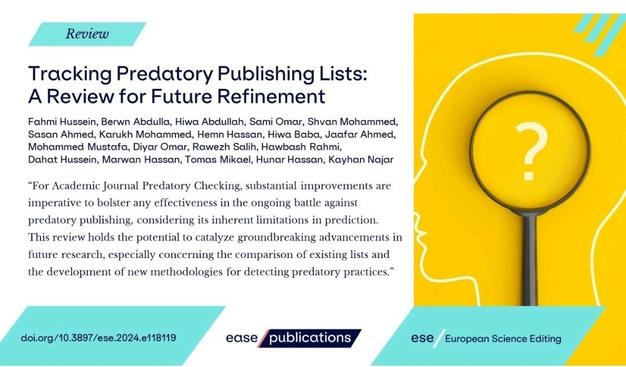
Mainly examining lists from Beall, Cabells, & Kscien, a review in European Science Editing looks at how useful each list is at defining unethical journal activity and how they help spot such journals. The review includes practical recommendations to bridge gaps in the lists and make their assessment more robust.
https://doi.org/10.3897/ese.2024.e118119
#AcademicJournals #PredatoryJournals #BeallsList #Cabells #Kscien #EuropeanScienceEditing #PredatoryPublishing
Although predatory publishers are increasingly recognized, universally accepted criteria for defining predatory journals are lacking. These journals challenge the scholarly community by blurring the line between legitimate and questionable publishing practices. Several lists and reports of predatory journals have been published, which offer valuable insights; however, they are not devoid of criticism. Beall’s list, although criticized for its inclusion criteria, is currently managed anony-mously and updated infrequently. Cabells’ list uses an extensive array of inclusion criteria, some of which are similar to those used in Beall’s list. Several of these cri-teria are redundant and fail to detect predatory practices, and using all of them in evaluating a journal is seldom practicable. Kscien’s list has emerged as a promising alternative for identifying predatory publishers or journals. However, it requires refinement, potentially through creating a distinct list supported by unequivocal evidence, such as accepting a fake manuscript (ascertained through a sting opera-tion). The present review seeks to catalyze research on identifying predatory jour-nals and publishers by comparing existing lists and suggesting new techniques for detecting predatory practices.
 EASE
EASE