2022 February 8

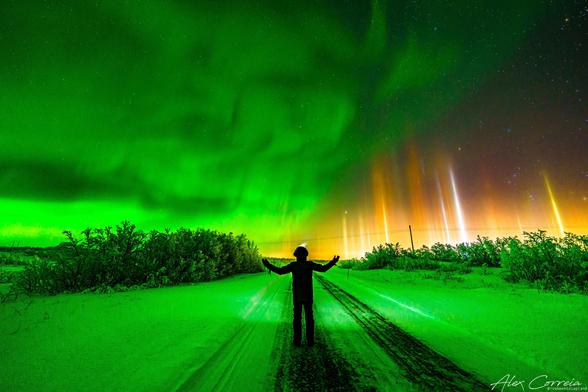
Aurora and Light Pillars over Norway
* Image Credit & Copyright: Alexandre Correia

Explanation:
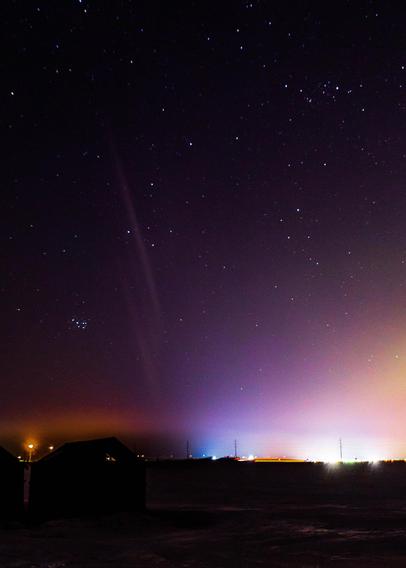
Which half of this sky is your favorite? On the left, the night sky is lit up by particles expelled from the Sun that later collided with Earth's upper atmosphere — creating bright auroras. On the right, the night glows with ground lights reflected by millions of tiny ice crystals falling from the sky — creating light pillars. And in the center, the astrophotographer presents your choices. The light pillars are vertical columns because the fluttering ice-crystals are mostly flat to the ground, and their colors are those of the ground lights. The auroras cover the sky and ground in the green hue of glowing oxygen, while their transparency is clear because you can see stars right through them. Distant stars dot the background, including bright stars from the iconic constellation of Orion. The featured image was captured in a single exposure two months ago near Kautokeino, Norway.

https://apod.nasa.gov/apod/ap220208.html

#space #earth #lightpillars #athmosphere #astrophotography #photography #NASA #science #physics #nature #education

2020 November 17

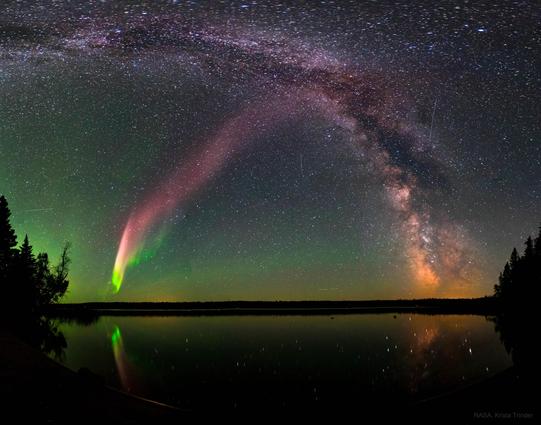
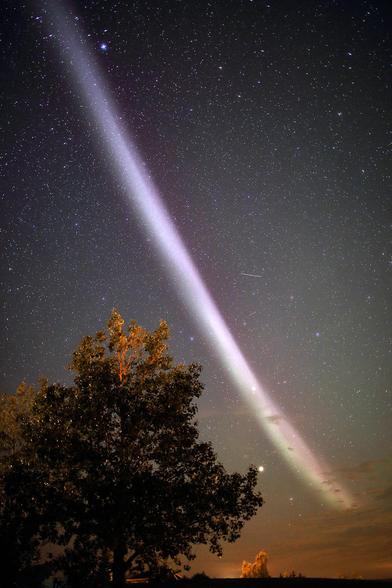
A Glowing STEVE and the Milky Way
* Image Credit: NASA, Krista Trinder

Explanation:
What's creating these long glowing streaks in the sky? No one is sure. Known as Strong Thermal Emission Velocity Enhancements (STEVEs), these luminous light-purple sky ribbons may resemble regular auroras, but recent research reveals significant differences. A STEVE's great length and unusual colors, when measured precisely, indicate that it may be related to a subauroral ion drift (SAID), a supersonic river of hot atmospheric ions thought previously to be invisible. Some STEVEs are now also thought to be accompanied by green picket fence structures, a series of sky slats that can appear outside of the main auroral oval that does not involve much glowing nitrogen. The featured wide-angle composite image shows a STEVE in a dark sky above Childs Lake, Manitoba, Canada in 2017, crossing in front of the central band of our Milky Way Galaxy.

https://apod.nasa.gov/apod/ap201117.html

#space #earth #milkyway #STEVE #athmosphere #astrophotography #photography #NASA #science #physics #nature #education

2023 September 27

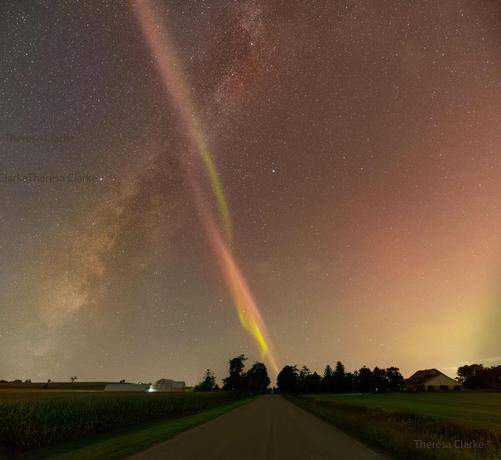
STEVE and Milky Way Cross over Rural Road
* Image Credit & Copyright: Theresa Clarke
https://www.instagram.com/tc_1865/

Explanation:
Not every road ends in a STEVE. A week ago, a sky enthusiast's journey began with a goal: to photograph an aurora over Lake Huron. Driving through rural Ontario, Canada, the forecasted sky show started unexpectedly early, causing the photographer to stop before arriving at the scenic Great Lake. Aurora images were taken toward the north -- but over land, not sea. While waiting for a second round of auroras, a peculiar band of light was noticed to the west. Slowly, the photographer and friends realized that this western band was likely an unusual type of aurora: a Strong Thermal Emission Velocity Enhancement (STEVE). Moreover, this STEVE was putting on quite a show: appearing intertwined with the central band of our Milky Way Galaxy while intersecting the horizon just near the end of the country road. After capturing this cosmic X on camera, the photographer paused to appreciate the unexpected awesomeness of finding extraordinary beauty in an ordinary setting.

https://apod.nasa.gov/apod/ap230927.html

#space #earth # STEVE #athmosphere #astrophotography #photography #NASA #science #physics #nature #education

2017 October 14

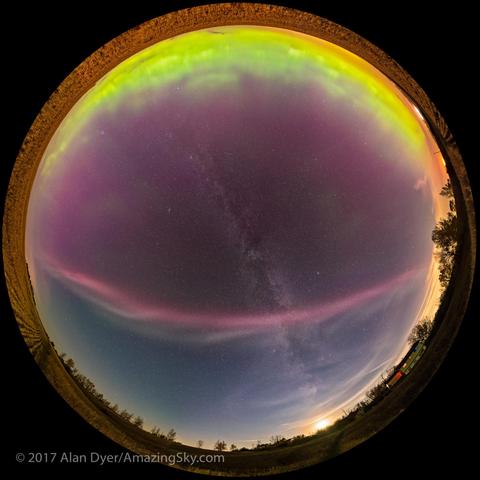
All-Sky Steve
* Image Credit & Copyright: Alan Dyer, Amazingsky.com, TWAN
https://www.amazingsky.com/

Explanation:
Familiar green and red tinted auroral emission floods the sky along the northern (top) horizon in this fish-eye panorama projection from September 27. On the mild, clear evening the Milky Way tracks through the zenith of a southern Alberta sky and ends where the six-day-old Moon sets in the southwest. The odd, isolated, pink and whitish arc across the south has come to be known as Steve. The name was given to the phenomenon by the Alberta Aurora Chasers Facebook group who had recorded appearances of the aurora-like feature. Sometimes mistakenly identified as a proton aurora or proton arc, the mysterious Steve arcs seem associated with aurorae but appear closer to the equator than the auroral curtains. Widely documented by citizen scientists and recently directly explored by a Swarm mission satellite, Steve arcs have been measured as thermal emission from flowing gas rather than emission excited by energetic electrons. Even though a reverse-engineered acronym that fits the originally friendly name is Sudden Thermal Emission from Velocity Enhancement, his origin is still mysterious.
http://spaceweathergallery.com/aurora_gallery.html
https://www.esa.int/Applications/Observing_the_Earth/FutureEO/Swarm/When_Swarm_met_Steve

https://apod.nasa.gov/apod/ap171014.html

#space #earth #STEVE #athmosphere #astrophotography #photography #NASA #science #physics #nature #education

2024 October 28

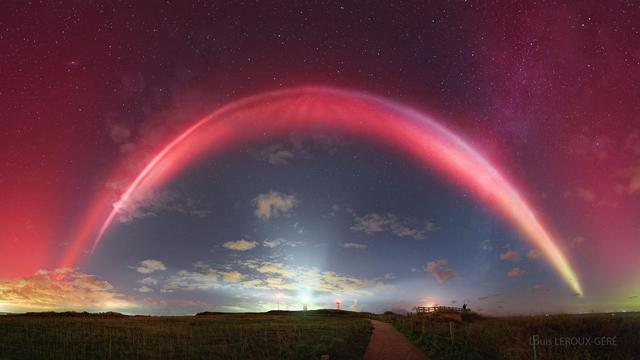
STEVE: A Glowing River over France
* Credit & Copyright: Louis LEROUX-GÉRÉ
https://app.astrobin.com/u/Lrx.photo

Explanation:
Sometimes a river of hot gas flows over your head. In this case the river created a Strong Thermal Emission Velocity Enhancement (STEVE) that glowed bright red, white, and pink. Details of how STEVEs work remain a topic of research, but recent evidence holds that their glow results from a fast-moving river of hot ions flowing over a hundred kilometers up in the Earth's atmosphere: the ionosphere. The more expansive dull red glow might be related to the flowing STEVE, but alternatively might be a Stable Auroral Red (SAR) arc, a more general heat-related glow. The featured picture, taken earlier this month in Côte d'Opale, France, is a wide-angle digital composite made as the STEVE arc formed nearly overhead. Although the apparition lasted only a few minutes, this was long enough for the quick-thinking astrophotographer to get in the picture -- can you find him?
https://ui.adsabs.harvard.edu/abs/2018GeoRL..45.7968G/abstract
https://en.wikipedia.org/wiki/STEVE#Research_into_cause
https://science.nasa.gov/earth/earth-atmosphere/earths-atmosphere-a-multi-layered-cake/
https://science.nasa.gov/earth/10-things-to-know-about-the-ionosphere/
https://spaceweatherarchive.com/2021/11/22/3308/
https://apod.nasa.gov/apod/ap171014.html

https://apod.nasa.gov/apod/ap241028.html

#space #earth #STEVE #athmosphere #astrophotography #photography #NASA #science #physics #nature #education

From Wikipedia, the free encyclopedia

STEVE
is an atmospheric optical phenomenon that appears as a purple and green light ribbon in the night sky, named in late 2016 by aurora watchers from Alberta, Canada. The backronym later adopted for the phenomenon is the Strong Thermal Emission Velocity Enhancement. According to analysis of satellite data from the European Space Agency's Swarm mission, the phenomenon is caused by a 25 km (16 mi) wide ribbon of hot plasma at an altitude of 450 km (280 mi), with a temperature of 3,000 °C (3,270 K; 5,430 °F) and flowing at a speed of 6 km/s (3.7 mi/s) (compared to 10 m/s (33 ft/s) outside the ribbon). The phenomenon is not rare, but had not been investigated and described scientifically prior to that time.

Discovery and naming
The STEVE phenomenon has been observed by auroral photographers for decades. Some evidence suggests that STEVE observations may have been recorded as early as 1705. Notations resembling the phenomenon exist in some observations from 1911 to the 1950s by Carl Størmer.

The first accurate determination of the nature of the phenomenon was not made, however, until after members of a Facebook group, Alberta Aurora Chasers, named it, attributed it to a proton aurora, and began calling it a "proton arc". When physics professor Eric Donovan from the University of Calgary saw their photographs and suspected that their determination was incorrect because proton auroras are not visible, he correlated the time and location of the phenomenon with Swarm satellite data and one of the Alberta Aurora Chaser photographers, Song Despins. She provided GPS coordinates from Vimy, Alberta, that helped Donovan link the data to identify the phenomenon.

One of the aurora watchers, photographer Chris Ratzlaff, suggested using the name "Steve" for the phenomenon, in reference to Over the Hedge, an animated comedy movie from 2006. The characters in the movie give the name to a hedge that appears overnight, in order to make it seem more benign. Reports of the heretofore undescribed and unusual "aurora" went viral as an example of citizen science on Aurorasaurus.

That acronym, "STEVE", has been adopted by the team at NASA Goddard Space Flight Center that is studying the phenomenon and stands for "Strong Thermal Emission Velocity Enhancement".

Location and timing
STEVE phenomena may be spotted further from the poles than the aurora, and as of March 2018, have been observed in the United Kingdom, Canada, Alaska, northern U.S. states, Australia, New Zealand and Denmark. The phenomenon appears as a very narrow arc extending for hundreds or thousands of kilometers, aligned east–west. It generally lasts for twenty minutes to an hour. As of March 2018, STEVE phenomena have only been spotted in the presence of an aurora. None were observed from October 2016 to February 2017, or from October 2017 to February 2018, leading NASA to believe that STEVE phenomena may only appear during certain seasons. However, STEVE phenomena have since been reported and photographed in South Australia during a geomagnetic storm event on 11 October 2024.

Research into cause
A study published in March 2018 by Elizabeth A. MacDonald and co-authors in the peer-reviewed journal, Science Advances, suggested that the STEVE phenomenon accompanies a subauroral ion drift (SAID), a fast-moving stream of extremely hot particles. STEVE marks the first observed visual effect accompanying a SAID.

In August 2018, researchers determined that the skyglow of the phenomenon was not associated with particle precipitation (electrons or ions) and, as a result, could be generated in the ionosphere.

One proposed mechanism for the glow is that excited nitrogen breaks apart and interacts with oxygen to form glowing nitric oxide.
Association with picket-fence aurora

CREDIT
Contributors to Wikimedia projects

https://en.wikipedia.org/wiki/STEVE

#space #earth #STEVE #athmosphere #astrophotography #photography #NASA #science #physics #nature #education

2024 January 25

Jyväskylä in the Sky
* Image Credit & Copyright: Harri Kiiskinen

Explanation:
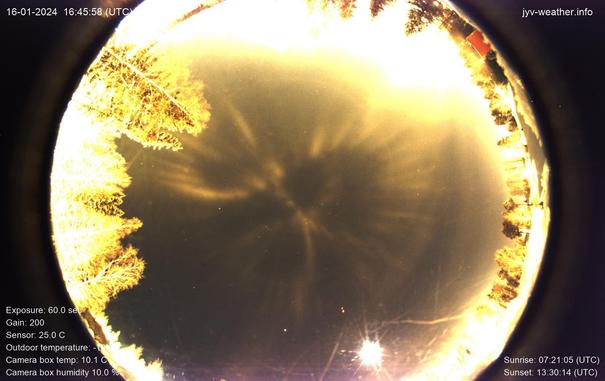
You might not immediately recognize this street map of a neighborhood in Jyväskylä, Finland, planet Earth. But that's probably because the map was projected into the night sky and captured with an allsky camera on January 16. The temperature recorded on that northern winter night was around minus 20 degrees Celsius. As ice crystals formed in the atmosphere overhead, street lights spilling illumination into the sky above produced visible light pillars, their ethereal appearance due to specular reflections from the fluttering crystals' flat surfaces. Of course, the projected light pillars trace a map of the brightly lit local streets, though reversed right to left in the upward looking camera's view. This light pillar street map was seen to hover for hours in the Jyväskylä night.
https://www.openstreetmap.org/search?query=Jyv%C3%A4skyl%C3%A4&zoom=6&minlon=-7.119140625&minlat=46.255846818480315&maxlon=28.037109375000004&maxlat=55.89995614406812#map=14/62.24083/25.74946
https://earthobservatory.nasa.gov/
https://atoptics.co.uk/blog/light-pillars/

https://apod.nasa.gov/apod/ap240125.html

#space #earth #lightpillars #athmosphere #astrophotography #photography #NASA #science #physics #nature #education

2018 December 21

Extraordinary Solar Halos
* Image Credit & Copyright: Magnus Edback
https://www.astrobin.com/users/Magnusedback/

Explanation:
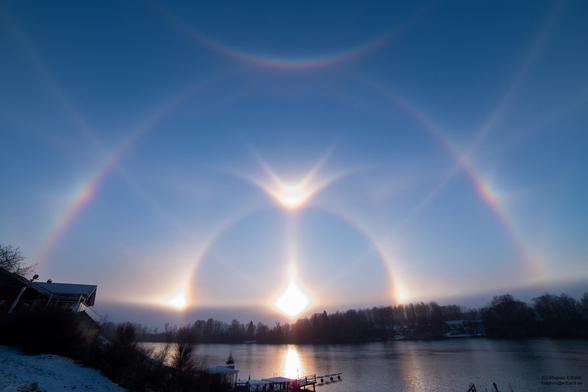
Welcome to the December Solstice, the first day of winter in planet Earth's northern hemisphere and summer in the south. To celebrate, consider this extraordinary display of beautiful solar ice halos! More common than rainbows, simple ice halos can be easy to spot, especially if you can shade your eyes from direct sunlight. Still it's extremely rare to see anything close to the complex of halos present in this astounding scene. Captured at lunchtime on a cold December 14 near Utendal, Sweden the image includes the relatively ordinary 22 degree halo, sundogs (parhelia) and sun pillars. The extensive array of rarer halos has been identified along with previously unknown features. All the patterns are generated as sunlight (or moonlight) is reflected and refracted in flat six-sided water ice crystals in Earth's atmosphere. In this case, likely local contributors to the atmospheric ice crystals are snow making machines operating at a nearby ski center.

https://apod.nasa.gov/apod/ap181221.html

#space #earth #halos #athmosphere #astrophotography #photography #NASA #science #physics #nature #education

>> annotated version of previous image

Diamond Dust Sky Eye
* Image Credit & Copyright: Jaroslav Fous

#space #earth #halos #athmosphere #astrophotography #photography #NASA #science #physics #nature #education

2024 December 25

Diamond Dust Sky Eye
* Image Credit & Copyright: Jaroslav Fous

Explanation:
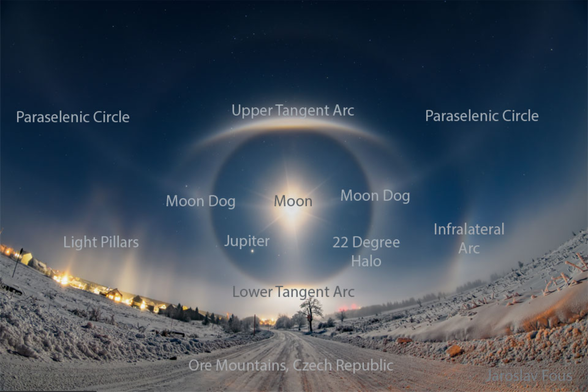
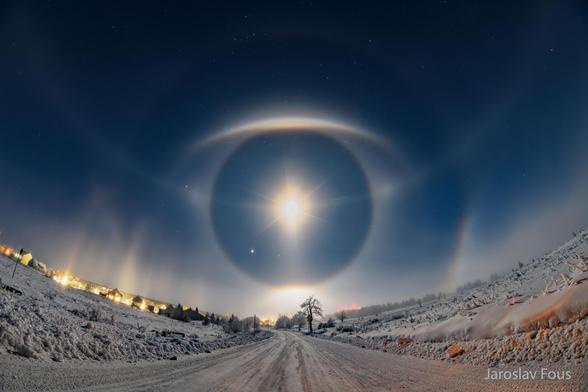
Why is there a huge eye in the sky? Diamond dust. That is an informal term for small ice crystals that form in the air and flitter to the ground. Because these crystals are geometrically shaped, they can together reflect light from the Sun or Moon to your eyes in a systematic way, causing huge halos and unusual arcs to appear. And sometimes, together the result can seem like a giant eye looking right back at you. In the featured image taken in the Ore Mountains of the Czech Republic last week, a bright Moon rising through ice fog-filled air resulted in many of these magnificent sky illusions to be visible simultaneously. Besides Moon dogs, tangent arcs, halos, and a parselenic circle, light pillars above distant lights are visible on the far left, while Jupiter and Mars can be found just inside the bottom of the 22-degree halo.
https://www.worldatlas.com/articles/what-is-diamond-dust.html
https://communitycloudatlas.wordpress.com/2015/04/04/colorful-arcs-in-the-sky/
https://apod.nasa.gov/apod/ap160321.html
https://apod.nasa.gov/apod/ap180914.html
https://en.wikipedia.org/wiki/Parhelic_circle

>> annotated version see next post <<
.. if you like TOPICS like this you might want to see my TOPIC>Lists:
https://defcon.social/@grobi/114810788357770292

https://apod.nasa.gov/apod/ap241225.html

#space #earth #halos #athmosphere #astrophotography #photography #NASA #science #physics #nature #education