 Anthropology.net
A valley in northern Israel has produced 10 handaxes deliberately shaped around fossils and geodes, unprecedented for a single Acheulean site. What did early humans see in strange stone? #Palaeolithic #Acheulean #HumanEvolution https://www.anthropology.net/p/shaped-around-the-fossil-acheulean
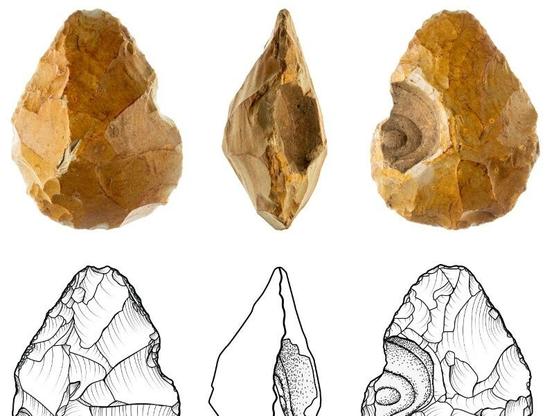
New dating evidence pushes ‘Ubeidiya in the Jordan Valley back to at least 1.9 million years old — roughly the same age as Dmanisi. Were two different hominin groups leaving Africa at the same time? #HumanEvolution #Paleoanthropology #Acheulean https://www.anthropology.net/p/ubeidiya-is-at-least-19-million-years

 Radical Anthropology
Big shift in skills of #biface knapping half a million years ago in Britain, showing variation between phases of #Acheulean occupation of Britain
https://www.sciencedirect.com/science/article/pii/S2352409X25005966?via%3Dihub
A 500,000-year-old tool made from elephant bone, found in England, reveals how early humans used rare materials to sharpen Acheulean handaxes with precision. Ingenuity leaves quiet traces. #Archaeology #HumanOrigins #Acheulean #Paleoanthropology
https://www.anthropology.net/p/the-elephant-bone-that-sharpened

 charring auh
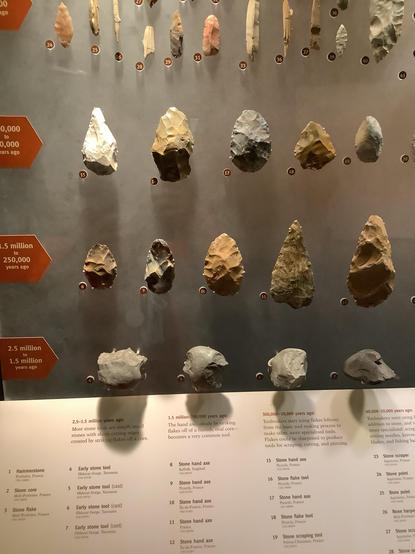
cordiform biface as commonly found in the #Acheulean (replica) 1.5 million 250,000 years ago the #handaxe made by striking flakes off of a flattish oval core become a very common tool
 Jeff
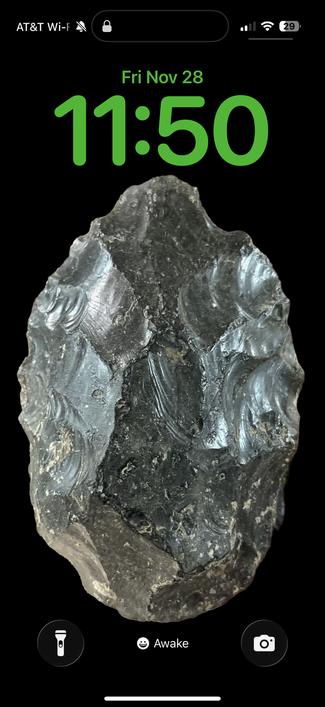
JeffMy new lock screen wallpaper:
Lower Paleolithic 1.2-million-year-old obsidian hand axe made by unknown hominin at Simbiro III (Melka Kunture, Upper Awash Valley, Ethiopia)
#acheulean #lithics #paleoanthropoly
 MONREPOS
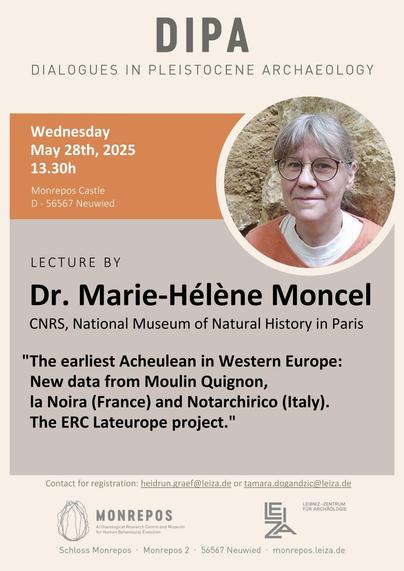
Our DiPA (Dialogues in Pleistocene Archaeology) will continue on Wednesday, May 28th, at 13.30.
Marie Hélène Moncel (CNRS, Muséum national d'histoire naturelle de Paris) will give a talk about
"The earliest Acheulean in Western Europe: New data from Moulin Quignon, la Noira (France) and Notarchirico (Italy). The ERC Lateurope project."
Zoom registration is possible!
#paleomonrepos #archaeology #palaeolithic #paleolithic #Acheulean #DiPA #LEIZA
 Matt Willemsen
Mysterious rock depicted in 15th-century painting is most likely a Stone Age tool
Why medieval painter Jean Fouquet chose to depict Acheulean hand ax remains a mystery.
https://arstechnica.com/science/2023/10/mysterious-rock-depicted-in-15th-century-painting-is-most-likely-a-stone-age-tool/#MelunDiptych #medieval #French #painter #miniaturist #JeanFouquet #Acheulean #stone #handaxe
Why medieval painter Jean Fouquet chose to depict Acheulean hand ax remains a mystery.
https://arstechnica.com/science/2023/10/mysterious-rock-depicted-in-15th-century-painting-is-most-likely-a-stone-age-tool/#MelunDiptych #medieval #French #painter #miniaturist #JeanFouquet #Acheulean #stone #handaxe

 DomCom
Paléoanthropologie.
Nos lointains ancêtres essayaient-ils de transformer des pierres en sphères parfaites ?
The limestone spheroids of ‘Ubeidiya: intentional imposition of symmetric geometry by early hominins?
https://royalsocietypublishing.org/doi/10.1098/rsos.230671

Nos lointains ancêtres essayaient-ils de transformer des pierres en sphères parfaites ?
Une étude suggère que des pierres vieilles de 1,4 million d’années ne seraient pas devenues rondes à force d’être utilisées comme outil par les ancêtres des humains. Elles auraient été intentionnellement taillées en forme de sphère.
The earliest European #Acheulean: new insights into the large shaped tools from the late Early Pleistocene site of Barranc de la Boella (Tarragona, #Spain)
https://www.frontiersin.org/articles/10.3389/feart.2023.1188663/full

The earliest European Acheulean: new insights into the large shaped tools from the late Early Pleistocene site of Barranc de la Boella (Tarragona, Spain)
Since the oldest known Acheulean lithic techno-typological features in Europe were reported at the site of Barranc de la Boella (Tarragona, Spain), continuous fieldwork has been conducted there in archeological deposits of the late Early Pleistocene age (0.99–0.78 Ma). As a result, excavations in two of the three open-air localities have significantly expanded the collection of lithic and faunal remains, allowing us to make progress in the interpretation of the hominin behaviors in an open-air fluvial-deltaic sedimentary environment. This includes examples of cumulative palimpsests, such as those found at the locality of La Mina, in which hominins only had a minimal role as modifying agents, as well as the extraordinary mammoth butchery site recorded at the Pit 1 locality. The aim of this paper is to present a comprehensive update of the collection of large shaped tools and to assess its significance in the framework of the earliest occurrence of the Acheulean in Europe. This cultural entity is increasingly well-documented for the early Middle Pleistocene, but very little is known about its presence in Europe before the Brunhes–Matuyama boundary. Large shaped tools appear in the three localities explored in the Unit II of Barranc de la Boella, including choppers (unifacial and bifacial) and standard Acheulean forms, such as picks, knives, and cleaver-like forms. Techno-typological and morphometrical analyses revealed a basic heavy-duty component obtained through simple sha...