The Great Antarctic Escape of Iceberg A-83…

After detaching from the Brunt Ice Shelf in May 2024, Iceberg A-83 was trapped by dense sea ice until late winter... Satellite imagery tracking the iceberg’s thermal footprint, showed its journey and interactions with the environment... scitechdaily.com #antarctica #seaice #climatechange #iceberg #environment #A83 #brunticeshelf

https://formuchdeliberation.wordpress.com/2024/09/18/the-great-antarctic-escape-of-iceberg-a-83/

The Great Antarctic Escape of Iceberg A-83…

After detaching from the Brunt Ice Shelf in May 2024, Iceberg A-83 was trapped by dense sea ice until late winter… Satellite imagery tracking the iceberg’s thermal footprint, showed its journ…

for much deliberation
#A83 reopens via Old Military Road #OMR following 500-tonne #Landslide caught in debris nets, following a safety review by #BEAR #Scotland. #BearNW #Landslip

#A83 #RestAndBeThankful #Landslip #Landslide 8:20am 15/9/24
From #BearNW
A brief update to advise that the A83 at the Rest and be Thankful has been closed due to an on-going #DebrisSlide on the hillside.

Traffic is being diverted onto the A82/A85/A819 whist the situation is on-going.

Further updates to follow.

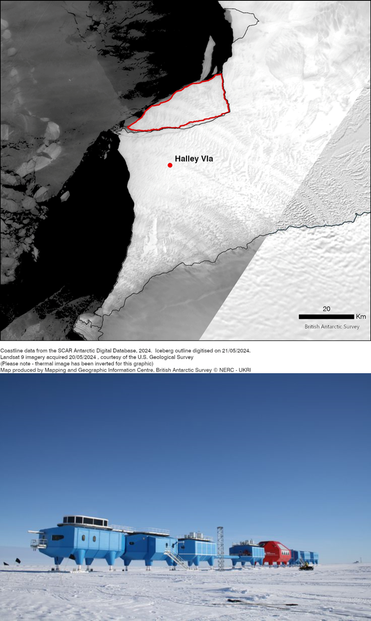
On May 20th, 2024, an iceberg measuring 380 square kilometers (~147 mi2) broke off the
Brunt Ice Shelf in Antarctica.

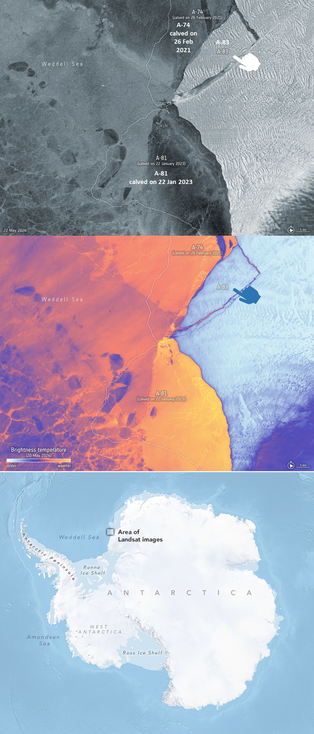
This event (A-83) is this region's third significant iceberg calving in the past four years.
The first came in 2021, when A-74 broke off the ice sheet, while an even larger berg named A-81 followed in 2023.

The separation of this iceberg was captured by two Earth Observation satellites
– the ESA's Copernicus Sentinel-1and NASA's Landsat 8 satellites
– which provided radar imaging and thermal data, respectively.

The iceberg has been officially designated A-83 by the U.S. National Ice Center, which assigns names based on the Antarctic quadrant where the iceberg was first sighted

#iceberg #antarctica #a83
https://www.sciencealert.com/gigantic-iceberg-in-antarctica-tears-loose-in-major-calving-event

Gigantic Iceberg in Antarctica Tears Loose in Major Calving Event

On May 20th, 2024, an iceberg measuring 380 square kilometers (~147 mi2) broke off the Brunt Ice Shelf in Antarctica.

ScienceAlert

"On May 20th, 2024, an #iceberg measuring 380 square kilometers (~147 mi2) broke off the Brunt Ice Shelf in #Antarctica.

The ongoing loss of Antarctic ice is one of the clearest indications of rising global temperatures and a dire warning."

https://www.sciencealert.com/gigantic-iceberg-in-antarctica-tears-loose-in-major-calving-event
#A83

Gigantic Iceberg in Antarctica Tears Loose in Major Calving Event

On May 20th, 2024, an iceberg measuring 380 square kilometers (~147 mi2) broke off the Brunt Ice Shelf in Antarctica.

ScienceAlert

Although the calvings in this area are not thought to be directly linked to climate change, NASA states that "the Brunt Ice Shelf is feeling the same pressures as elsewhere around Antarctica, including low sea ice conditions. When less sea ice is present, ice shelves are more exposed to destabilizing wind and wave action."

In the waters around Antarctica, ice coverage in Feb. 2024 shrank to near-historic lows for the third year in a row.

https://earthobservatory.nasa.gov/images/152848/antarctic-ice-shelf-spawns-iceberg-a-83
#Iceberg #A83 #Antarctic
4/n

Antarctic Ice Shelf Spawns Iceberg A-83

The Brunt Ice Shelf lost a large wedge of floating ice, the third sizeable iceberg to calve from the shelf in recent years.

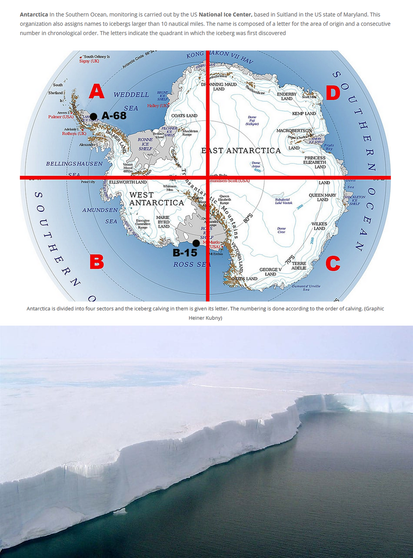
Names for icebergs larger than 10 nautical miles (on the longest axis) start with the letter A, B, C or D followed by a sequentially assigned number, e.g., A-83.

The letter is based on the Antarctic quadrant where an iceberg originates, as shown in the graphic below -
A = 0-90W (Bellingshausen/Weddell Sea)
B = 90W-180 (Amundsen/Eastern Ross Sea)
C = 180-90E (Western Ross Sea/Wilkesland)
D = 90E-0 (Amery/Eastern Weddell Sea)

https://polarjournal.ch/en/2021/02/18/how-to-name-an-iceberg/
#Iceberg #A83 #Antarctic
3/n

How to name an iceberg

Over the last three years media reported again and again about the iceberg A-68. What is hidden behind the letter-number-combination you can read in this report.

Polarjournal

The Halley VIa Research Station operated by the British Antarctic Survey (BAS) is located on the Brunt Ice Shelf as shown in the map below. It used to sit on the A-81 iceberg area as seen in the map above and was moved to its current location in 2016 before A-81 broke loose.

BAS notes that this A-83 calving was expected, the ice shelf is stable and they don’t expect a response to this new event.

https://www.bas.ac.uk/media-post/brunt-ice-shelf-in-antarctica-calves-new-iceberg/
https://www.bas.ac.uk/polar-operations/sites-and-facilities/facility/halley/
#A83 #Halley #Antarctic
2/n

Brunt Ice Shelf in Antarctica calves new iceberg - British Antarctic Survey

ANTARCTICA – 21 May. A large iceberg (380 km²), about the size of the Isle of Wight, has broken off the 150m thick Brunt Ice Shelf.

British Antarctic Survey

An iceberg named A-83, 380 sq km in size, broke off the Brunt Ice Shelf in Antarctica on May 20.

"This calving event results from a prolonged weakening of the ice at the McDonald Ice Rumples and progressive eastward extension of the so-called ‘Halloween Crack’ into the ice shelf."

In 2021, the Brunt Ice Shelf produced an iceberg called A-74 followed by an even bigger berg, named A-81, in 2023.

https://www.esa.int/ESA_Multimedia/Images/2024/05/Iceberg_A-83_breaks_free
https://earthobservatory.nasa.gov/images/152848/antarctic-ice-shelf-spawns-iceberg-a-83
#A83 #Antarctica
1/n

Iceberg A-83 breaks free

An iceberg roughly the size of the Isle of Wight has broken off the Brunt Ice Shelf in Antarctica on 20 May.