From Jericho to Jerusalem
Salvation, Service, and Surrender
Thru the Bible in a Year
Luke’s account of Jesus’ journey from Jericho to Jerusalem brings us to the edge of history’s greatest turning point—the cross. These chapters, Luke 19 and 20, pull us close to the heartbeat of Jesus as He moves steadily toward His crucifixion and resurrection. We watch Him bring salvation to a single lost soul, challenge His followers with a parable of stewardship, enter Jerusalem as the long-awaited King, and face opposition that will soon lead to His death. Yet, through it all, His purpose remains unwavering—to seek and to save the lost.
The Salvation of Zacchaeus: When Grace Climbs a Tree
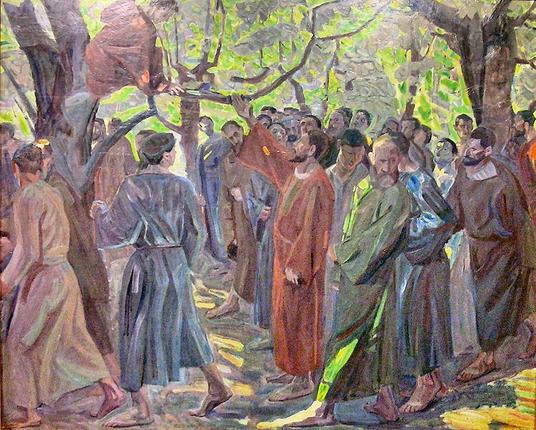
Luke 19 opens with a familiar story—Zacchaeus, the wealthy tax collector who climbed a sycamore tree just to see Jesus pass by. His story is one of spiritual hunger wrapped in unlikely packaging. As a tax collector, he was despised by his own people, labeled a collaborator with Rome and a symbol of greed. Yet beneath his wealth lay a soul that longed to see the Savior.
Zacchaeus’ curiosity led to an encounter that changed everything. When Jesus looked up and said, “Zacchaeus, come down immediately. I must stay at your house today” (Luke 19:5), the invitation wasn’t just social—it was salvific. In a moment, grace reached up that tree and touched a heart that had been hiding behind success.
Notice the order: Jesus calls first, and the change follows. Zacchaeus didn’t clean up his life to earn the Lord’s attention; the Lord’s attention transformed his life. His confession, “Look, Lord! Here and now I give half of my possessions to the poor” (v.8), wasn’t a transaction but a testimony—evidence that real salvation always bears fruit.
And Jesus’ declaration still rings true: “Today salvation has come to this house… For the Son of Man came to seek and to save what was lost.” (v.9–10). What an encouragement for us! Christ still seeks those who hide in the branches of fear, guilt, or pride. When He calls our name, it’s not to shame us, but to restore us.
The Parable of the Ten Pounds: Stewardship as Worship
Right after Zacchaeus’ conversion, Jesus told the parable of the ten pounds (or minas). This wasn’t by coincidence. Having just witnessed a man transformed, Jesus now turns to teach about what a transformed life looks like—faithful stewardship.
In the story, a nobleman gives varying amounts of money to his servants and leaves for a distant country. Upon his return, he expects to see what they’ve done with what they were given. Two servants are diligent and double their share; one hides his in fear. The contrast is striking. The first two trust the master’s goodness; the last one distrusts it.
This parable echoes the principle we saw in Zacchaeus: salvation leads to service. When grace touches the heart, generosity and faithfulness follow. God gives each of us time, talents, and opportunities—not equally, but equitably, “according to our ability.” He doesn’t compare our results, only our faithfulness.
I’ve often found that the people most afraid of failing are those who never start. Yet Jesus reminds us that failure isn’t found in falling short—it’s in refusing to act. The servant who buried his gift didn’t just lose money; he lost his purpose. The Lord’s response is both sobering and merciful: “To everyone who has, more will be given.” (Luke 19:26). In God’s kingdom, the more we give, the more He entrusts. The more we serve, the more we grow. Stewardship, then, is not a duty—it’s an act of worship.
The Triumphal Entry: When Praise and Opposition Meet
As Jesus entered Jerusalem (Luke 19:28–44), the atmosphere was electric. The crowds laid their cloaks on the road and shouted blessings to “the King who comes in the name of the Lord!” Yet even in celebration, Jesus wept. He saw what others could not—the spiritual blindness of a city that would reject its Redeemer.
The triumphant entry teaches us that popularity and faith are not the same. The same crowd that cheered on Palm Sunday would cry “Crucify Him!” by week’s end. Jesus’ tears remind us that He values hearts over applause, repentance over recognition. As He looked upon the city, He foresaw the destruction of Jerusalem in A.D. 70—a direct consequence of hardened hearts.
When I read this passage, I hear a call to self-examination. How often do we welcome Jesus with words of praise but deny Him in our actions? He longs not just for palm branches waved in moments of emotion, but for obedience rooted in love. As we walk through our own Jerusalem moments—times when faith is tested and the cost is high—may our devotion remain steady and sincere.
The Cleansing of the Temple: A House of Prayer, Not Profit
Immediately following His entry, Jesus entered the temple and drove out those who were buying and selling (Luke 19:45–48). He declared, “My house will be a house of prayer, but you have made it a den of robbers.”
This was no moment of rage—it was a moment of restoration. The temple was meant to be a place where heaven met earth, where hearts communed with God. Yet it had become commercialized, cluttered with greed. Jesus’ cleansing was both literal and symbolic: He was preparing the house of God for its true purpose.
Every believer’s heart is now that temple. Paul later writes, “Do you not know that your body is a temple of the Holy Spirit?” (1 Corinthians 6:19). Christ still comes to cleanse—removing distractions, overturning idols, restoring prayer to its rightful place. Sometimes He must drive out what hinders our worship so that His peace may dwell fully within us.
The Attacks in Jerusalem: Words Before Wounds
Luke 20 records the beginning of the verbal assaults that would soon lead to the cross. The religious leaders, unable to silence Jesus’ influence, tried to trap Him with their questions.
First came the question about paying taxes to Caesar. They hoped to corner Him between political and religious loyalty, but His answer disarmed them: “Render to Caesar the things that are Caesar’s, and to God the things that are God’s.” (v.25). Jesus recognized both the legitimacy of government and the higher claim of divine authority. We owe earthly institutions our respect, but our ultimate allegiance belongs to God alone.
Then came the Sadducees’ question about marriage in the resurrection. They mocked the idea of eternal life with a hypothetical scenario, but Jesus’ reply exposed their error. He reminded them that in heaven, relationships are transformed—God is the God of the living, not the dead. Resurrection is not a continuation of earthly forms, but the fulfillment of divine purpose.
Finally, Jesus countered with His own question about the Messiah: “How can they say that the Christ is David’s son? For David himself says… ‘The Lord said to my Lord, Sit at my right hand.’” (v.41–43). With this, He revealed His divine nature—the Son of David and yet the Lord of David. Those who sought to trap Him instead found themselves silenced by truth.
As Luke notes, the verbal attacks will soon become physical. Words often pave the way for wounds. But through it all, Jesus remains steadfast, teaching us that integrity and faith must stand firm even when misunderstood or opposed.
Walking with Jesus Through the Word
As we journey Thru the Bible in a Year, passages like these remind us that the story of Scripture is not just history—it’s heart work. From Zacchaeus’ salvation to the temple’s cleansing, from parables to persecution, every scene reveals the heart of our Redeemer.
We are called to climb down from our trees of comfort like Zacchaeus, to invest what God has given us, to welcome Christ not just in celebration but in surrender, and to let Him cleanse what has grown cluttered within us. Luke 19 and 20 show us that faith is not a spectator sport; it’s a daily decision to follow the One who gave everything for us.
May the Word of God you have read today continue to take root in your heart. May His Spirit give you insight, courage, and faith as you walk with Jesus from Jericho to Jerusalem—from curiosity to conviction, from fear to faithfulness. Thank you for walking Thru the Bible in a Year. Remember, God’s Word never returns void—it always accomplishes what He intends.
Recommended Reading:
“The Road to the Cross: Jesus’ Final Week” – Bible.org
FEEL FREE TO COMMENT SHARE SUBSCRIBE
#bibleStudy #ChristianDiscipleship #faithJourney #JesusFinalWeek #Luke1920 #ParableOfTheTenPounds #templeCleansing #ThruTheBibleInAYear #triumphalEntry #Zacchaeus
 Jonathan Mills
 Intentional Faith
 Venice church of Christ