[DE+EN] English Summary: Overtime and illness

Overtime must either be paid or compensated with paid time off. If you have a fixed monthly salary, your contract may allow a limited number of unpaid overtime hours – but only if your average hourly wage still meets minimum wage requirements. Any hours beyond that must be paid. If you leave the job with a negative hours balance, you don’t have to make up the time. Note: Paid overtime might push your income over the mini-job limit, making it taxable. In that case, taking time off instead might be the better option.

If you get sick, you're entitled to full pay for up to six weeks – as long as you’ve worked there for at least four weeks. For those with irregular hours, the average wage over the past 13 weeks counts. You must submit a doctor’s note by the third day of illness – or earlier if required. Don’t go to work sick: even a headache is reason enough to stay home and get paid.

[DE] Mehr Infos & kompletter Text: berlin.fau.org/ressourcen/

#YourDamnRights

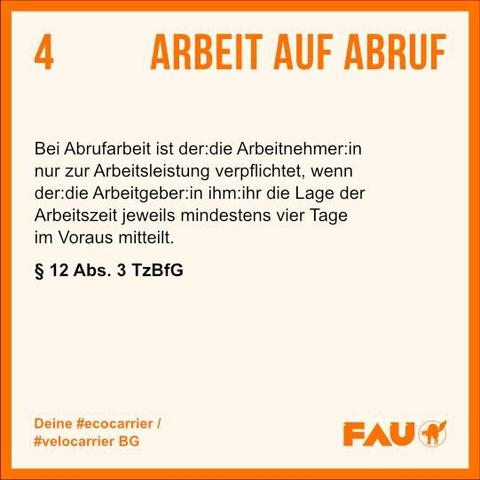
[DE+EN] English Summary: What if there are no agreed working hours?
   
If there are no agreed working hours, managers may exploit this by not scheduling you, leaving you unpaid for some weeks, which is not allowed. Under the Part-Time and Fixed-Term Employment Act, on-call workers are entitled to 20 hours per week unless otherwise agreed in the contract; regular employees get the usual hours unless specified.

So, if you’re available but not scheduled, you can claim pay for 20 hours per week—provided you actively offer your services (e.g., email or WhatsApp your boss stating you want to work).

Watch the statute of limitations: wage claims usually expire after three years, though contracts or collective agreements may set shorter deadlines (minimum three months), except for minimum wage claims, which always expire after three years. Only the portion exceeding minimum wage can expire sooner.

[DE] Mehr Infos & kompletter Text: berlin.fau.org/ressourcen/

#YourDamnRights

[DE+EN] English Summary: Roster (Dienstplan)

You have the right to know your working hours at least four days in advance, including for contractually agreed “on-call work.” This must be communicated via a duty roster, which should be posted somewhere easily accessible to all employees.

The roster must clearly state your working days and hours. Your scheduled hours on the duty roster are binding. If your employer sends you home before your rostered shift ends, you are entitled to be paid for the entire shift as listed. The claim that you are not entitled to pay because there is no work is incorrect.

Legally, under § 615 BGB, employers are in “default of acceptance,” meaning they must pay you for lost hours and you do not need to make up the time.

[DE] Mehr Infos & kompletter Text: berlin.fau.org/ressourcen/

#YourDamnRights

[DE+EN] English Summary: Working days, rest periods, and breaks
   
Working time may not exceed 8 hours per day, but can be extended to 10 hours if the average over 24 weeks is no more than 8 hours. Workers must get at least 11 hours of rest between shifts (12 for young people).

Some sectors, like nursing and catering, have exceptions. By law, you must take a 30-minute break if you work over 6 hours, and 45 minutes if you work 9 hours or more. Breaks are unpaid and not counted as working time; you can use this time freely. Some companies skip breaks and deduct 30 minutes of unpaid time anyway—though this is illegal—so employees often end up working half an hour for free.

Special rules may apply to certain industries.

[DE] Mehr Infos & kompletter Text: berlin.fau.org/ressourcen/

#YourDamnRights

[DE+EN] Genau lesen! Urlaubsgeld und Urlaubsentgelt.

English Summary 👉 Vacation allowance and vacation pay

Vacation allowance is an extra, voluntary or collectively agreed benefit, while vacation pay entitles you to paid leave. If your contract states vacation pay is “included in hourly wage,” this is invalid (ECJ, C-131/04 and C-257/04).

On public holidays, if you work fixed days, you must be paid as usual. If you work on a public holiday, you're generally entitled to a bonus and a compensatory day off within 8 weeks (§11(3) ArbZG).

If you fall ill on vacation, submit a sick note—the missed days aren’t counted as leave. If employment ends, unused vacation is paid out (§7(4) BUrlG). Vacation entitlement usually expires end of March the following year, but employers must help ensure you can take it. If leave is denied, assert your right within the year.

[DE] Mehr Infos & kompletter Text: berlin.fau.org/ressourcen/

#YourDamnRights

[EN+DE] Bezahlter Urlaub.

EN Summary 👉 All workers are entitled to paid leave. According to Germany’s Federal Vacation Act (BUrlG), all employees are legally entitled to paid vacation. This means time off is not just permitted—it must be paid as if you were working.

The statutory minimum is 24 vacation days/year based on a six-day workweek. Since most people work five or fewer days, this effectively guarantees at least four weeks of paid leave. For example, someone working three days a week is entitled to 12 vacation days annually.

If your working hours vary, your vacation pay is calculated based on your average earnings over the past 13 weeks. Vacation pay must be paid in advance, before your leave begins.

You begin accruing vacation from your first month on the job, but you're only entitled to the full annual leave after 6 months of employment.

Vacation is a legal right and a binding part of your employment contract. It ensures both rest and financial security during your time off. #yourdamnrights

Unser kleines Einmaleins des Arbeitsrechts: Heute Abfindung! #YourDamnRights
Unser kleines Einmaleins des Arbeitsrechts: Heute Aufhebungsvertrag! #YourDamnRights
Unser kleines Einmaleins des Arbeitsrechts: Heute Urlaubsabgeltung! #YourDamnRights
Kenn deine Rechte! Teil 4: Arbeit auf Abruf. #YourDamnRights #ecoCARRIER #veloCARRIER