 anlomedad
#AMOC musings and global mean temperature GMT
Says here https://www.nature.com/articles/s41561-024-01568-1.epdf?sharing_token=O3cvnzvEWDHiaPGAV-CB3dRgN0jAjWel9jnR3ZoTv0M2PsD_MIel1A6mz6UbuhaTQSv4VfXkSU9okrbFGA0gy1etRpvwJw0P0tMsHg9ro8Nv1h-GiKg-3Km08jevWj3MVZ6uFzlIrUTv-X1bF8I0K8crc3qdtYsHtgUTx9fE2Zc%3D
(Original #Pontes etal 2024 https://www.nature.com/articles/s41561-024-01568-1 )
it takes 5 years for the Southern warming signal from AMOC slowdown to appear in the Atlantic near South Africa. And another 14 years for the signal to propagate from South Africa's coast to Brazil's.
So for 14 to 19 years, GMT can be expected to drop from the cooling from Greenland to St Petersburg.
(Yay, another told-you-so-moment for climate deniers!)
But then, when the warming Atlantic is seriously trapped in the South, for a while there, GMT will be stable.
Just goes to show how meaningless the concept of GMT really is. Civilisation will have disappeared in a puff of smoke, or maybe, in a blizzard. But GMT is stable. Yay.
This study looks at a few climate elements over 1000 years after fossil fuel cessation https://esd.copernicus.org/articles/15/1353/2024/esd-15-1353-2024.html
by #King et al 2024 "Exploring climate stabilisation at different global warming levels"
Among other continued regional climate changes, they find that Antarctic sea ice will continue to decline despite stabilisation of GMT🌡️ after CO2zero.
But the paper does not mention this:
continued Antarctic #seaice decline means that #Antarctic bottom water formation slows down. Which in turn changes the ocean carbon cycle and slows down AMOC.
Since they don't mention either, how trustworthy is the overall model result?
And can it also mean that a stabilised GMT is merely the result of an AMOC shutdown where cooling over North East Atlantic is balanced by warming everywhere else?
It did mean exactly that in #paleoclimate during the #LastGlacialMaximum, #LGM:
The bellwether for global mean temperature is a place called Ceara Rise off the coast of North Brazil.
It's surface temperature proxies stayed stable-ish with minuscule changes during known AMOC shutdowns in the last #IceAge
( #Westerhold et al 2020 https://www.science.org/doi/abs/10.1126/science.aba6853)
I'm not convinced that global mean temperature has meaning at all. Haven't been for a long time now. Especially because I see climate scientists on Twix, here or Bluesky mis-using GMT as proof for something to be irrelevant if it only has an impact of 0.05°C on GMT for example.
But regional impacts of something is where it hits us, our civilisation!
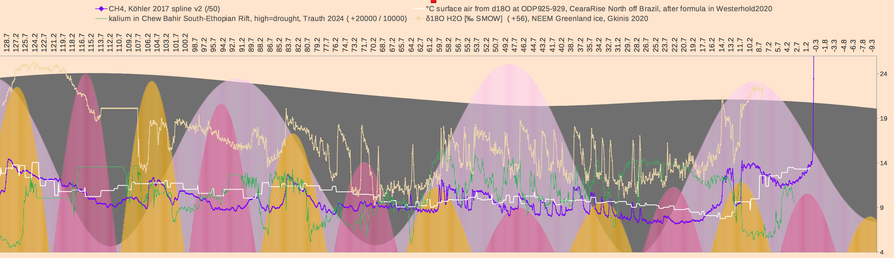
The chart shows temperature at Ceara Rise as white line. It's values are the originals, not in any way amended to fit the y-axis.
Greenland's d18O in light yellow is a proxy for temperature changes. When it goes up or down, it's likely that AMOC hickupped.
But Ceara Rise, the bellwether for global mean temperature, stayed a stable holiday destination for the Neanderthals throughout the Last Glacial Maximum, with changes of maybe 0.2°C .

Weakening of the Atlantic Meridional Overturning Circulation driven by subarctic freshening since the mid-twentieth century - Nature Geoscience
Fresh meltwater entering the Labrador and Irminger seas has resulted in a slowing of the Atlantic Meridional Overturning Circulation since the 1950s, according to a combination of modelling approaches.
 Golarion Today