 WE AND THE COLOR
Villa Normanni Proves That Mediterranean Retreat Design Can Be Both Minimal and Deeply Local
There is a particular kind of design intelligence that refuses to shout. Villa Normanni, a newly completed Mediterranean retreat nestled in the olive groves of San Vito dei Normanni in Apulia, southern Italy, speaks quietly—and that is precisely why it deserves your attention. Completed in 2025 by studio Urban Interior, this project is the result of a private investment initiative by Markéta and Lars Killi, financed through the sale of two properties in Prague. What began as a calculated real estate strategy evolved into something far more considered: a dialogue between architecture and landscape, between the imported and the indigenous, between investment logic and creative conviction.
Apulia—the heel of Italy’s boot—is having a cultural moment. The region sits between the Adriatic and Ionian Seas, and its particular quality of light, its ancient olive groves, its tufo-stone vernacular, and its still-affordable land prices have made it a magnet for a new wave of design-conscious developers and lifestyle investors. Villa Normanni arrives right at this inflection point. But unlike the many retreats that merely borrow a Mediterranean aesthetic, this project earns its place within it.
So what makes Villa Normanni different from the sea of white-plastered holiday villas flooding Apulian Instagram feeds? The answer lies in what architect and designer Markéta Killí calls grounded minimalism—a design approach that prioritizes material honesty, climatic intelligence, and regional authenticity over the kind of glossy neutrality that photographs well but feels hollow in person.
Villa Normanni is a Mediterranean retreat in the olive groves by Urban Interior.What Does “Genius Loci” Actually Mean When You Build a Villa from Scratch?
The concept of genius loci—the spirit of a place—gets thrown around a lot in architectural writing. Most of the time, it functions as a polite cover for surface-level regionalism: slap on a terracotta roof, add a pergola, and call it contextual. Villa Normanni takes a different approach. Every architectural decision here connects back to the specific landscape of the Itria Valley hinterland and the constructional traditions of the Pugliese countryside.
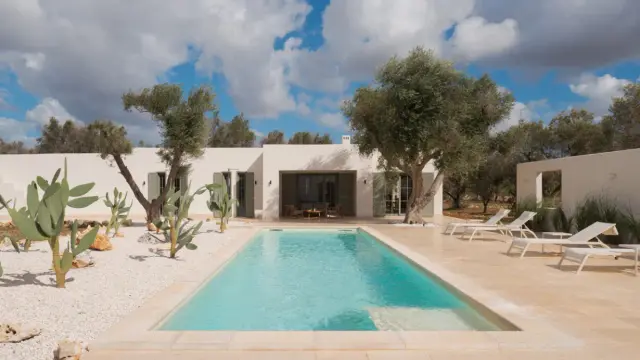
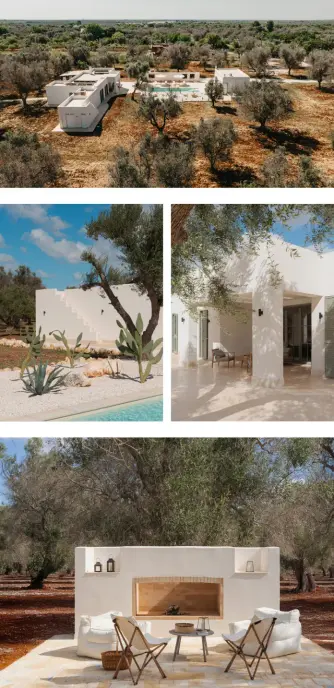
The single-story main villa reads immediately as local. Its white-plastered facade, softened edges, and external staircase leading to a walkable flat roof belong to a centuries-old building typology in southern Italy. The chimney, the traditional pillars, the walls built from local tufo stone, the reed-covered shading structures, the floors of pietra Leccese—none of these are decorative. Each is a functional and cultural decision that connects the building to its territory.
Green-grey window frames set against the luminous white walls introduce a chromatic note that echoes the silver-green of the surrounding olive trees. This is not an accident. It is what I would call “palette anchoring”: the deliberate alignment of a building’s color language with the dominant hues of its immediate landscape. The effect is subtle but powerful. The villas feel as though they have absorbed their surroundings rather than been dropped into them.
The smaller villa—adapted from an existing agricultural structure—takes this regional embeddedness even further. Its designers gave it a deliberately older character, a distinct architectural personality that differentiates it from the main villa. Two ceramic Pina figures crown its roof, a traditional Apulian good-luck symbol. This kind of cultural specificity is rare in contemporary holiday architecture. It signals that the designers actually looked at—and listened to—the place.
The Investment Case for High-Design Mediterranean Holiday Retreats
Let’s be direct about something: Villa Normanni is an investment property. It was conceived, funded, and built with rental income and capital appreciation in mind. The budget came from the sale of two Prague apartments. This financial transparency is worth acknowledging because it reframes the project as something beyond a personal passion project—it is a model for intelligent lifestyle investment in the southern European holiday villa market.
Apulia is still relatively underpriced compared to Tuscany or the Amalfi Coast, but that gap is closing fast. Tourism to the region has grown significantly over the past decade. Alberobello, Ostuni, Lecce, and now lesser-known coastal towns like San Vito dei Normanni are attracting a more design-literate, experience-driven traveler demographic—exactly the kind of guest willing to pay a premium for a villa that feels genuinely considered rather than generically luxurious.
The project spans 206 m² of built-up area, with 124 m² of usable floor space in the main villa and 41 m² in the smaller apartment. The main villa offers three ensuite bedrooms around a central living, dining, and kitchen space. Supporting facilities like laundry and storage are discreetly separated. This layout reflects a clear understanding of how premium holiday guests actually use space: they want privacy, they want flow, and they want the indoor-outdoor threshold to almost disappear.
Large folding windows in both villas orient every main living space toward the pool and the olive grove. This is prospect architecture—the deliberate framing of natural views as the primary interior experience. When you sit at the dining table or wake up in any of the three ensuite bedrooms, the landscape is always present. That is not incidental. It is the entire point.
How the Outdoor Sequence Works
The outdoor program of Villa Normanni deserves its own analysis. Pergolas, verandas, an outdoor kitchen, a fireplace terrace, a sun deck with pool, and covered parking form a carefully layered sequence of exterior rooms. Each serves a distinct function and a distinct social dynamic. The outdoor kitchen anchors the evening entertaining ritual. The fireplace terrace extends the usable season into autumn and early spring. The sun deck and pool create the visual centerpiece that every successful holiday rental requires.
Together, these elements constitute what I call a transitional landscape program—a series of designed thresholds that mediate between the interior and the raw Mediterranean environment. This is not unusual in Apulian vernacular architecture, but the execution here is more spatially articulate than most. The pergolas reference local reed-covered agricultural shelters without becoming a nostalgic pastiche.
Interior Design That Resists the Obvious
Inside, the design philosophy is best described as textural restraint. Wood, linen, rattan, and stone provide the material vocabulary. The palette is quiet: off-whites, warm neutrals, and the occasional dark note. Most of the furnishings came from the Czech Republic, supplemented by custom-made pieces produced locally. This hybrid sourcing strategy reflects a practical reality of international design projects—you bring what you know and trust, and you fill the gaps with what you find.
What is striking about the interiors is how much atmosphere they generate with so little visual noise. The diverse textures do the heavy lifting. Rough stone against smooth linen. Warm rattan against cool Pietra Leccese floors. Natural wood against white plaster walls. Each pairing creates a sensory contrast that keeps the spaces engaging without overwhelming them.
This is the opposite of the maximalist interior design trend that has dominated holiday villa imagery in recent years. Villa Normanni does not try to be a mood board. It tries to be a place-specific, tactile, and calm. For a design editor, this kind of restraint is harder to achieve and, ultimately, more satisfying to inhabit.
The Role of Natural Materials in Mediterranean Retreat Design
The choice to build and finish Villa Normanni almost entirely in natural materials is both aesthetic and climatic. Stone walls regulate temperature passively. Linen breathes. Rattan is light and tactile. Wood ages gracefully in humid coastal environments when properly treated. These are materials that improve with time rather than degrading against the backdrop of Mediterranean heat and salt air.
This is what I call “material climate intelligence”—the selection of finishes and furnishings based not only on how they look but on how they perform in a specific climate over a ten-to-twenty-year horizon. It is a design discipline that most short-term holiday rentals ignore entirely, to their eventual cost.
Technical Systems: Self-Sufficiency as a Design Value
Villa Normanni is technically designed for year-round habitation. Full air conditioning and heating systems serve both structures. Solar panels meet local renewable energy requirements. A 200-meter well—successfully completed on the second drilling attempt—supplies fresh water. A cistern harvests and recycles rainwater. The parking area includes an electric vehicle charging station.
These are not luxury add-ons. They are the infrastructure of serious self-sufficiency. Given the energy demands of air conditioning in a southern Italian summer—and the water management challenges of a site in the Apulian hinterland—the designers placed particular emphasis on what I call operational autonomy: the capacity of the villa complex to function independently of municipal supply infrastructure for extended periods.
This level of technical specification is unusual in private holiday villa development. It reflects the investment seriousness behind the project. A villa that runs efficiently, consumes its own solar energy, recycles its own rainwater, and charges its guests’ electric vehicles commands both higher daily rates and lower operating costs. That combination is the core of long-term yield optimization in the luxury holiday rental market.
Urban Interior’s Design Methodology: What “Grounded Minimalism” Actually Means in Practice
Studio Urban Interior’s approach to Villa Normanni introduces what I consider a distinct and replicable design methodology for Mediterranean retreat architecture. I define grounded minimalism as the practice of achieving spatial and visual simplicity through material specificity rather than material reduction. You do not strip a room bare and call it minimal. Instead, you select fewer materials, use each one with absolute confidence, and allow their inherent character to carry the entire atmospheric weight of a space.
This is different from the Scandinavian minimalism that dominates contemporary interior design discourse—that tradition privileges lightness, whiteness, and formal reduction. Grounded minimalism, as practiced at Villa Normanni, privileges texture, weight, and rootedness. The spaces feel anchored. They feel as though they belong to a specific latitude and a specific history.
This methodology has real implications for the broader field of Mediterranean retreat design. As the holiday villa market in southern Italy matures and becomes more competitive, the projects that will command premium pricing and media attention are those that demonstrate genuine design intelligence rather than superficial regional theming. Villa Normanni sets a clear standard.
Why Apulia Is the Right Place at the Right Time
The regional context matters enormously here. Apulia is emerging as one of southern Europe’s most compelling design destinations. Its architectural vernacular—trulli, masserie, tufo stone construction, and pietra Leccese details—provides a rich visual and material vocabulary that serious designers can work with substantively rather than superficially.
At the same time, Apulia remains accessible from a construction cost and land price perspective in ways that Tuscany or the Algarve no longer are. The window for smart investment is open, but it will not stay open indefinitely. Projects like Villa Normanni, which combine investment intelligence with genuine design quality, represent exactly the kind of development that accelerates a region’s transition from “undiscovered” to “established” on the international design and travel circuit.
San Vito dei Normanni itself sits in the Brindisi province, positioned between Ostuni to the west and the Adriatic coast to the east. It is close enough to the tourist infrastructure of the Valle d’Itria to benefit from its cultural cachet, and far enough from the crowds to offer genuine tranquility. For a holiday villa complex whose central design value is calm, this is exactly the right location.
The Photographer’s Role in How Villa Normanni Will Be Seen
The project was photographed by Cosimo Calabrese and Duotono Fotografia. This is worth noting because architectural photography is not a neutral act. The photographers who document a project shape how it will be understood, referenced, and shared across digital platforms. The right photographic vision amplifies a project’s design qualities; the wrong one flattens them.
For a project like Villa Normanni, where the quality of light—that particular Apulian late-afternoon gold—is integral to the architectural experience, photographers who understand Mediterranean light are essential. The documentation of this project will determine whether it circulates as a serious piece of design culture or gets lost in the visual noise of the holiday architecture genre.
What Villa Normanni Teaches the Broader Field
Every significant design project offers lessons that extend beyond its own boundaries. Villa Normanni offers several. First: investment properties do not have to compromise on design quality. The budget discipline that comes from financing a build through the sale of existing assets can focus a designer’s mind rather than limit it. Second: regional authenticity is not achieved through surface-level borrowing. It requires genuine research, material commitment, and a willingness to subordinate personal aesthetic preferences to the genius loci of a specific place.
Third: the outdoor sequence is as important as the interior program in Mediterranean retreat design. The transitional spaces—the verandas, pergolas, terraces, and pool decks—are where guests actually live. Designing these with the same rigor applied to the interior is what separates a well-designed villa from a merely comfortable one. Fourth: technical self-sufficiency is becoming a design value, not just a regulatory requirement. In a climate where energy costs are rising, and water scarcity is a growing concern across southern Europe, the ability of a building to generate its own power and manage its own water is increasingly central to both its environmental credentials and its investment case.
Villa Normanni gets all four of these right. That is why it matters.
A Personal View
I find myself returning, again and again, to the image of those green-grey window frames against the white walls, with the olive grove just beyond them. There is something profoundly right about that relationship. It is the kind of architectural decision that looks effortless but is actually the result of sustained attention to color, to context, and to the specific quality of Apulian light. That quality of attention is what distinguishes Villa Normanni from the many holiday villas that get built in southern Italy every year and then forgotten.
This is a project that deserves to be studied, referenced, and argued about. Not because it is radical or formally experimental, but because it is genuinely good. In a field where design quality is often sacrificed to speed, budget pressure, or the tyranny of the rental platform aesthetic, genuinely good is rare enough to celebrate.
Frequently Asked Questions About Villa Normanni
Where is Villa Normanni located?
Villa Normanni sits in Contrada Usciglio, San Vito dei Normanni, in the Brindisi province of Apulia, southern Italy. The site is surrounded by olive groves and positioned between the Adriatic and Ionian coasts.
Who designed Villa Normanni?
The project was designed by studio Urban Interior. The design’s author was Markéta Killí, whose husband Lars Killi was also actively involved as a creative professional. Together, they are the clients and co-creators of the project.
When was Villa Normanni completed?
Villa Normanni was completed in 2025.
What is the size of the Villa Normanni complex?
The complex has a total built-up area of 206 m². The main villa offers 124 m² of usable floor space, and the smaller villa provides 41 m².
What are the sustainable features of Villa Normanni?
The villas are equipped with solar panels for renewable energy production, a 200-meter well for fresh water supply, a cistern for rainwater harvesting and reuse, and an electric vehicle charging station in the parking area. The design places strong emphasis on operational self-sufficiency and year-round energy efficiency.
What local materials did the designers use?
The construction and finishing draw heavily on regional Apulian materials, including tufo stone for the walls, pietra Leccese for the floors, and reed-covered shading structures. These choices are both culturally and climatically appropriate.
How many bedrooms does Villa Normanni have?
The main villa offers three ensuite bedrooms around a central living, dining, and kitchen area. The smaller villa functions as a self-contained apartment with one bedroom, a living room, a kitchen, and a bathroom.
What is the design philosophy behind Villa Normanni?
The project applies a methodology of grounded minimalism—achieving spatial simplicity through material specificity rather than reduction. Natural materials, including wood, linen, rattan, and stone, define interiors that are restrained but tactile and warm. The architectural language draws directly from the Apulian vernacular tradition.
Who photographed Villa Normanni?
The project was documented by photographers Cosimo Calabrese and Duotono Fotografia.
Is Villa Normanni available as a holiday rental?
The project was conceived as an investment property designed for the high-end holiday rental market. Its layout, outdoor program, and technical systems are all configured for premium guest use. Specific rental availability should be confirmed directly with the owners or through authorized booking channels.
Take a look at WE AND THE COLOR’s architecture category for more.
#architecture #italy #UrbanInterior #villa #VillaNormanni