 Cosmin Saveanu
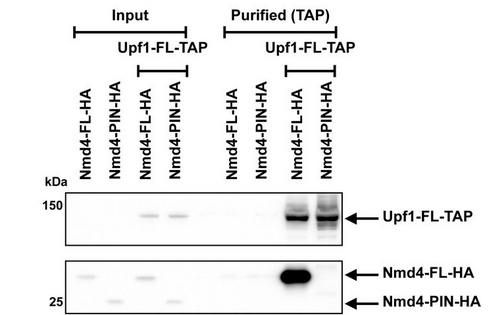
In a recent pre-print for a project led by Gwenael Badis and with the first author Toni Gouhier, we show that #Upf1, the core helicase of nonsense-mediated mRNA decay (#NMD), can selectively bind short poly(A) RNA and help their degradation. This is a new function for NMD!
Images show the levels of short poly(A) tailed RNA in the Upf1-associated RNA fraction and the impact of the absence of Upf1 on the levels of this particular population (for a reporter).
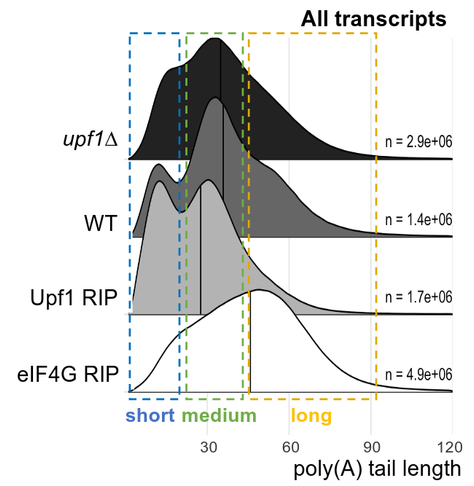
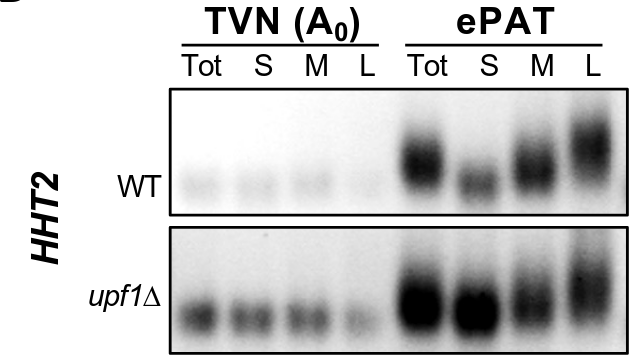

Most Upf1-associated mRNAs have short poly(A) tails, lack a premature termination codon and are targeted by NMD.
Nonsense-mediated mRNA decay (NMD) is a conserved eukaryotic surveillance pathway known to degrade mRNAs containing premature termination codons (PTCs). A distance long enough between the stop codon and the poly(A)-binding protein (Pab1) is required for mRNA recognition by the NMD factors Upf1, Upf2 and Upf3. Using Nanopore direct RNA sequencing, we show that PTC-containing NMD targets account for only 6% of Upf1-associated RNA and have long poly(A) tails, indicating that Upf1-binding occurs prior to RNA deadenylation. Conversely, most Upf1-associated mRNAs have short poly(A) tails, lack a PTC and correspond to highly expressed genes. A short poly(A) tail is thus an important feature of NMD targets, redefining the scope of this RNA degradation pathway. We propose a model in which loss of Pab1-binding to short poly(A)-tailed mRNAs impairs translation termination and dictates the recruitment of the NMD machinery, uncovering a hitherto unknown role of NMD in the degradation of these transcripts. ### Competing Interest Statement The authors have declared no competing interest.