#Tropetember Day 30

The final trope of the month, very deliberately so, mirrors the final step of Joseph Campbell's monomyth, where the lead character(s), after having been transformed by their experience, make a new life for themselves with the help of their new expertise. It is very easy to subvert/alter this ending, and there are many variants of it, but Happily Ever After remains popular, because rewarding the audience, trusting in their investment, has proven to be a strong factor in the

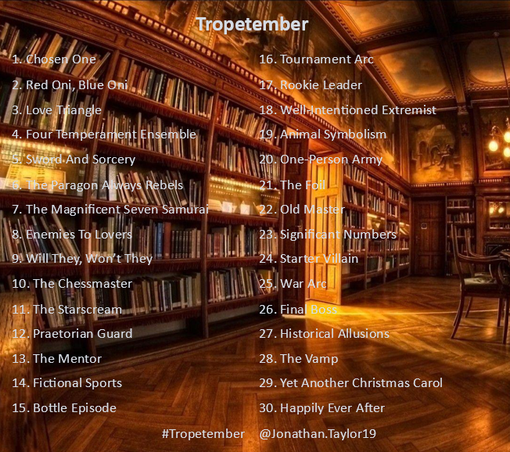
#Tropetember Day 29

Another trope that is both a long name and an allusion to a preexistent piece of fiction, this time referencing A Christmas Carol, where a character with a variety of status and/or personality signifiers goes on an adventure reminiscent of the one Dickens first described within his book. Surprisingly, this story wasn't just done as adaptations and remakes of the original, but also taking its various elements and utilising them with new casts. It doesn't even have to be set

#Tropetember Day 28

One of the oldest, and arguably the first prominent, trope of the art of cinema, The Vamp is a character, usually female, usually a villain, rarely a main villain, who utilises seductive ability in order to tempt the lead(s) away from their goal/quest/task. As women's rights progressed, and therefore the influence women had in society besides their sexuality expanded, this trope became another in a list of stock cinematic archetypes that could be ignored. The archetype was,

#Tropetember Day 27

Not much to say about today's entry, it's about including references to people or events from history. That could be as easy as a character sharing a name with a historical figure all the way to using a series of historical events as a plot blueprint. The reasons behind this vary from showing off to creating narrative parallels, adding context to the story and granting it additional symbolic weight.

When done poorly, it turns the narrative into a game of mad-libs,

#Tropetember Day 26

If your leads are facing off against more than one villain(ous ourganisation), one of them will, logically, be the last they face. This last enemy will be the embodiment/culmination of the struggles the characters will have faced up until reaching this main threat towards themselves and the rest of the world, with the defeat of this character representing the final triumph of the leads, and the culmination of the narrative intention fueling the events of the story.

#Tropetember Day 25

It's another one of those tropes with a not-distinctly-straightforward definition today. The briefest, most all-encompassing I could mention is 'any story arc where the lead characters participate in a war.' Whether the leads actively organise the war or are simply passing through as it rages around them, or they're conscripted to fight within it, is secondary to the trope, but crucial to its execution. What brings the leads in the war? What is their motivation to fight?

#Tropetember Day 24

If your narrative features more than one villain(ous party), one of them will, logically, be the first one the lead(s) will encounter. That villain will be the first obstacle the leads will have to overcome on their journeys/developments, their defeat the first milestone of the narrative. As such, in small ways, the Starter Villain will be a representation of the challenges awaiting them, a display of the skills and principles they will have to familiarise themselves with in

#Tropetember Day 23

Given it was his birthday recently: do you know how Stephen King often includes the number 19, or number that add up to that, within his works? That's what this trope is about, numbers that are granted specific meaning and emphasis, at least within the narrative frame, on account their relevance to story progression or setting development. Why would authors do that? Partly because they feel like it, partly to pay homage to something they like, as an easter egg, or because

#Tropetember Day 22

No, this isn't a repeat of Day 13, though an Old Master can be a Mentor as well. So, if the topic of the current day isn't a repetition, what is it? Simply put, it's about an old(er) character who displays mastery within the interest of the lead characters. Originating in Antiquity, it's initial message was 'deference to the elders,' however, in more recent times, as age lost its prestige, it became a reminder of not underestimating others, with 'seeing with your soul'

#Tropetember Day 21

The name of this trope comes from jewelry, given jewelers would often place gems on foil, in order for it to appear brighter to potential buyers. Narrative foils have a similar function, highlighting various aspects of a character, or a system/organisation, by contrasting them to those of a similar entity. Foils can be created out of whole cloth, or emerge through the interactions the various story entities have with each other, allowing each of them to define themselves