Just came across this nice study by Davidescu et al.

https://www.pnas.org/doi/10.1073/pnas.2206163120

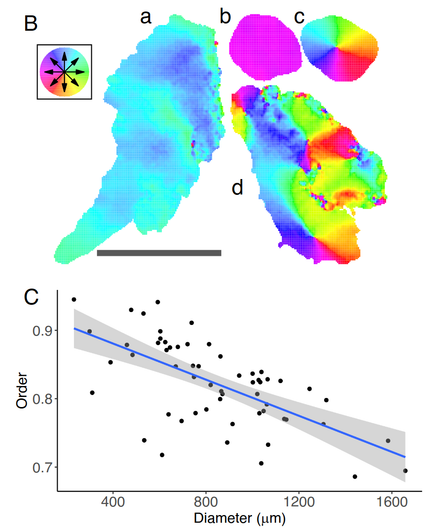
Larger bodies in the placozoan Trichoplax show less coordination across cells.

"We quantify the trade-off between increasing size and coordination in a multicellular animal with a decentralized anatomy that shows evidence of criticality and hypothesize as to the implications of this on the evolution hierarchical structures such as nervous systems in larger organisms."

#Trichoplax #collectiveBehaviour #evolution

The simple #marine animal #Trichoplax utilizes an ancient, bacteria-derived lysozyme for acidic extracellular digestion, proving that essential animal immune mechanisms evolved from early digestive processes.
#EvolutionaryBiology #MarineBiology #Immunology #sflorg
https://www.sflorg.com/2026/02/ebio02112601.html
Tiny marine animal reveals bacterial origin of animal defence mechanisms

Marine animals, such as the extremely simple flatworm Trichoplax, are ideal model organisms for studying the early evolutionary origins

Multicellular organisms without a nervous system behave like a swarm, finds study

Coordination between individuals is a fundamental challenge in collectives, and this is just as true for a country's government as it is for simple multicellular organisms. How does a group of many cells coordinate itself into a body that performs coherent behavior? In more evolved animal groups, that's the nervous system's job.

Phys.org