 Daniel Fischer
The First Radio-bright Off-nuclear #TidalDisruptionEvent AT 2024tvd Reveals the Fastest-evolving Double-peaked Radio Emission: https://iopscience.iop.org/article/10.3847/2041-8213/ae0a26 -> Astronomers Discover Fastest-Evolving Radio Signals Ever Observed from Black Hole Tearing Apart Star: https://public.nrao.edu/news/astronomers-discover-fastest-evolving-radio-signals-ever-observed/ - NRAO telescopes reveal first radio-bright "off-nuclear" tidal disruption event, showing unprecedented double-peaked radio emission -> Investigation of the First Radio-Bright Off-Nuclear Tidal Disruption Event: https://aasnova.org/2025/10/15/investigation-of-the-first-radio-bright-off-nuclear-tidal-disruption-event/
The 6 year radio lightcurve of the #TidalDisruptionEvent AT2019azh: https://arxiv.org/abs/2509.17525 -> Long-term radio observations track the evolution of a tidal disruption event: https://phys.org/news/2025-09-term-radio-track-evolution-tidal.html

The 6 year radio lightcurve of the tidal disruption event AT2019azh
Analysis of radio emission from tidal disruption events allows for detailed constraints on the properties of ejected outflows and the host environment surrounding the black hole. However, the late-time radio behaviour of tidal disruption events is not well-studied due to a lack of observations. In this work we present long-term radio monitoring observations of the tidal disruption event AT2019azh spanning 1167-2159 days post disruption. We fit a physically motivated synchrotron model to the radio spectra at each epoch, and model the decay of the light curve under the assumption that the outflow transitions into the non-relativistic Sedov-Taylor regime at late times. Through this modelling we obtain strong constraints on the density profile of the circumnuclear medium, finding an unusually flat density profile proportional to $r^{0.24^{+0.11}_{-0.15}}$. Overall we find that unlike some tidal disruption events, AT2019azh does not show late time re-brightening up to 6 years post-disruption. The Sedov-Taylor light curve decay model provides a good fit to the data, motivating the assumption that the outflow was produced by a single ejection of material close to the time of stellar disruption. From forward modelling the evolution of the radio light curve decay we predict that the radio afterglow from AT2019azh should be detectable for decades at its current rate of evolution.
 AlcorNews
Un trou noir engloutit tout rond une étoile et déclenche un type inédit de supernova en lieu et place d'un bon vieux rot ! 🌌 Quelles surprises cache l'univers?
https://www.geo.fr/sciences/en-avalant-une-etoile-un-trou-noir-provoque-un-genre-inedit-de-supernova-228143
#Space #Science #Innovation #Astrophysics #BlackHole #TidalDisruptionEvent #Supernova #AstroAlert
https://www.geo.fr/sciences/en-avalant-une-etoile-un-trou-noir-provoque-un-genre-inedit-de-supernova-228143
#Space #Science #Innovation #Astrophysics #BlackHole #TidalDisruptionEvent #Supernova #AstroAlert

En avalant une étoile, un trou noir provoque un genre inédit de supernova
Une étude récente révèle qu'une supernova découverte en 2023 serait bien plus exceptionnelle qu'on ne le croyait. Il s'agirait probablement d'une bataille gravitationnelle déchaînée entre un trou noir et une étoile massive sur le point de mourir.
Continued Rapid Radio Brightening of the #TidalDisruptionEvent AT2018hyz: https://arxiv.org/abs/2507.08998 -> Thread https://bsky.app/profile/whereisyvette.bsky.social/post/3ltzjx56oc226
Continued Rapid Radio Brightening of the Tidal Disruption Event AT2018hyz
We present ongoing radio observations of the tidal disruption event (TDE) AT2018hyz, which was first detected in the radio at 972 days after disruption, following multiple non-detections from earlier searches. The new observations presented here span approximately 1370-2160 days and 0.88-240 GHz. We find that the light curves continue to rise at all frequencies during this time period, following a power law of about F ~ t^3 (compared to F_nu ~ t^5.7 at 972-1400 days), and reaching a peak luminosity of L~ 10^40 erg/s, comparable to the luminosity of the relativistic TDE Swift 1644+57 on the same timescale. The multi-frequency data indicate that the peak frequency does not significantly evolve over the 1030-day span of our observations, while the peak flux density increases by an order of magnitude. The observed behavior is consistent with two possible scenarios: (i) a delayed spherical outflow launched about 620 days post-disruption with a velocity of ~0.3c and an energy of ~10^50 erg, and (ii) a highly off-axis (~80-90 deg) relativistic jet with a Lorentz factor of Gamma ~8 and E_K ~ 10^52 erg. Continued radio observations to capture the light curve peak, as well as VLBI observations, could distinguish between these scenarios.
 Unofficial PetaPixel Bot
Hubble Captures Rogue Black Hole ‘Eating’ a Star https://petapixel.com/2025/05/20/hubble-captures-rogue-black-hole-eating-a-star/ #hubblespacetelescope #tidaldisruptionevent #celestialobjects #interstellar #lightyears #blackhole #Space #News #NASA #star

A Massive Black Hole 0.8 kpc from the Host Nucleus Revealed by the Offset #TidalDisruptionEvent AT2024tvd: https://arxiv.org/abs/2502.17661 -> Not one, but two massive black holes are eating away at this galaxy: https://news.berkeley.edu/2025/05/08/not-one-but-two-massive-black-holes-are-eating-away-at-this-galaxy/
A Massive Black Hole 0.8 kpc from the Host Nucleus Revealed by the Offset Tidal Disruption Event AT2024tvd
Tidal disruption events (TDEs) that are spatially offset from the nuclei of their host galaxies offer a new probe of massive black hole (MBH) wanderers, binaries, triples, and recoiling MBHs. Here we present AT2024tvd, the first off-nuclear TDE identified through optical sky surveys. High-resolution imaging with the \textit{Hubble Space Telescope} shows that AT2024tvd is $0.914\pm 0.010^{\prime\prime}$ offset from the apparent center of its host galaxy, corresponding to a projected distance of $0.808\pm 0.009$ kpc at $z=0.045$. Chandra and VLA observations support the same conclusion for the TDE's X-ray and radio emission. AT2024tvd exhibits typical properties of nuclear TDEs, including a persistent hot UV/optical component that peaks at $L_{\rm bb}\sim 6\times 10^{43}\,{\rm erg\,s^{-1}}$, broad hydrogen lines in its optical spectra, and delayed brightening of luminous ($L_{\rm X,peak}\sim 3\times 10^{43}\,{\rm erg\,s^{-1}}$), highly variable soft X-ray emission. The MBH mass of AT2024tvd is $10^{6\pm1}\,M_\odot$, at least 10 times lower than its host galaxy's central black hole mass ($\gtrsim 10^8\,M_\odot$). The MBH in AT2024tvd has two possible origins: a wandering MBH from the lower-mass galaxy in a minor merger during the dynamical friction phase or a recoiling MBH ejected by triple interactions. Combining AT2024tvd with two previously known off-nuclear TDEs discovered in X-rays (3XMM J2150 and EP240222a), which likely involve intermediate-mass black holes in satellite galaxies, we find that the parent galaxies of all three events are very massive ($\sim 10^{10.9}\,M_\odot$). This result aligns with expectations from cosmological simulations that the number of offset MBHs scales linearly with the host halo mass.
 scinexx - das wissensmagazin
18 Sternentode auf einen Streich. Astronomen entdecken zuvor verborgene Sternzerstörungen durch Schwarze Löcher. #TidalDisruptionEvent #SchwarzesLoch #Astronomie #Sternentod
https://www.scinexx.de/news/kosmos/18-sternentode-auf-einen-streich/
https://www.scinexx.de/news/kosmos/18-sternentode-auf-einen-streich/

 heise online
Astronomie: Schwarzes Loch verschlingt gleichen Stern in mehreren Etappen
Einem Forschungsteam ist eine besondere spektakuläre Entdeckung gefunden: Ein Schwarzes Loch, das einem Stern mehrfach Teile entreißt, ohne ihn zu verschlingen.
#Astronomie #Astrophysik #erosita #schwarzesLoch #stern #tidaldisruptionevent
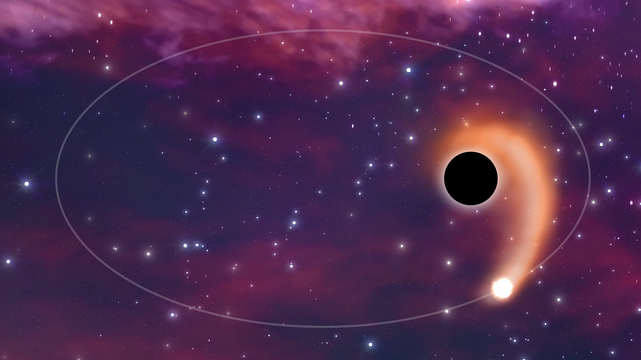

 Ansgar Schmidt
Astronomers witness unprecedented corona formation, evolution around black hole https://www.nasaspaceflight.com/2023/01/nustar-black-hole/ #tidaldisruptionevent #astrophysics #blackholes #astronomy #at2021ehb #featured #uncrewed #nustar #nicer #other #swift #ztf

A Black Hole Consumed a Star and Released the Light of a Trillion Suns https://www.universetoday.com/158919/a-black-hole-consumed-a-star-and-released-the-light-of-a-trillion-suns/ #supermassiveblackhole(smbh) #tidaldisruptionevent #time-domainastronomy #relativisticjets #blackholes #transients #astronomy #stars
