 Kirst Mason D'Raven
The Nice List is a Lie.
There’s a peculiar kind of myth we cling to at this time of year. It’s laminated, colour-coded, and suspiciously well-behaved. The ‘Nice List’.
A tidy little fiction that suggests winter is a simple moral transaction:
behave yourself, receive reward; misstep, get coal (or more likely, a gently worded conversation and another chocolate anyway).
It’s comforting. It’s neat.
And it’s absolute nonsense.
Because no winter tradition worth its frost ever worked like that.
Before lists, before stars and stickers and reward charts, winter had ‘watchers’. And they didn’t care if you smiled for the camera.
Winter, historically speaking, was not designed to be gentle. It was long, hungry, dark, and unforgiving. Communities survived it by cooperation, discipline, memory, and a very clear understanding of boundaries. Folklore wasn’t entertainment, it was infrastructure. Stories told children where danger lived, how to behave when adults weren’t watching, and what happened when selfishness tipped into risk.
So instead of a kindly overseer tallying up good deeds, winter gave us judges.
Not judges in robes and wigs, but roaming figures who appeared when the nights were longest and the rules mattered most. They didn’t just reward. They ‘assessed’. They tested manners, honesty, industry, respect. And they delivered consequences that were immediate, memorable, and sometimes deliberately frightening.
Fear wasn’t a bug in the system.
It was the point.
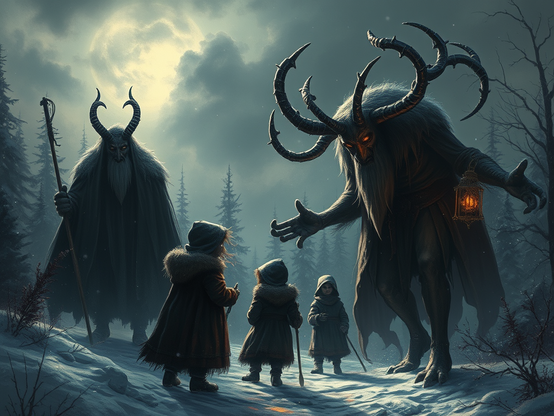
Take Belsnickle, ragged and unpredictable, turning up unannounced weeks before Christmas. He didn’t arrive on schedule and he didn’t consult a list. He looked children in the eye. Asked questions. Watched how they answered. He scattered treats on the floor for the worthy and carried a switch for those who thought they could bluff their way through winter.
Or Krampus, dragging chains through Alpine villages, embodiment of consequence rather than punishment. He wasn’t interested in mild mischief. He appeared when boundaries were crossed. When selfishness, cruelty, or laziness threatened the group. He was what happened when warning stories stopped working.Then there’s Frau Perchta, far more unsettling than any horned demon. She didn’t judge children for noise or naughtiness. She judged homes. Spinning undone. Bread poorly baked. Domestic order neglected. In a world where these tasks meant survival, Perchta wasn’t cruel. She was practical. Her judgements were visceral because the stakes were.
Père Fouettard, too, trailing behind Saint Nicholas in parts of France and Belgium, carried the memory of wrongdoing. He didn’t erase it. He reminded.
Shame, in these traditions, wasn’t about humiliation. It was about correction and reintegration.
Even the winter hag – the crone, the Cailleach, the old woman of frost and stone – wasn’t evil. She measured endurance. She watched who prepared, who wasted, who respected the season’s power.
None of them offered unconditional rewards.Winter didn’t do unconditional.
And this is where the Nice List quietly falls apart.
The idea that goodness is a static state, that behaviour can be tallied neatly across a year, that judgement is distant and abstract – that’s a modern comfort. It belongs to a world buffered by heating, supermarkets, and artificial light. It assumes safety.
Older winters assumed nothing.
They understood that children – and adults – needed stories that ‘watched us back. Stories that didn’t vanish when the door closed. Stories that lingered in the dark corners of the room and reminded you that your choices mattered even when no one was clapping.
That’s why these figures were so often messy, frightening, morally ambiguous. They weren’t meant to be cuddled. They were meant to be ‘Remembered’.
Of course, as Christmas softened, polished by Victorian sentimentality and later commercial necessity, the judges were gently ushered out. They were too loud. Too frightening. Too honest. You can’t sell terror easily, and you can’t market moral complexity to children.
So the watchers were diluted.
Judgement became outsourced. Behaviour became transactional. Fear became embarrassment. Consequence became optional.
The Nice List stepped in where winter once stood.
But folklore has a habit of waiting.
Because look around – truly look – and you’ll see them creeping back in through the cracks.
Krampusnacht fills streets again. Dark folklore thrives online. Winter rituals are reclaimed. Horror films peak in December. We joke about being watched. We pretend it’s ironic, but something older stirs beneath the humour.
In a world that feels increasingly unstable, we’re drawn back to stories that acknowledge darkness instead of pretending it doesn’t exist. Stories that admit winter is hard, that survival requires cooperation, that actions ripple outward.
We don’t actually want a list.
We want meaning.
And maybe that’s why this myth still itches. Because deep down, we know that no ancient winter ever promised reward without responsibility. No watcher ever counted smiles. No judge ever cared about performative goodness.They cared about honesty. About effort. About respect – for people, for place, for season.
As the year thins toward its end and the light stays low and grey, perhaps the old figures are closer than we think. Not lurking under beds or rattling chains, but quietly reminding us that winter has always asked something of us.
Not perfection.
Not cheer.
Just awareness.
The Nice List is a lie.
But the watchers?
They were never imaginary.
#ChristmasTraditions #Folklore #FrauPercht #Krampus #NaughtyOrNice #TheNiceList