 Dobviews
Quick Astro Fact - Sun
https://youtube.com/shorts/n5KyZsxRMng?si=55rYPxJwSz96nDbX
#astronomy
#sun
#sunspot
#educationalshorts
#photography
#astrophotography
#smartphoneastronomy
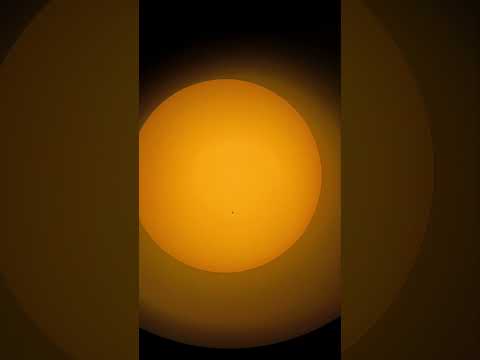
Quick Astro Fact - Sun
https://youtube.com/shorts/n5KyZsxRMng?si=55rYPxJwSz96nDbX
#astronomy
#sun
#sunspot
#educationalshorts
#photography
#astrophotography
#smartphoneastronomy
Oh I'm sure it'd take the mother of all tinted windows to stop it from blinding you, but imagine being on a solar sail, making a fly-by to gain speed to your final destination, and then seeing *this* out your window. The ultimate scenic route, in my own painting, "Reach for the light".
#art #digitalart #digitalpainting #painting #scifi #scifiart #spaceart #spaceflight #solarsail #spacecraft #sun #star #sunspot
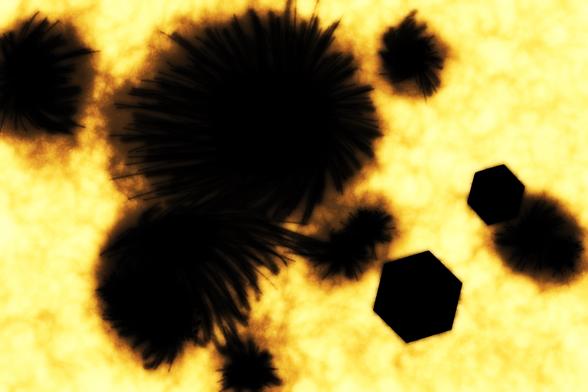

Witnessing Magnetic Reconnection in Tangled Superpenumbral Fibrils around a Sunspot, Chen, Hechao, Tian, Hui, Priest, Eric R., Prior, Christopher B., Xia, Chun, Yeates, Anthony R., Yan, Xiaoli, Duan, Yadan, Hou, Zhenyong, Huang, Zhenghua, Rice, Oliver E. K.
#ActiveSunspotRegion4366 Crosses the #Sun
#Astronomy #Picture of the Day


From #SolarHam - Progression of new #Sunspot #AR4366 (not yet Earth-facing, but will be soon):
"Sunspot Watch
January 31, 2026 @ 04:15 UTC
Newly assigned sunspot region 4366 continues to gradually develop as it turns into view in the northeast quadrant. It is currently producing minor C-Class flares and it is likely now a threat for a moderate M-Flare. Something to keep an eye on this weekend. Image by SDO/HMI.
Growing Flare Threat
January 31, 2026 @ 14:50 UTC
AR 4366 continued to expand over the past 12 hours in both size and magnetic complexity. The region has a Beta-Delta magnetic configuration and is producing frequent mid level minor C-Flares. A moderate M-Flare will remain possible on Saturday.
M6.6 Solar Flare
February 1, 2026 @ 10:40 UTC
Solar activity increases even further with an M6.6 solar flare peaking at 10:02 UTC (Feb 1). The source, AR 4366, is magnetically complex and is now a threat for an isolated X-Flare. Image below by SDO/AIA.
High Solar Activity
February 1, 2026 @ 16:50 UTC (UPDATED)
What a difference a few days make on the Sun. Active sunspot region 4366 turned into a firecracker on Sunday with at least fifteen M-Class solar flares and one X-Flare (so far). Despite the brightness of these events, the mechanics have so far failed to launch any noteworthy coronal mass ejections into space and towards our planet. That could change over the next few days as the region continues to develop and currently sports a Beta-Gamma-Delta magnetic configuration. More solar flares including another X-Flare will remain possible.
[And today...]
Impulsive X8.1 Solar Flare
February 2, 2026 @ 00:10 UTC
An impulsive X8.1 solar flare was just detected peaking at 23:57 UTC (Feb 1). This is the second strongest flare in terms of peak X-Ray flux of the current solar cycle. Although a bright flare, new imagery suggests that if a CME is associated, it will likely be fairly mild. Stay tuned to SolarHam where you will get the most up to date and accurate information regarding this space weather event."
#SolarFlares #SolarCycle25 #KesslerEffect #KesslerSyndrome #XClassFlares
🚨 BIG SUNSPOT ALERT 🚨
Sunspot 4366 didn’t exist days ago—now it’s nearly 10× wider than Earth and already fired off a triple-peaked M7–X1–M6 solar flare lasting over 6 hours. Its unstable magnetic field means more flares are likely. A radio blackout followed… and space weather may not be done yet.
Track it live: https://spaceweather.com/
#Sunspot #SolarFlare #SpaceWeather #Sunspot4366 #XClassFlare #Astronomy

“Both NOAA and SOHO coronagraphs have detected a full halo storm cloud heading directly for Earth. NASA and NOAA models agree that the #CME will arrive Dec. 9th:”
“The impact could spark G2 (Moderate) to G3 (Strong) category geomagnetic storms. Mid-latitude auroras mixed with moonlight are possible if the storm reaches the upper end of this range. "
 Adamas Nemesis
 Daniel Fischer
 LidoHZ
 Khurram Wadee ✅
 Santiago Andrés Triana
 Amy
Amy DoomsdaysCW
 Westport Observatory
 skry
skry