Not really a nightmare as it wasn't so bad. For the most part everything worked the way it was supposed to and I didn't need to do a bazillion takes for the different setups.

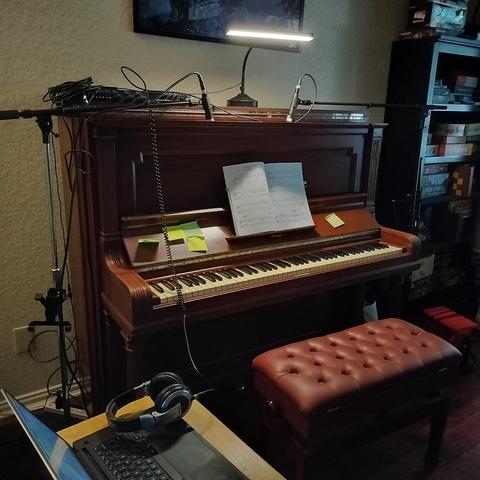
I took the day off so I could have the house to myself specifically to try this (and mess about with the sax hopefully after lunch). I tested with my Shure PGA81, Sennheiser MK4, and two SM57's to mess with stereo.

I tried recording from the back, from the top, and from the front-floor (with the panel removed). I didn't try from the top front as I've already experimented with that.

Interestingly I think I like the bottom front the most with from the top being the 2nd best. The problem with the top is it picks up a lot of mechanical noise of the piano, but since the mics are effectively inside the piano, it rejects a lot of outside noise which is nice.

I liked the sound of the PGA81 over the MK4. The SM57's had a nice sound but were too soft and might be nerfing the highs. Mostly the lack of gain has me wanting to pick up another PGA81 for a stereo pair.

That or the Rode M5 matched mic pair or maybe the LYX Pro I've seen mentioned. LYX seems like a budget option but it did sound pretty damn good when I looked up samples of it (albeit when recording an acoustic guitar).

#StudioNightmares #Piano #MicPlacement
Or why I haven't practiced sax in longer than I'd like. The ADAT extenders came in and opted to give them ago. They take optical ADAT and convert that over to a copper signal sent through CAT5e cabling (commonly used for Ethernet, e.g. normal network cables). This let me run a single cable from up home office studio down to the piano room where I setup my Saffire Pro 40 on the other end (after pre-configuring it on my PC).

I then setup remote desktop to control Ableton from my laptop next to my piano. Connected my mic, plugged my headphones in, routed some signals around in RME TotalMix and BAM, ready to rock!

It worked phenomenally well. This allowed me to record a few short piano parts for one of the songs we're working on (which, notably, also has sax in it), currently called Downside Up.

More to come but I was pretty giddy this solution worked so well I thought I'd share a quick update there.

#StudioNightmares #ADATExtenders
The Pulse 16MX came in! And indeed it's hella awesome! While doing so I spent some time properly routing cables around between the Pulse, mixer, patchbay, and MOTU 828 and labeling things in TotalMix and Ableton. Kinda boring stuff, but super important for when I want to patch things around without having to stop band practice for 20 minutes while I fart around.

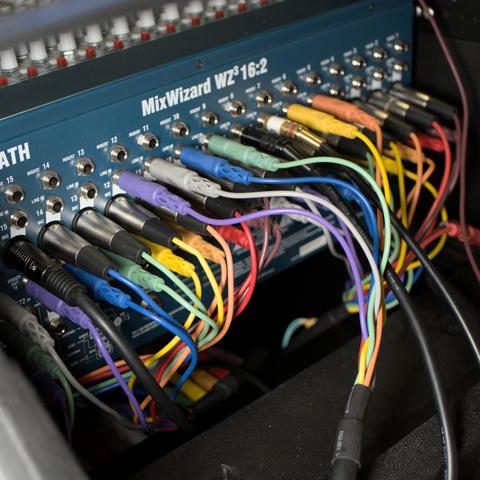
Shown in the photo is a literal rainbow connection. The XLR patches all go to the Pulse 16MX. These are for routing sounds from Live, typically for when I want to do an analog mixdown.

The row above the XLRs is for patching synths and mics. On the mixer those take priority (if something is plugged into the top, it disables the XLR). The top row is for inserts.

I have snakes not pictured here to patch in most of the synths as well as an insert snake that routes to the front patch bay.

Anyways I treated myself to doing an analog mixdown of one of the synthwavey songs we're working on. The new setup made all that a ton easier. The mix sounded fantastic too! Song isn't done yet (though it's getting close) so this wasn't a final mix or anything but I REALLY liked it.

There's still some things to do before the setup is fully complete but I'm liking it so far. Worth all the cost, headaches and time lost not making music or practicing sax? Between the sonic upgrades and the easier workflow I think so but it's probably still a bit too soon to say for certain.

#StudioNightmares #RainbowConnection
My new to me RME HDSPe PCI express card arrived today! Since my Pulse 16MX isn’t here yet, there isn’t anything to connect it to. But since it includes a single line out jack on the card itself, I was able to at least install the card and drivers. This let me take TotalMix and setup Ableton Live. The Pulse may get here as early as tomorrow.

One struggle I’ve had with upgrading my studio is the whole battle between USB, Firewire, and Thunderbolt. USB has always gotten a bad rap for being less great for audio due to some fundamental tradeoffs in how it works. Often mentioned is that USB requires “polling” whereas something like Firewire and Thunderbolt do not. The reality is a lot more nuanced. When a standup company like RME says USB is plenty good, I tend to believe them. For my own gear, USB works but I have found Firewire is more consistent and have been using that for years now via a PCI Express card.

I still think Firewire is pretty wonderful though sadly Intel and Apple have replaced it with the much more complicated solution of Thunderbolt. As I alluded to in Studio Nightmares #1, on PC this has proven very problematic due to Thunderbolt 1 and 2 compatibility, not to mention the whole complicated mess that is getting a Thunderbolt solution working on PCs in general. This may be one reason many newer external audio interfaces have gone back to USB.

Initially my studio upgrade plans called for using a MOTU 64M. This is an external AVB/MADI to USB interface and would have been a great solution I think – were it obtainable. Sadly MOTU AVB gear has been very hard to find. Likewise, USB wasn’t something I wanted to invest heavily in given the above so perhaps this was a bit of a blessing in disguise. RME is about to release a new PCI Express card, the HDSPe AoX-M. Sidenote, RME could stand to have better product names for some of this stuff, but I digress. The AoX is a MADI and AVB (Milan) combo card. It nails all my use cases in every way except, of course, price.

For now, I managed to find a used RME HDSPe MADI card and while it doesn’t have quite as much I/O, I’m able to meet all my current requirements (including remote recording the piano, hopefully, but more on that in another Studio Nightmares). And notably it’s a PCI Express card, so no having to deal with USB vs Thunderbolt debates and debacles.

I don’t yet know how good the latency is going to be as I’m only able to get audio out of the stereo line out on the card from software sources. I can say however, after just a brief listen, I can see why folks rave about RME’s converters. It. sounds. beautiful! Noticeably better than the main outs on my MOTU 828 although I haven’t done a proper A/B to say for sure. I’m hoping the Pulse 16MX also sounds pretty decent given its converters, but we’ll see once that arrives!

Other than RME converters a lot of folks rave about TotalMix which is the software used to control the audio routing through the card allowing one to route the hardware inputs and outputs as well as the software channels (ala Ableton Live). While it’s not a holy grail, I have found it way way better to understand and follow than the MOTU828 or Saffire Pro 40 mixing applications. For one, I can name my inputs and outputs. Two, it’s easy to save and recall mixer configurations (and name them). Since I can’t yet route audio yet, little hard to say how well I’ll get on with it for more complicated things, but so far yeah I can see why RME gear is pricey.

This is probably a good place to stop for now, but still to come is discussing the analog patchbay, the Pulse 16MX, how I’m going to be wiring up the MOTU and that remote recording solution with the piano I plan on doing.

#StudioNightmares #RME #MADI
I mentioned AVB last time, and it's some cool stuff! And in fact RME, the folks that make the premium (expensive) audio solutions and are known for good integrated pre-amps, may be investing more into AVB this year. But as mentioned last time, everytime I've tried to update my studio, I always have ended up waiting for the next thing.

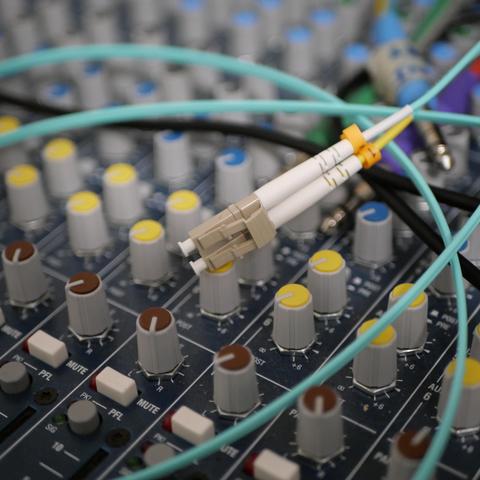
This time I didn't do that. Even though I think AVB is cool, I decided to forge ahead on what options I do have. I ended up looking into MADI. MADI (Multichannel Audio Digital Interface) is like a grown up ADAT. It supports waaaaay more channels over much longer distances. It reuses fiber cabling and terminators used in networking gear. It is also a non-licensed encumbered standard (you can probably see a theme here - I *really* don't like Dante for being closed sourced and effectively proprietary, and also expensive relative to standardized solutions which are arguably superior).

Hold up though, what’s ADAT? In consumer gear, TVs and stereos, it’s more known as optical or toslink. Pretty much the same thing. Being an optical connection it means you do not have to worry about ground loops because there is not electrical connection between gear. That’s a pretty big deal and something I hadn’t appreciated until recently. ADAT has been around forever. It’s pretty inexpensive, and provides a decent amount of audio channels - 8 channels at 48kHz, 4 at 96 and 2 at 192. This is partly why you see it used for home theater systems and things.

MADI is also an optical connection which addresses some of the limitations of ADAT that one might find in a studio/music setting, albeit for a higher cost. MADI provides 8x more channels (64 at 48kHz, 32 at 96, 16 at 192) and can be used for very long cable runs (kilometers). It repurposes optical cabling and connectors found in computer networking applications. Like ADAT, MADI is point to point. You can chain devices together in a loop though unlike AVB, Dante, and other ethernet based solutions, you can route audio all over the place freely (which ethernet solutions are able to do by leverage ethernet switches, just as we do for normal data). That has some really neat benefits! Which is why I’m still enamored by AVB.

But at the same time, I don’t really need to do that and given the distances MADI runs, all the solutions I need can be solved without – at least for now. MADI is a lot simpler to connect too. Just like ADAT. You just plug it in and pretty much go.

Why is any of this crap important? Well for the home musician that does most things “in the box” and only needs a mic and maybe a line in for a guitar, it's probably not important. In times that it is, ADAT may still be a reasonable solution. But for folks like me that have lots of synths and want to have more analog routing options, it becomes hella important, especially at high sample rates. And if you’re wanting to avoid the really high cost of Dante, this is one of those ways to do it.

#StudioNightmares
I guess first things first, our band blog is a hot mess and we need to improve it. Been trying to see if I can just have it display our ActivityPub posts but so far no luck.

John suggested I should document a project that's taken me years to finally do - upgrading the "studio" (quotes since it's just my cluttered messy home office). While I was gonna write this on our blog, until we make that thing not embarrassing, I'll post it here. Might not be super interesting but here we go anyway!

My current digital setup is a MOTU 828mk3 with a Saffire Pro 40 connected to it over ADAT. Because I like to track at 96kHz, that means I only get 4 I/O from the pro 40. And 8 (ish) from the MOTU. MOTU is connected over Firewire. Yes Firewire. In 2024. It's better than USB. There. I said it. Fight me.

Sounds like a lot of I/O. And it is! But it gets eaten up quick when considering the synths, the reel to reel, wanting to send to things like my tube pre, etc. I had solved this via a patch bay (I was using wrongly turns out). This mostly worked though.

Two things tipped the scales into wanting to upgrade. I wanted to add in John's MS2000 to our synth army, and importantly I've wanted to use our 16 channel Allen & Heath MixWizard we used for live shows for both tracking (for analog EQ) and mixing. I've tested this out and I LOVE it! A third distant option is finding a solution for being able to easily record my piano, which isn't at all close to the studio.

The problem? Well, I've tried this before several times. And every time I get stuck on something being out of stock, or having to chance paying like $200 for getting Thunderbolt on my PC (don't, and honestly a solid FU to Intel for bricking fleets of audio gear due to forced deprecation of TB1).

This time around I got so. damn. close. to what I was wanting by way of MOTU's AVB lineup. Why AVB and not Dante? Many folks probably don't know what those even are but basically Dante is license encumbered and expensive (much like Thunderbolt, again, FU to Intel here for putting us in a darker timeline on purpose...). Both of these are Ethernet based solutions, but AVB is an IEEE standard and, on paper, I actually think seems superior (there is also Ravenna, also a non-licensed standard but it hasn't caught on too much in the music space).

Sadly, most MOTU gear is unobtanium at present. Which sucks. A lot. I've been at this for about 3 weeks now to try and find a solution, largely running around in circles.

But! I finally found a solution. It has been more of an investment than I planned, but seems to tick all the boxes.

More on that in part 2!

#StudioNightmares