The Dragon, the Eagle, and the Burning Crescent: Trump’s visit to China in an Age of Fragmentation and Geoeconomic Disorder - World Geostrategic Insights
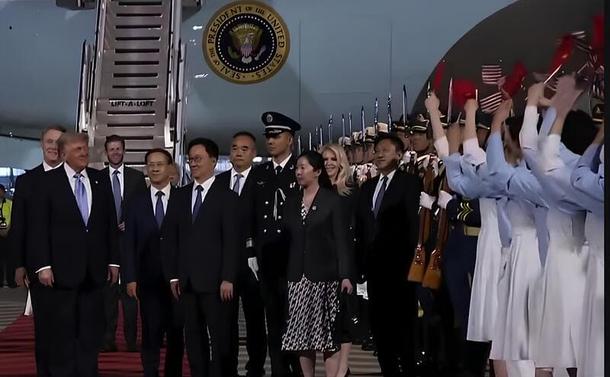
By Mirza Abdul Aleem Baig The visit of President Donald Trump to China from May 13 to 15, 2026, is not merely another diplomatic engagement between Washington and Beijing. It is a strategic encounter taking place at a historical inflection point where the global order itself is under reconstruction. Beneath the ceremonial handshakes, red carpets,

Evolving US Indo-Pacific Posture and Strategic Competition with China
<p xmlns:xsi="http://www.w3.org/2001/XMLSchema-instance" class="first" dir="auto" id="d1923588e91">
<i>The United States (US) under its Indo-Pacific policy explicitly aims to counter China’s
political, economic and military maneuvers. China’s territorial claims compelled the
US to revisit its Indo-Pacific policy and posture. In 2022, under former President
Joe Biden, the US introduced its Indo-Pacific strategy that underscores the free,
open and prosperous vision of the region. Viewing from the lens of Neo-Realism, the
strategy hinted towards building alliances with partners, promoting transparent democratic
values and norms in the region, mitigating any aggressive threat to the region and
finally securing the US’ interests. Increased military spending, forming new partnerships
and alliances—QUAD, AUKUS ANZUS—developing economic and technological infrastructures
in the region are all part of the strategies which the US state department had issued
in the IPS-2022. Similarly, its National Defense Strategy (NDS) implicitly mentions
all those measures which are to be taken by the US to ensure stability in the region.
The reelection of President Trump in the office in 2025 is anticipated to have significant
impacts on the established international norms and values but the containment of China
remains a core objective of the US. While on the other hand, in response to the IPS
2022, China has increased its defense spending, expanded regional economic projects,
challenged US narratives and positions at the UNSC, and imposed reciprocal tariffs
to maintain its influence.
</i>
<i>This paper aims to address the political, economic and military implications of the
US Indo-Pacific policy for China including regional alliances, trade and investments,
arms race, maritime security, tariffs and duties. It also re-evaluates IPS 2022 under
Trump 2.0 administration and analyzes the US and China’s military capabilities deployed
in the region.
</i>
</p>
 Mirza Abdul Aleem Baig
 ScienceOpen
 @economyandspace