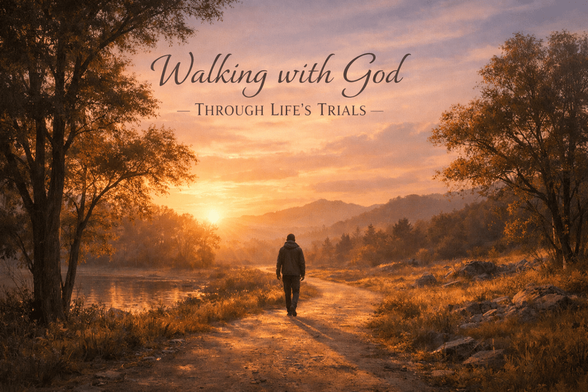
Walking with God Through Life’s Trials: A Practical and Faith-Focused Guide

1,680 words, 9 minutes read time.

Life has a way of delivering trials that feel unfair, overwhelming, and at times utterly confusing. Illness, financial strain, broken relationships, and emotional suffering do not discriminate. They arrive. They demand attention. They force questions. For people of faith, the central question often becomes: how do I walk with God through this?

This post explores the Christian concept of enduring hardship while maintaining faith and spiritual discipline. It is not about shallow optimism or pretending suffering is easy. It is about the theological and practical framework that allows believers to navigate trials with purpose, resilience, and trust. Drawing on principles found in the teachings of Christianity and the historical record of spiritual practice in the Christian tradition, we will examine what it means to walk with God when life hurts and how that journey shapes character and perspective.

Walking with God Through Life’s Trials: The Theological Foundation

Christian theology teaches that suffering is not meaningless. This is a difficult concept for many modern readers because contemporary culture often equates success with comfort and happiness with the absence of difficulty. The Christian worldview rejects that premise. Instead, it asserts that trials can serve a redemptive and transformative purpose.

According to Christian teaching, human existence is marked by imperfection and brokenness. The doctrine of original sin explains that the world is not as it should be—people make moral errors, systems fail, and nature itself can inflict suffering. Yet within that brokenness, God remains present. The message of Christianity is not that believers will avoid hardship but that God accompanies them through it. This concept is expressed repeatedly in Christian scripture and tradition, emphasizing divine presence rather than exemption from difficulty.

Faith, in this framework, becomes a relationship rather than a transaction. It is not a contract in which God guarantees comfort in exchange for belief. Instead, it is a commitment to trust God’s wisdom and presence even when circumstances defy understanding. This distinction matters because it shapes expectations. A transactional view of faith can collapse when trials arrive, leading to disillusionment. A relational view of faith, by contrast, acknowledges that relationships endure through both ease and difficulty.

The Christian narrative of suffering also includes the example of Jesus Christ. According to Christian doctrine, Jesus experienced profound suffering and ultimately crucifixion, an event interpreted as a redemptive act. Whether one accepts the theological implications of that narrative, it remains a central example within Christianity of endurance and purpose in the face of hardship. The message is that suffering does not negate worth or meaning.

This theological foundation provides a starting point for understanding how believers approach trials. It frames hardship as a component of human experience rather than evidence of divine abandonment. That perspective does not eliminate pain, but it offers a framework for meaning.

Practical Spiritual Discipline During Trials

Belief alone, however, is not sufficient to navigate the emotional and psychological challenges of hardship. Walking with God through trials requires practical spiritual discipline. This discipline involves intentional practices that sustain faith and provide structure during turbulent times.

Prayer is central to this discipline. In Christian practice, prayer functions as communication with God—an expression of dependence, gratitude, and request. During trials, prayer often shifts in tone. It may become less about asking for immediate resolution and more about seeking strength and understanding. This shift reflects an acceptance that some circumstances require endurance rather than instant solutions.

Prayer also serves psychological functions. It creates moments of reflection and stillness in a world that often demands constant activity. For believers, these moments reinforce the awareness that they are not isolated in their struggles. Whether one interprets prayer as divine communication or as a meditative practice, its impact on emotional regulation and perspective is well documented in spiritual literature.

Scripture reading constitutes another pillar of spiritual discipline. The Christian tradition emphasizes the importance of engaging with sacred texts as a source of guidance and encouragement. The teachings found in The Bible address themes of suffering, redemption, and divine faithfulness. For example, many passages describe individuals who endured significant trials yet maintained trust in God’s purposes. These narratives provide historical and theological context for modern believers facing their own challenges.

Reading scripture during hardship is not an exercise in escapism. It is an effort to ground perspective in principles that transcend immediate circumstances. This does not mean that scripture provides simple answers to complex problems. Rather, it offers a framework for thinking about those problems in ways that emphasize meaning and resilience.

Community also plays a vital role in spiritual discipline. Christianity traditionally emphasizes the importance of fellowship among believers. Human beings are social creatures, and isolation often intensifies suffering. A supportive community can provide practical assistance, emotional encouragement, and shared understanding. This does not imply that communities are perfect—any human institution contains flaws—but the value of mutual support remains significant.

In practical terms, community involvement might include attending worship services, participating in small groups, or engaging in acts of service. These activities reinforce connections and remind individuals that they are part of something larger than their personal struggles. Service, in particular, shifts focus outward and cultivates empathy. Helping others during difficult times can paradoxically strengthen one’s own sense of purpose.

Spiritual discipline during trials also requires honesty. Pretending that everything is fine when it is not can create emotional dissonance. Christian tradition encourages believers to bring their struggles before God with sincerity. This does not mean complaining for its own sake but acknowledging reality while seeking guidance and strength. Honesty in prayer and reflection fosters a relationship grounded in truth.

The Transformative Potential of Trials

One of the most challenging aspects of Christian teaching on suffering is the idea that trials can be transformative. This concept is often misunderstood as suggesting that suffering is desirable or that it should be welcomed. That is not the message. The Christian perspective recognizes that suffering is painful and undesirable. However, it also asserts that growth can emerge from adversity.

Human character often develops through challenges. Skills such as patience, empathy, and resilience are rarely cultivated in comfort alone. Trials force individuals to confront limitations and reconsider assumptions. They can reveal strengths that were previously unknown and foster a deeper appreciation for life’s positive aspects.

This transformative potential does not minimize the reality of pain. It acknowledges that growth often comes at a cost. The Christian narrative of redemption emphasizes that suffering is not the final word. Difficult experiences can shape individuals in ways that enable greater compassion and wisdom.

Historical examples within Christianity illustrate this principle. Throughout history, believers have faced persecution, social marginalization, and personal hardship. Many of these individuals responded with acts of courage and service. Their stories do not romanticize suffering but demonstrate the capacity for meaning and purpose even in adverse circumstances.

From a practical standpoint, recognizing the potential for growth during trials can influence mindset. This does not mean forcing positivity or denying legitimate emotions. It means acknowledging that circumstances, while difficult, can also contribute to development. This perspective encourages proactive engagement with challenges rather than passive resignation.

Psychological research supports the idea that individuals can experience post-traumatic growth. This phenomenon refers to positive psychological change following adversity. Examples include increased appreciation for life, strengthened relationships, and enhanced personal resilience. While not everyone experiences post-traumatic growth, the possibility underscores the complexity of human responses to suffering.

For believers, post-traumatic growth aligns with theological concepts of redemption and transformation. The idea that God can work through difficult circumstances to produce positive outcomes resonates with Christian teaching. It does not guarantee that every trial will result in visible benefits, but it affirms the potential for meaning.

Walking Forward with Faith

Walking with God through life’s trials is neither simple nor immediate. It requires theological understanding, spiritual discipline, and emotional honesty. Christianity teaches that suffering is part of human existence but not its final definition. God’s presence, according to Christian belief, remains constant even in hardship.

Practical spiritual practices such as prayer, scripture engagement, and community involvement provide structure and support during difficult times. These disciplines do not eliminate pain but help believers navigate it with purpose. They reinforce the relational aspect of faith and cultivate resilience.

Trials also offer the potential for growth. While suffering is undesirable, it can shape character and deepen understanding. This perspective does not diminish the reality of hardship but acknowledges that human beings are capable of finding meaning in adversity.

Ultimately, walking with God through trials is about trust. It is about believing that circumstances, however difficult, do not separate believers from divine presence and purpose. This trust does not require blind optimism. It rests on the conviction that meaning exists even in suffering and that growth is possible.

Faith is not a guarantee of comfort. It is a commitment to journey forward, step by step, with the awareness that one is not alone.

Call to Action

If this study encouraged you, don’t just scroll on. Subscribe for more bible studies, share a comment about what God is teaching you, or reach out and tell me what you’re reflecting on today. Let’s grow in faith together.

D. Bryan King

Sources

The Bible Gateway – Online access to biblical texts
GotQuestions.org – Christian apologetics and explanations
Pew Research Center – Studies on religion and society
Desiring God – Christian teaching and resources
Christianity Today – News and analysis on Christian life
Barna Group – Research on faith and culture
American Psychological Association – Research on trauma and resilience
National Center for Biotechnology Information – Studies on psychological growth
JSTOR – Academic research on religion and society
U.S. Department of Health and Human Services – Mental health resources
SAMHSA – Substance Abuse and Mental Health Services Administration
World Christian Database – Data on global Christianity
Encyclopaedia Britannica – Overview of Christianity
Ligonier Ministries – Reformed Christian teaching
Crossway – Publisher of Christian resources

Disclaimer:

The views and opinions expressed in this post are solely those of the author. The information provided is based on personal research, experience, and understanding of the subject matter at the time of writing. Readers should consult relevant experts or authorities for specific guidance related to their unique situations.

#biblicalEncouragement #biblicalPrinciples #biblicalResilience #biblicalWisdom #ChristianDiscipleship #ChristianDiscipline #ChristianEncouragement #ChristianEncouragementForHardship #ChristianEndurance #ChristianFaith #ChristianGrowth #ChristianGuidance #ChristianHope #ChristianHopeInTrials #ChristianLifeLessons #ChristianLifestyle #ChristianPerspectiveOnTrials #ChristianSuffering #ChristianTeaching #ChristianUnderstandingOfSuffering #ChristianValues #ChristianWorldview #emotionalHealing #emotionalResilience #enduringTrials #faithAndHardship #faithAndHealing #faithAndLife #faithAndSuffering #faithInTrials #faithJourney #faithBasedResilience #GodAndSuffering #GodSFaithfulness #GodSPresenceInSuffering #GodSPurpose #meaningInSuffering #overcomingAdversity #overcomingStruggles #PersonalGrowth #prayerDuringTrials #resilienceInFaith #scriptureForHardTimes #spiritualDiscipline #spiritualEndurance #SpiritualGrowth #spiritualJourney #spiritualMaturity #spiritualMeaning #spiritualPerseverance #spiritualReflection #spiritualStrength #theologyOfSuffering #trialsOfLife #trustAndGrowth #trustInGod #trustingGod #walkingWithGod

When God Works Deeper Than the Circumstance

As the Day Ends

As the day settles into quiet, many of us carry unanswered prayers into the evening. We had hoped for resolution, relief, or visible change, yet the fig tree still does not bud and the fields still feel barren. Habakkuk’s words meet us precisely in this space—not in denial of loss, but in defiant trust. “Though the fig tree does not bud and there are no grapes on the vines… yet I will rejoice in You, my Lord.” This is not optimism born of circumstance; it is worship rooted in conviction. Sometimes God chooses not to alter the visible conditions of our lives because He is performing a deeper, more enduring work within us.

The prophet Habakkuk does not rejoice because the hardship has passed, but because God remains present and faithful within it. The Hebrew posture here is one of settled confidence rather than emotional ease. God is revealed not merely as the One who provides, but as the One who sustains. When Scripture declares, “You, Lord, are my strength,” it speaks to an inner miracle—a reorientation of the heart that no external change could produce on its own. God strengthens us not only by lifting burdens, but by reshaping how we carry them. This kind of transformation enables us to stand steady even when outcomes remain unresolved.

Paul echoes this truth centuries later when he writes, “We rejoice in our sufferings, knowing that suffering produces perseverance” (Romans 5:3, italics mine). This is not a call to celebrate pain, but to trust God’s purpose within it. Perseverance is not forged in ease; it is formed when faith learns to endure without bitterness. God may allow the drought to remain because He is cultivating resilience, humility, and hope that cannot grow in comfort alone. As the day ends, we are invited to release our demand for immediate answers and instead rest in the assurance that God is still at work—quietly, faithfully, and wisely.

The image Habakkuk uses is striking: “You make my feet like the feet of a deer; You enable me to go on the heights.” The terrain has not changed, but the one walking upon it has. God’s miracle is not always the removal of the valley, but the strengthening of the traveler. He lifts us to heights of trust, perspective, and peace that would otherwise remain unreachable. What once felt inconceivable becomes lived reality—not because circumstances improved, but because God carried us beyond what we thought possible.

Triune Prayer

Father, I come to You at the close of this day aware of both my gratitude and my weariness. You see the places where I hoped for change and instead encountered endurance. Thank You for remaining near when answers were delayed and outcomes uncertain. I ask You to continue shaping my heart so that I may trust You not only for what You do, but for who You are. Teach me to rest in Your care tonight, knowing that even in stillness You are at work within me.

Jesus, Son of Man and faithful Savior, You walked the path of obedience through suffering and showed me that trust does not depend on relief. I thank You for sharing my weakness and for interceding on my behalf. When I struggle to rejoice, remind me that You are my life and my hope. Strengthen my resolve to follow You even when the road remains steep, and grant me peace as I lay down my concerns at the end of this day.

Holy Spirit, Comforter and Helper, settle my restless thoughts and guard my heart as I prepare for rest. Where anxiety lingers, speak truth. Where discouragement presses in, restore perspective. Continue the quiet work You have begun within me—shaping perseverance, deepening faith, and cultivating trust that holds through the night. I welcome Your presence and guidance as I entrust this day, and all that remains unresolved, into God’s faithful hands.

Thought for the Evening

Even when circumstances remain unchanged, God may be doing His most meaningful work within you—rest in that truth tonight.

For further reflection on trusting God amid hardship, consider this article from Ligonier Ministries:
https://www.ligonier.org/learn/articles/trusting-god-in-the-dark

FEEL FREE TO COMMENT, SUBSCRIBE, AND REPOST, SO OTHERS MAY KNOW


#ChristianHope #eveningDevotional #Habakkuk3Reflection #spiritualPerseverance #trustingGodInSuffering

Dive into Lily Among Thorns: Shape Up and Fly Right — follow Lily’s faith‑filled journey through trials, courage, love and spiritual perseverance in a world gone awry. Read: https://www.annettekmazzone.com/lily-among-thorns-shape-up-and-fly-right-unknown/

#LilyAmongThorns #AnnetteKMazzone #ChristianFiction #FaithJourney #SpiritualPerseverance #MustRead

Spinning Faith in Royal Places

On Second Thought

Advent is a season of waiting, but it is not a season of retreat. As the Church leans into the quiet expectation of Christ’s coming, Scripture invites us not merely to pause, but to prepare our hearts with courage and attentiveness. In that light, the wisdom saying from Proverbs 30:28 feels unexpectedly timely: “The spider taketh hold with her hands, and is in kings’ palaces.” At first glance, it is an odd image—almost unsettling. Spiders are rarely admired. They do not charm, impress, or inspire affection. Yet Scripture, with its unflinching honesty, points to this small, persistent creature as a teacher of faith. The spider survives not by strength or favor, but by tenacity. She takes hold.

The proverb does not praise the spider’s beauty, nor her popularity, but her diligence. She spins, she clings, she persists. If her web is destroyed, she does not protest or retreat. She simply begins again. And remarkably, she does so even in places of power and privilege—in kings’ palaces. The image is not about entitlement, but access. The spider does not wait for permission; she works with what she has and where she is. In the same way, faith is not a timid posture that waits for ideal conditions. Faith takes hold. It reaches, clings, and remains, even when circumstances are swept away.

The reflection rightly presses this image into the spiritual life. Many believers settle for what might be called a “spiritual attic”—a cramped, dusty place of minimal expectation—rather than living in the courts of the King. This is not because God withholds access, but because we hesitate to take hold. We confuse humility with hesitation and reverence with retreat. Yet biblical humility is never passive. It is grounded, confident, and anchored in trust. The Greek word for boldness in Hebrews 4:16, parrēsia, carries the sense of freedom of speech, openness, and confident access. “Let us therefore come boldly to the throne of grace,” the writer urges, not because we are worthy in ourselves, but because Christ our High Priest has gone before us.

Advent reminds us that God is not distant. He draws near. Emmanuel—God with us—redefines access entirely. If God has chosen to dwell among us in flesh, then timidity no longer makes theological sense. The reflection’s call to “take hold by the hand of faith” is not a summons to arrogance, but to alignment. We take hold in the name of Another. Our confidence is borrowed, not manufactured. Hebrews 13:6 grounds this holy boldness clearly: “So we may boldly say, The Lord is my helper, and I will not fear what man shall do unto me.” Fear-driven faith is a contradiction. Scripture is unequivocal that fear does not originate with God. As Paul writes to Timothy, “For God hath not given us the spirit of fear; but of power, and of love, and of a sound mind.”

This distinction matters deeply, especially during Advent. Waiting can easily become passive resignation if fear governs our posture. But Advent waiting is active expectancy. It is the kind of waiting that prepares the house, lights the candles, and watches the horizon. The spider does not wait idly for conditions to improve. She takes hold where she is, with what she has. Faith works the same way. Grace is already given. Opportunity is already present. The question is whether we will reach for it or shrink back.

The reflection challenges us to reconsider how we approach life itself. Too often, we handle faith “timidly and gingerly,” as though God’s promises were fragile or conditional. Yet Scripture consistently presents faith as a forward-leaning trust. The Hebrew word chazaq, often translated “be strong” or “take courage,” literally means to seize, to grasp firmly. Faith is not merely assent; it is attachment. To take hold of grace is to trust that God’s generosity exceeds our caution. To take hold of opportunity is to believe that obedience opens doors fear never will.

Living in the King’s palace is not about status or spiritual elitism. It is about proximity. It is about living consciously in God’s presence rather than on the margins of expectation. The spider’s web in the palace is not an act of presumption, but of persistence. Likewise, prayer that clings, obedience that endures, and hope that rebuilds after disappointment are not acts of pride—they are acts of trust. During Advent, as we prepare for the coming King, we are reminded that His courts are already open. The veil has been torn. Access has been granted.

The call, then, is simple but demanding: do not live in the attic. Do not confine your faith to safe corners and low expectations. Take hold. Spin your web of trust, prayer, and obedience in the very places God has placed you—work, family, uncertainty, waiting. If it is swept away, begin again. Faith that clings will always find itself nearer the King than faith that hesitates.

On Second Thought

There is a paradox tucked quietly into this proverb that we often miss on first reading. The spider does not conquer the palace, nor does she transform it. She simply inhabits it. On second thought, perhaps the deepest challenge of this reflection is not its call to bold action, but its redefinition of where boldness truly lives. We assume bold faith must be loud, visible, or immediately successful. Yet the spider’s boldness is subtle, almost unnoticed. She does not announce her presence; she persists in it. Her courage is expressed not in dominance, but in continuity.

This reframes spiritual boldness in a way that may surprise us. To take hold of faith does not always mean dramatic change or visible triumph. Sometimes it means remaining. Praying again after disappointment. Trusting again after loss. Obeying again after failure. The palace is not entered through force, but through faithful presence over time. Advent itself embodies this paradox. God enters the world not with spectacle, but with vulnerability. The King comes as a child. On second thought, perhaps living in the King’s courts looks less like spiritual bravado and more like quiet, resilient faith that refuses to leave.

So, the question Advent asks us is not merely whether we believe, but whether we will stay. Will we continue to take hold when our webs are swept away? Will we trust that access remains even when evidence feels thin? The spider teaches us that persistence is its own form of praise. And perhaps the most faithful thing we can do this season is not to strive harder, but to cling more closely—confident that the palace remains the safest place to build.

FEEL FREE TO COMMENT, SUBSCRIBE, AND REPOST, SO OTHERS MAY KNOW


#AdventDevotion #boldFaith #ChristianCourage #Proverbs3028 #spiritualPerseverance #throneOfGrace

When Faith Walks Into the Fire

Thru the Bible in a Year

Acts 23–25

There are moments in Scripture where the pages feel dense with tension, as if the air itself is crackling. Acts 23–25 brings us into one of those seasons in Paul’s life. This portion of our reading unfolds like a courtroom drama mixed with political intrigue and spiritual warfare. Yet beneath the noise of plots, accusations, and shifting Roman officials runs a steady thread of God’s faithfulness. As we walk with Paul through these chapters, we see not merely a missionary enduring hostility but a servant of Christ kept and guided by the Lord he trusted.

These chapters remind us that following Jesus often places us directly in the path of human opposition. But they also show us a God who never abandons His witnesses, even when the crowd grows hostile, the system becomes corrupt, or the future seems uncertain. If you’ve ever faced unfair criticism, misunderstood motives, or systems that seemed stacked against you, these chapters speak a comforting truth: God’s sovereignty is not shaken by human injustice.

Acts 23 — Standing Before Foes

Acts 23 opens with Paul standing before the Sanhedrin—the very council he once served as a rising star. Now he stands as a defendant, not a celebrated Pharisee. The enmity in Jerusalem was deep, persistent, and fueled by spiritual blindness. When Paul began to speak, the high priest ordered him struck on the mouth—a humiliating and unjust action. Paul rebuked him sharply, only to be corrected for speaking against the high priest. Even in this tense moment, we see Paul navigating the complicated blend of boldness and humility required when serving Christ in hostile environments.

Sensing the fierce division between Pharisees and Sadducees, Paul wisely emphasized his hope in the resurrection. This insight ignited a schism so intense that the Roman commander feared Paul might literally be torn apart. Isn’t it something how quickly self-righteous religious men can turn violent? Yet even this chaos becomes part of God’s protection. Human rage cannot thwart divine purpose.

That night, the Lord Himself stood by Paul. In one of the most comforting moments in Acts, Jesus told him, “As you have testified in Jerusalem, so you must also testify in Rome.” God does not always remove us from hostility, but He anchors us with promises that outlast our suffering. Paul’s comfort did not come from his circumstances but from the Lord’s presence and assurance.

The next day brought a conspiracy—more than forty men vowed not to eat or drink until they had killed Paul. But God had already positioned help. Paul’s nephew overheard the plot and reported it. The commander responded by arranging a nighttime transfer to Caesarea under heavy guard. What the conspirators meant for death, God turned into deliverance. The cruelty of men could not outrun God’s providence. The courage of a young boy, the attentiveness of Roman soldiers, and the promise of Jesus combined to shepherd Paul safely forward.

Acts 24 — A Corrupt Courtroom and a Courageous Witness

When Paul reached Caesarea, he stood before Felix, a Roman governor known for his cunning and instability. The Jews hired an orator, Tertullus, to make their accusations. With polished rhetoric, he twisted the truth, painting Paul as a plague among the nations. Every allegation was distorted, crafted to incite fear and gain political favor.

Paul, however, responded with clarity, honesty, and confidence. He reviewed the facts, pointed to his clean conscience, and emphasized that the real issue was his belief in the resurrection. While the accusations were crafted in deception, Paul’s defense was rooted in truth. Here we see the freedom of a faithful conscience—when we walk uprightly before God, we can speak plainly, even when wrongly accused.

Felix then deferred judgment, claiming he needed to wait for Lysias, though he had no intention of summoning him. His deceit became obvious. He hoped Paul might offer him money—a bribe for release. Meanwhile, he allowed Paul some freedom to receive visitors. For two years, Paul remained in custody, caught in a political game designed to please the Jews.

Imagine those two years. No missionary journeys. No new cities. No fresh churches. Just waiting. Yet God wastes none of it. During seasons where our freedom feels limited, our influence unseen, or our circumstances unfair, God is still shaping us and using us. We do not see Paul complaining. Instead, he continues sharing Christ with all who come to him—including Felix and his wife Drusilla.

The patience God cultivated in Paul during this confinement would prepare him for the greater witness awaiting him in Rome.

Acts 25 — A New Governor and a New Appeal

After two years, Felix was replaced by Festus. The Jewish leaders quickly approached him, urging that Paul be brought back to Jerusalem—a trap designed for his death. But Festus insisted the trial take place in Caesarea.

During the trial, the accusations remained false, echoing the same distortions used earlier. Paul, seeing the danger and recognizing his rights as a Roman citizen, appealed to Caesar. This was not an act of fear but of faith. He knew God had promised Rome. Appealing to Caesar aligned him with the very path Jesus had laid out the night He stood beside him.

Then King Agrippa entered the picture. Festus explained Paul’s case to him, intrigued that Paul had appealed to Caesar despite the lack of clear charges. Agrippa expressed interest in hearing Paul himself. This sets the stage for one of Paul’s most compelling testimonies, which we will explore in tomorrow’s reading.

What strikes me is how God used Roman bureaucracy—delays, transfers, appeals, and political shifts—to escort Paul exactly where he needed to go. Nothing about Paul’s journey was accidental. Each setback was a setup for a larger witness.

Living These Lessons Today

As we reflect on Acts 23–25, several themes rise to the surface—each one offering insight for our walk with Christ:

Faithfulness may place us in hard places.
Paul did not face hostility because he failed; he faced it because he was obedient. Sometimes faithfulness draws fire. But when God places us before adversaries, He also stands beside us.

God’s presence anchors us when circumstances do not improve.
Jesus stood with Paul in the night. His presence restored what the day had taken. Suffering is not evidence of abandonment; it is often a setting for deeper intimacy with Christ.

God places the right people in the right place at the right time.
Paul’s nephew overheard the plot. Soldiers were assigned. Governors came and went. Behind each human action was a sovereign hand guiding every step.

Waiting seasons are not wasted seasons.
Paul spent two years in Caesarea. What looked like stagnation was preparation. God often forms our character while the world assumes nothing is happening.

The gospel’s advance cannot be hindered by human agendas.
Accusations, conspiracies, political corruption—none of it slowed God’s plan. What men intended for harm, the Lord turned into avenues for testimony.

These chapters call us to trust that God’s will operates even through flawed systems and imperfect people. When we stand faithfully, speak truthfully, and cling confidently to Christ, we find that His purposes move forward—even when ours feel delayed.

A Pastoral Blessing

As you continue this journey Thru the Bible in a Year, may your heart find courage in Paul’s example and comfort in God’s sovereignty. Thank you for your commitment to Scripture. It will shape you, steady you, and strengthen you. God’s Word never returns void. Whatever fires you walk into, may you feel the nearness of Christ, who stands beside His people in every trial and leads them faithfully forward.


Relevant Resource:

For additional insights on Paul’s trials and perseverance, see this article from The Gospel Coalition:
https://www.thegospelcoalition.org/


FEEL FREE TO COMMENT SHARE SUBSCRIBE


#acts23Commentary #bibleReadingPlanDevotional #paulBeforeFelixAndFestus #spiritualPerseverance #trialsOfTheApostlePaul