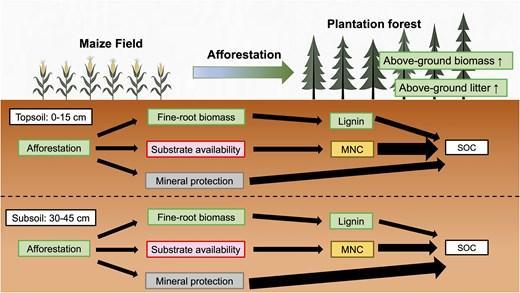
#Afforestation in subtropical #KarstEcosystems drives #SoilOrganicCarbon accumulation through distinct, depth-dependent pathways --- fostering microbial activity in the topsoil and enhancing mineral protective capacity.

#Lignin | #MicrobialNecromassCarbon | #SoilDepth | #SubtropicalRegion
https://doi.org/10.1093/jpe/rtaf166

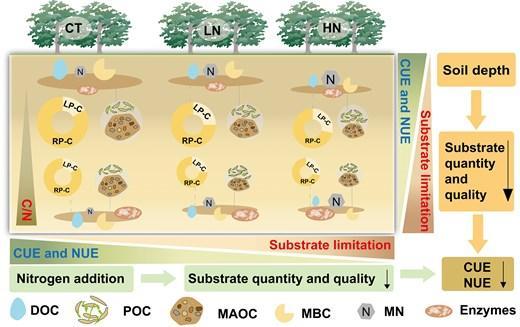
Microbial carbon use efficiency (CUE) and nitrogen use efficiency (NUE) were significantly positively correlated, and both declined with increasing nitrogen addition rates.

#NitrogenDeposition | #MicrobialGrowth | #MicrobialMineralization | #SoilDepth | #CarbonFractions

https://doi.org/10.1093/jpe/rtaf183

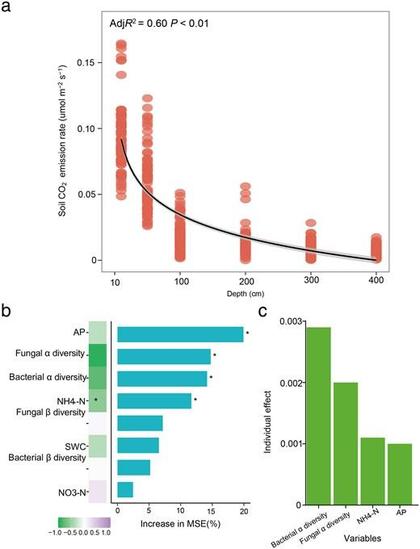
The significant decrease in soil #CO2Emissions with increasing #SoilDepth in old-growth #SubtropicalForests is primarily due to diminished microbial activity and reduced availability of substrates in deeper layers.

#SoilProperties | #MicrobialDiversity

https://doi.org/10.1093/jpe/rtaf175

ใ€๐ŸŽ‰Latest accepted articleใ€‘
Available nutrients and microbial alpha diversity contribute to #CO2Emission in a #SubtropicalPrimaryForest: insight from a 4 m soil vertical profile

#SubtropicalForest | #SoilDepth | #SoilProperties | #MicrobialDiversity

https://doi.org/10.1093/jpe/rtaf175

ใ€๐ŸŽ‰Latest accepted articleใ€‘
Depth-dependent mechanisms underpinning #SoilOrganicCarbon accumulation following #Afforestation

#Lignin | #MicrobialNecromassCarbon | #KarstEcosystem | #SoilDepth | #SubtropicalRegion

https://doi.org/10.1093/jpe/rtaf166