 bot
botWroclove.rb 및 Haggis Ruby 2026: Ruby와 Event Sourcing을 활용한 반응형 시스템 구축
Wroclove.rb 2026에서 Ruby와 Event Sourcing을 결합하여 백엔드 상태 변화에 UI가 반응하는 시스템 구축 사례를 발표함
Wroclove.rb 및 Haggis Ruby 2026: Ruby와 Event Sourcing을 활용한 반응형 시스템 구축
Wroclove.rb 2026에서 Ruby와 Event Sourcing을 결합하여 백엔드 상태 변화에 UI가 반응하는 시스템 구축 사례를 발표함
I’m sure #AstroTheoros brings some #Atrologers joy, but as a Mage who is mostly interested in the #Magick side of #Astrology ,it falls very very short, charging too much for too little.
Astrodienst manages to be very useful in terms of Fixed Stars-but needs to add more, & has #Sidereal options. For free.
If I ever get a Desktop again I will be using either one of the free Open Source Astrology apps and or a copy of SolarFire.
#Occult #AstrologicalMagic #Magic #Picatrix #Grimoires #FixedStars
What would it mean if there were cycles in #nature tied to #sidereal time?
It would be surprising if there were cycles lined up with a #celestial body (or just direction).
This is now a practical question because these would be _subtle_ if they exist. There's an enormous sea of data if you declare "nature" as your domain.
It's far-out I acknowledge. But if such a thing was found it'd prompt questions.
e.g. Beetle infestation linked to #CygnusX being overhead.
#TruthBeTold #time #day #solstice #astronomy #sidereal #ISS #relativity
The truth is...
A day is 24 hours long, plus or minus about 20-30 seconds. However, during the winter the days get longer. At the winter solstice the days are the shortest.
But the southern hemisphere is different. In the southern hemisphere the days are nearly always 24 hours (+/- about half a minute).
And on the equator it gets really weird, because a sidereal day on the equator is only about 23 hours, 56 minutes year-round. And at the north and south poles, occasional the day is a second longer (leap second), due to climate change, among other reasons.
In space, astronauts experience time differently because they are in an area of lower gravity due to general relativity. For example, the International Space Station experiences 16 sunrises and sunsets per Earth day.
In areas where there is daylight saving time, on the day those areas enter daylight saving time the day is 23 hours, and when it switches back to standard time it’s 25 hours. These short and long days only occur in the areas where there is daylight saving time which you’d think would cause massive geological strain on the Earth’s crust and upper mantle, but for some reason it doesn’t.
- - -
#TruthBeTold = A statement that is logically or literally true (or partly true), but seems to imply something that isn’t true or is just plain weird. (for rhetoric, logic or propaganda studies… or just for fun)
(public domain image from Mediawiki Commons)
(image not to scale)
An Astronomical Mechanical Clock, in More Ways Than One
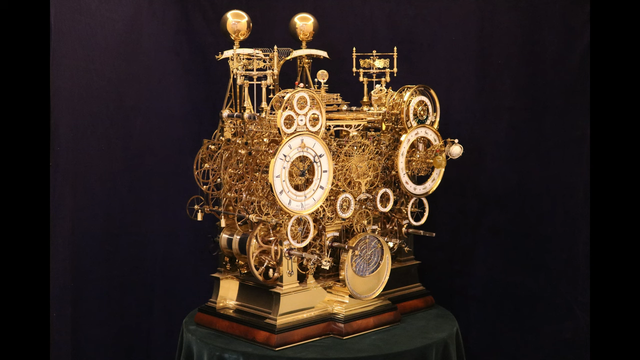
If the workings of a mechanical timepiece give you a thrill, prepare to be blown away by this over-the-top astronomical clock.
The horological masterpiece, which was designed by [Mark Frank] as his "dream clock", is a riot of brass, bronze, and steel -- 1,200 pounds (544 kg) of it, in fact, at least in the raw materials pile. Work on the timepiece began in 2006, with a full-scale mockup executed in wood by Buchannan of Chelmsford, the Australian fabricator that [Mark] commissioned to make his design a reality. We have a hard time explaining the design, which has just about every horological trick incorporated into it.
[Mark] describes the clock as "a four train, quarter striking movement with the fourth train driving the astronomical systems," which sounds far simpler than the finished product is. It includes 52 "complications," including a 400-year perpetual calendar, tide clock, solar and lunar eclipse prediction, a planisphere to show the constellations, and even a thermometer. And, as if those weren't enough, the clock sports both a tellurion to keep track of the Sun-Earth-Moon system and a full orrery out to the orbit of Saturn, including all the major moons. The video below shows the only recently finished masterpiece in operation.
[Mark]'s dream clock has been under construction for the better part of two decades, and we applaud not just his design but his patience. The skeletonized construction reminds us of the Clickspring clock from a few years back; now seems like a great time to go back and binge-watch that whole series again.
Thanks to [J. Peterson] for the tip.
#clockhacks #clock #clockmaking #equationoftime #horology #orrery #sidereal #tellurion #timepiece

 The Dead And The Decaying
 Mікє Вυгг
 High Priestess 💎
 Starry Starry Knight
 Pat
Pat hackaday unofficial