Book Review: The Real Shakespeare - Emilia Bassano Willoughby by Irene Coslet

https://shkspr.mobi/blog/2026/01/book-review-the-real-shakespeare-emilia-bassano-willoughby-by-irene-coslet/

Given my blog's domain name, I don't write nearly enough about Shakespeare. Luckily, the good folks at NetGalley have sent me Irene Coslet's provocative new book to review.

Who was the real Shakespeare? It's the sort of low-stakes conspiracy theory which is driven by classism ("a low-born man couldn't write such poetry!"), plagiarism ("he stole from other writers!") and, according to this book, sexism and racism.

From the blurb:

Now, in this intriguing and well-documented book, Irene Coslet conclusively demonstrates that Shakespeare was a not a man, but a woman: a dark-skinned lady, of Jewish origin, born into a family of Court musicians from Venice, and the mother of the English-speaking world. Her name was Emilia Bassano.

Yes! In your face, Bacon! Get stuffed, Marlowe! Edward de Who?!

The life of Emilia Bassano is genuinely fascinating. The book offers some excellent insights into the lives of women, Moors, and Jews during the time period. The analysis of the sexual politics - both in the plays and real life - are both interesting and well researched. For that reason, I have to give it some stars.

The book starts with Kuhn and his ideas about paradigm shifts - the more tweaks we have to bolt on to a model, the more likely it is the model will eventual collapse and a new model will emerge. I'm 100% behind that - given the deficiencies in Shakespeare's biography, people keep adding more and more fantastical explanations to it. But the counterpoint is that extraordinary claims require extraordinary evidence.

So, what evidence is there that Emilia Bassano was the writer of Shakespeare?

  • Shakespeare's name is an anagram of "A-She-Speaker".
  • Beatrice from Much Ado shares the same Myers-Briggs type as Emilia Bassano.
  • The names "Emilia" and "Bassano" pop up in several plays.
  • If you fold the portrait of Shakespeare in a certain way, it looks like a portrait of Emilia.

And so it goes on. Sadly, the evidence presented rarely rises to the level of circumstantial, let alone extraordinary. Some of it is of the sort found in the discredited Bible Code. If you selectively squish the data, you can make it say anything:

Here, the author exploits the similarity in Hebrew between the word Portia (PRT) and the word lead (YPRT). Portia (PRT) is nested within the lead (YPRT), embedding one one term inside the other to create multiple layers of meaning. Only a person who is fluent in Hebrew [...] would be able to make such a pun.

This book is a monument to what happens if you start with a conclusion and then selectively pick only the clues which support your case. There's no testing of the evidence against other candidates - for example, the author describes folding the Droeshout portrait in a specific way until it looks a bit like one of the portraits which might be of Emilia Bassano. It's a bit "Mad Magazine Fold In" - but can the image be folded different ways? Are there other people that it looks like? Sadly, the folded image isn't included on (dubious) copyright grounds.

There's also no mechanism suggested. Let's suppose that Emilia Bassano did write all these plays and poems. What was the method whereby "The Man From Stratford" took them and passed them off as his own? Was there payment? Why did she keep writing if they were being stolen? Wouldn't someone have noticed her slipping in all these "clues" about the true authorship and then removed them?

I'm generally sympathetic to the idea of trying new ways to look at old problems and I genuinely found some of the analysis interesting. I tried to keep an open mind and to steelman the arguments. Nevertheless, I found most of it unconvincing.

Here are some of the arguments I have trouble with.

Scholars agree that the plays are ‘feminist’ but have not been able to explain why the author was interested in gender issues.

To which a suitable response might be "Hath not a man eyes? hath not a man hands, organs, dimensions, senses, affections, passions?" It also ignores all the decidedly unfeminist tropes and characters in Shakespeare.

Emilia Bassano tells about this portion of her life in Cymbeline through the character of Posthumus Leonatus. Posthumus is the son of Sicilius, a reference to the Sicilian origin of the family. Sicilius has two other sons, who both die prematurely, an allusion to Lewis and Philip, Baptista and Margaret’s sons who died in infancy.

You could pick any random character out of any play and find someone in history who it could be an allegory for.

But, again, there are some reasonable arguments that Shakespeare may not be who we think. Emelia Bassano certainly had some of the background necessary:

The playwright had direct knowledge of the Veneto region. The playwright is familiar with the Commedia dell’Arte. [...] In 1582, Emilia Bassano travelled to Denmark, and that journey, according to Hudson, provided the material for Hamlet. [...] They all stayed at the Castle of Elsinore – which is renowned today as the setting of the play Hamlet. The delegation met two prominent Danish noblemen: Georgius Rosencrantz and Petrius Guildenstern

Most of these arguments seem to be taken from John Hudson's 2014 book "Shakespeare's Dark Lady: Amelia Bassano Lanier The woman behind Shakespeare's plays?" with very little in the way of original research.

The author does prove that there are a few positive connections between Emilia Bassano and Shakespeare. For example, she was the paramour of Henry Carey - founder of the Lord Chamberlain's Men. Could that have taken her into the orbit of Shakespeare's theatre company?

Yet, in 1594, Henry Carey was a sixty-eight military General (he died in 1596): it is hard to believe that the creation of a theatre company was his initiative. It is more likely that it was Emilia Bassano’s idea, who was twenty-five and a playwright at the peak of her creativity.

That's just pure speculation! When you go looking for evidence, and squint your eyes, it's possible to make anything seem like a connection:

Ophelia – whose name rhymes with ‘Emilia’ – has a relationship with the Lord Hamlet and gets pregnant. Ophelia is the daughter of the Lord Chamberlain – a reference to the Lord Chamberlain, Henry Carey, who was her fiancé in real life.

The book veers between cold-reading and the Forer effect. For example, the author asserts that one of Shakespeare's characters is based on a friend of Emilia Bassano. How can that be proven?

Shakespeare had the uncanny ability to give an accurate impression of the characters without describing them in detail. There is a painting by Thomas Francis Dicksee entitled Anne Paige (circa 1862). Although Dicksee was not aware that the character of Anne Paige is based on Lady Anne Clifford, his impression of Anne Paige looks strikingly similar to the portrait of Lady Anne Clifford by William Larking (1618): brown-haired, big-eyed and with a rounded face. It appears that the way the audience imagines Anne Paige when reading the play – and the way Dicksee represented her – is exactly how Anne Clifford looked. Same goes with Falstaff: Shakespeare gives such an accurate impression of Falstaff, without describing him in detail, that now we have an idea of how Alfonso Lanyer looked in real life.

I don't know how to fully respond to that. Two paintings looking slightly similar is not evidence! Where are all the other paintings of Anne Paige? Do they all look similar? There's cherry-picking, and then there's this!

Anyway, I give you Dicksee's portait and Larkin's so you may compare their similarity.

Similarly, some of the discussion is of the sort you might have after imbibing a few bottles of wine:

It is fascinating how two very different cultures and religions used the same sounds, Shekinah and Shakti, to indicate the divine feminine presence, and how these sounds can also be found in the name Shakespeare: Shekinah, Shakti, Shakespeare.

Emilia Bassano is the acknowledged author of the poem "Salve Deus Rex Judaeorum". Surely a textual analysis of her work and that of Shakespeare's would throw up some similarities? Alas, all we get are:

Prospero asks Miranda: ‘Cants thou remember / A time before we came unto this cell?’. In Salve Deus Rex Judaeorum Emilia Bassano says that she lives in a cell: ‘I that live clos’up in Sorrowes Cell’

And

there are many rhetorical similarities between the Passion in Salve Deus and Shakespeare’s The Rape of Lucrece. For example, Jesus is associated with the colours white and red, like Lucrece. In Salve Deus we read: ‘The purest colours both of White and Red’ (1828). In the Rape of Lucrece: ‘To praise the clear unmatchèd red and white’

Frankly, that's less than nothing!

The book concludes with this:

From the viewpoint of white men and businessmen, the story of the Stratford man is inspiring. It is the story of a white boy, a merchant, with little education, who resorted to writing and miraculously became a genius. Society likes the narrative of the genius, because when we say ‘genius’ we think of a miracle and it does not require much explanation. It is all about magical thinking.

I agree that there's a lot to be said about Shakespeare and race. There may well be arguments about the true authorship of the plays and sonnets - and it is certainly interesting to approach them from a new perspective. The book does a reasonable job of contextualising some of the gender politics surrounding Shakespeare's propaganda for Queen Elizabeth and, similarly, the historical context in which the plays were written. But most of the evidence presented is somewhere between magical thinking and divine inspiration.

Emilia Bassano was undoubtedly a fascinating woman - poet, teacher, entrepreneur, confidant of the Queen - she deserves better than this scattershot ramble through her life.

#BookReview #NetGalley #ShakeRace #shakespeare
Book Review: The Real Shakespeare - Emilia Bassano Willoughby by Irene Coslet

Given my blog's domain name, I don't write nearly enough about Shakespeare. Luckily, the good folks at NetGalley have sent me Irene Coslet's provocative new book to review. Who was the real Shakespeare? It's the sort of low-stakes conspiracy theory which is driven by classism ("a low-born man couldn't write such poetry!"), plagiarism ("he stole from other writers!") and, according to this…

Terence Eden’s Blog

🆕 blog! “Book Review: The Real Shakespeare - Emilia Bassano Willoughby by Irene Coslet”
★⯪☆☆☆

Given my blog's domain name, I don't write nearly enough about Shakespeare. Luckily, the good folks at NetGalley have sent me Irene Coslet's provocative new book to review.

Who was the real Shakespeare? It's the sort of low-stakes …

👀 Read more: https://shkspr.mobi/blog/2026/01/book-review-the-real-shakespeare-emilia-bassano-willoughby-by-irene-coslet/

#NetGalley #ShakeRace #shakespeare

Book Review: The Real Shakespeare - Emilia Bassano Willoughby by Irene Coslet

Given my blog's domain name, I don't write nearly enough about Shakespeare. Luckily, the good folks at NetGalley have sent me Irene Coslet's provocative new book to review. Who was the real Shakespeare? It's the sort of low-stakes conspiracy theory which is driven by classism ("a low-born man couldn't write such poetry!"), plagiarism ("he stole from other writers!") and, according to this…

Terence Eden’s Blog

Book Review: The Great White Bard - How to Love Shakespeare While Talking About Race by Farah Karim-Cooper

https://shkspr.mobi/blog/2025/01/book-review-the-great-white-bard-how-to-love-shakespeare-while-talking-about-race-by-farah-karim-cooper/

Romeo and Juliet is obviously about a young Pakistani girl whose overbearing father wants to marry her off to a cousin, despite her age and wishes. How could it be anything but?

‘Oh dear, please don’t ruin Romeo and Juliet by talking about race!’ said a member of the public when the Globe hosted an anti-racist webinar on the play. You may be thinking this too. But worry not, because the play can’t be ruined. It can be opened up, however, and questioned, unpacked, challenged even

I've reviewed several books about "Shakerace" the study of Shakespeare through a lens of race and racism. This is a sober and thoughtful look at how we critically evaluate text in the 21st century.

There's something magical about being able to read Shakespeare in a whole new light - to see the plays from a different point of view. Some people seem to want to preserve him carved in marble, never to be sullied. But all art must be examined.

One way to examine Shakespeare is to look him dead in the eye. This is hard to do if we keep him on his pedestal. Shakespeare teaches us this each time he satirises the poets who worshipped their mistresses in florid terms that turned them into nameless, faceless statues or dolls. Shakespeare couldn’t abide it. But there are many people who insist passionately that he should remain in an elevated position of godliness. So we must start by asking ourselves what sort of readers and lovers of Shakespeare we want to be.

This is the key. If we are going to study Shakespeare, we have to burst the bubble of his fame. A large part of the start of the book is dedicated to understanding how the myth of Shakespeare was created. Shakespeare wasn't immediately elevated to "National Treasure" status; it took a concerted effort by his supporters to raise him to secular sainthood.

Shakespeare-the-myth is a relatively modern invention. He was Bowdlerised, whitewashed, cleaned up, and elevated long after his death. The relentless marketing of Shakespeare has been impressive - but leaves little room for dissent when it comes to discussing his works.

Shakespeare, as far as we know, did not own any slaves. But he was writing in an era when the slaver Francis Drake was enriching the nascent British Empire. We often talk about separating the art from the artist - but can we separate the artist from the times they live in? Shakespeare often refers to sugar - both real and metaphorical - but where did that sugar come from?

Most of the chapters take a play-by-play approach, which means you're not jumping around to much. The book always tries to tie us back to 20th & 21st century contexts.

If Iago were real and alive today, he’d spend most of his time in a Reddit chatroom provoking misogynistic, racist and homophobic involuntary celibates to deepen their fear and hate.

Another good example is that, despite Cleopatra being ostensibly a woman of colour, she has mostly been played by white women until comparatively recently. Why is that?

Why has it taken so long, we might wonder, to acknowledge the skin colour of Cleopatra? Perhaps due to white academics and directors failing to see inequalities where they exist in the study as well as the performance of Shakespeare’s plays, Cleopatra’s racial identity is continually denied and she is presumed to represent the default position: whiteness. […] But there is something particular about Cleopatra and the imaginative escape she offers for white performers. She presents a fantasy of a stately queen with an erotic power that white actresses can inhabit and take pleasure in without facing any of the difficulties faced by Black women. Like white European colonial settlers, they occupy her character though only briefly.

It is, of course, impossible to know what Shakespeare and his actors truly felt. But we can examine how their work makes us feel.

Given the way some Black actors view Othello – as a racist portrayal and over-fictionalised fantasy of how a black man might behave under pressure – I wonder could Shakespeare have created such a deep and biting portrayal without having a more than anecdotal awareness of race?

There's an excellent discussion about whether Othello is a dangerous stereotype and one that conscientious Black actors should avoid, and whether it is still acceptable to "black up" when non-Black actors play the part. In an ideal world, we could be race-blind in all our casting decisions, and we could let actors use whichever tools they want to convey a character. But this isn't an ideal world. We have to face the world as imperfect as it is, and find ways to make art inclusive.

Jews had mostly been expelled from England when Shakespeare was writing The Merchant of Venice. Are his actors playing caricatures designed to be jeered at by an anti-Semitic audience? Should a modern audience boo at Shylock?

Perhaps it is wishful thinking, but I like to imagine that Shakespeare himself saw these ideas as problematic even then. Why else would he stage them other than to be provocative, political, and at times, critical, of his own moment?

We can set Shakespeare plays in space, in the modern day, as cartoons, or as musicals. So why can't we revisit some of the language which is deeply hurtful?

Racist slurs in classic texts hurt as much if not more because they get excused for being ‘original’, authentic and historically legitimated and this somehow means we have to keep them around like old relics or statues of slave traders. This desire to keep Shakespeare static normalises the racist language and its effects upon those of us who are

And, of course, the plays do contain racist "jokes". Anyone who claims otherwise is wilfully ignorant. In "Much Ado about Nothing" alone, you have Claudio telling Leonarto he would marry Hero's cousin "were she an Ethiope", and Benedict saying that Beatrice is "too brown for a fair praise". What else can you call that?

The chapters can be a little scattershot. They mostly focus on one play, or theme, but then include several seemingly irrelevant observations tacked on. There are some minor formatting errors with the eBook - almost like it was copied from a paper typeset. Nothing too egregious, but it can be distracting. Like lots of eBooks the majority of the images are at the end (where they're cheaper to print on paper).

That said, I thoroughly recommend this book. It doesn't require you to read dense academic text and jargon. It reasonably accessible to people with only a passing interest in Shakespeare. It might even open your mind.

If Shakespeare is your favourite playwright, reading his plays through race will not threaten that. It may make you uncomfortable at times, but in the end, I believe you’ll know him better, love him more, and all the more enjoy the myriad ways he can be presented by actors of all backgrounds on the 21st-century stage.

#BookReview #ShakeRace #shakespeare

Book Review: The Great White Bard - How to Love Shakespeare While Talking About Race by Farah Karim-Cooper

Romeo and Juliet is obviously about a young Pakistani girl whose overbearing father wants to marry her off to a cousin, despite her age and wishes. How could it be anything but? ‘Oh dear, please don’t ruin Romeo and Juliet by talking about race!’ said a member of the public when the Globe hosted an anti-racist webinar on the play. You may be thinking this too. But worry not, because the play can’t be ruined. It can be opened up, however, and questioned, unpacked, challenged even I've reviewe…

Terence Eden’s Blog

🆕 blog! “Book Review: The Great White Bard - How to Love Shakespeare While Talking About Race by Farah Karim-Cooper”
★★★★☆

Romeo and Juliet is obviously about a young Pakistani girl whose overbearing father wants to marry her off to a cousin, despite her age and wishes. How could it be anything…

👀 Read more: https://shkspr.mobi/blog/2025/01/book-review-the-great-white-bard-how-to-love-shakespeare-while-talking-about-race-by-farah-karim-cooper/

#BookReview #ShakeRace #shakespeare

Book Review: The Great White Bard - How to Love Shakespeare While Talking About Race by Farah Karim-Cooper

Romeo and Juliet is obviously about a young Pakistani girl whose overbearing father wants to marry her off to a cousin, despite her age and wishes. How could it be anything but? ‘Oh dear, please don’t ruin Romeo and Juliet by talking about race!’ said a member of the public when the Globe hosted an anti-racist webinar on the play. You may be thinking this too. But worry not, because the play can’t be ruined. It can be opened up, however, and questioned, unpacked, challenged even I've reviewe…

Terence Eden’s Blog

Theatre Review: Macbeth - with David Tennant and Cush Jumbo

Would you like to spend two hours with David Tennant whispering in your ears? You'd be a fool to say no!

The stage is bare, the costumes are monochrome, Pepper's Ghost serves as a backdrop, the audience wears headphones. Is this style over substance? Almost.

So let's talk about the schtick. Every actor is wearing a microphone which allows their merest whisper to be picked up. An impressive audio mix is created, with ravens flying o'erhead, along with other non-diegetic sounds. The music is played live for the most part and is also perfectly incorporated into the world. Are we listening to a live-action radio play? It feels like it at times. I'll admit, I occasionally slipped the headphones off so I could hear the actors raw.

But it works. There are a few giggles from the audience at the start as "When shall we three meet again?" sidles into our ears, and then we all just accept that we're surrounded by sound. It becomes an intimate production full of whispered oaths and subtle inflections. Is this what Shakespeare was like when performed in court far away from the rabble?

Tennant plays a Macbeth riddled with PTSD from the battlefield, equally seduced and repelled by his abominable wife. Jumbo drips poison in his ears and, spookily, into ours.

Obviously the whole cast is magnificent (at West End prices, you'd hope so!) with Jatinder Singh Randhawa stealing the show as the Porter. His performance perfectly shows the power of comic relief after a bloody murder. He smashes the tension to smithereens, indulges the audience, brings us into his lunatic world, and then serves us up raw for other performers.

The whole thing is stunning and powerful. The cast are kinetic, bouncing and twitching with energy, the spartan set and costuming means we can concentrate on the performances, and the tension is perfectly built up.

From a production perspective, the technology is brilliantly integrated - although perhaps open-ear headphones would have allowed a greater mix between performed audio and piped audio? (There are also many accessibility options available.) Similarly, the use of Pepper's Illusion is superb - giving a literal ghostly quality to some of the performers (although not necessarily the ones you expect).

If you want traditional Shakespeare, you might find it a bit gimmicky. If you've seen Macbeth a dozen times and are longing for a new way to experience it, this is perfect.

The play has been cut down to a tight 1 hour 50 minutes with no interval. So expect hefty queues at the loos before and after (the Pinter at least has loos on every floor, distributing the load somewhat).

Shakerace

How does this add to the study of #ShakeRace? Each time you see Shakespeare performed, the nature of the cast transforms your understanding of the text.

As befits a modern production, the cast are not all-white. What they are, however, is all Scottish.

Well, all except one.

Lady Macbeth.

There stands Cush Jumbo, dressed in pure white, with a cut-glass English accent to mark her as different from the others members of court. Is it her perfidious English nature that drives the pair's murderous ambition? Can we ever really trust an Englishwoman so close to the crown? Perhaps the coming of ten-thousand of her kinsman, ready to slaughter, is what causes her to die?

The character of Fluellen from Henry V is a Welshman who is treated as an immigrant to London - so would the original audience of this play have treated Scots as foreigners? If so, how would they feel about seeing a pure Englishwoman married to savage Macbeth?

At the time the play was first performed, England was ruled by King James (VI Scotland and I England) who had married a Danish lass. Were his subjects worried about her foreign influence?

Are Tennant and Jumbo a modern power-couple in a post-race world, busting stereotypes, and liberating themselves from the confines of traditionalism? Or are they stuck in a mixed marriage which was doomed from the start?

The interpretation is, of course, up to you.

#Macbeth #ShakeRace #shakespeare #TheatreReview

Jatinder Singh Randhawa | Actor, Writer, Producer

Known for: Worlds Apart, Damaged, Crime

IMDb

🆕 blog! “Theatre Review: Macbeth - with David Tennant and Cush Jumbo”
★★★★★

Would you like to spend two hours with David Tennant whispering in your ears? You'd be a fool to say no! The stage is bare, the costumes are monochrome, Pepper's Ghost serves as a backdrop, the audience wears headphones. Is this style over substance? Almost…

👀 Read more: https://shkspr.mobi/blog/2024/11/theatre-review-macbeth-with-david-tennant-and-cush-jumbo/

#Macbeth #ShakeRace #shakespeare #TheatreReview

Theatre Review: Macbeth - with David Tennant and Cush Jumbo

Would you like to spend two hours with David Tennant whispering in your ears? You'd be a fool to say no! The stage is bare, the costumes are monochrome, Pepper's Ghost serves as a backdrop, the audience wears headphones. Is this style over substance? Almost. So let's talk about the schtick. Every actor is wearing a microphone which allows their merest whisper to be picked up. An impressive audio mix is created, with ravens flying o'erhead, along with other non-diegetic sounds. The music is…

Terence Eden’s Blog

Theatre Review: Coriolanus at the National Theatre
https://shkspr.mobi/blog/2024/10/theatre-review-coriolanus-at-the-national-theatre/

What is the city but the people?

What indeed? David Oyelowo is a powerhouse. His Coriolanus is a shitheel teetering somewhere between Trump and Mugabe. He isn't a noble character with a fatal flaw; his flaws are his character. The citizens celebrate him, turn on him, fear him. It isn't about power corrupting, it's about venal people abusing power structures.

There are persistent theories about the authorship of Shakespeare's plays. My personal favourite is that, in the absence of extant texts, the original publishers asked actors to recite the speeches they'd learned decades previously. Actors, not known for their modesty, surreptitiously added an extra soliloquy or two, padded the verses, and made sure their character got the longest speeches possible.

This explains a lot about Coriolanus.

Much like every modern miniseries, is padded out with exposition and hefty monologues. Endless scenes which don't move things forward, hoping you'll come back for the next act / episode.

Lyndsey Turner's staging is magnificent. The whole theatre becomes a kinetic museum. Swordplay is elegant and vicious, turning to slow motion to allow us to revell in its brutality. The lighting perfectly accentuates the power of the character, the fires make their shadows longer than their souls. Ominous music hums in the background like the finale of 2001.

And yet…

There are so many maddeningly long speeches that I rather wished the cast would have used their swords on the script. A few actors tackle them head on and charge at pace. Others turn to the Toast Of London school of acting and place their stresses wherever they land. What else can they do?

It is an excellent production of a difficult script. The humour comes out well, but simply can't keep 2 hour 50 minute show from flagging.

We went to see a relaxed performance - they'd turned down some of the special effects, and specifically told the audience that they were free to move around, and let people know that the theatre is a welcoming space for all; no matter how they react to the text. It made for a delightful atmosphere.

ShakeRace

Previous readers may be familiar with the idea of #ShakeRace. A few years ago, I reviewed Ira Aldridge - The African Roscius by Bernth Lindfors - it looks at early reactions to Black actors who played Shakespeare.

A contemporary reviewer said of him:

Owing to the shape of his lips, it is utterly impossible for him to pronounce English in such a manner as to satisfy even the unfastidious ears of the gallery.

This is, of course, bullshit. But it is important for people to understand the intersection of Shakespeare and Race when watching a modern version of the Bard's plays.

Coriolanus may or may not have been a real person. His ethnicity is uncertain. With a predominantly Black cast, we're forced to reevaluate the story as presented. Is this a story of old white men manipulating an upstart Black man? What drives Volumnia, his mother, to treat her son so harshly? Why do the plebeians so quickly turn on their champion? Why does Coriolanus have such disdain for the Roman hoi polloi?

When the generals try to thrust greatness onto Coriolanus, they demand an immediate answer. He is covered in blood and replies somewhat ambiguously:

CORIOLANUS: I will go wash;

And when my face is fair, you shall perceive

Whether I blush or no.

As I said, this is a complex and flawed play which is performed brilliantly. It is challenging and exciting - but it cannot escape the density of the script.

https://shkspr.mobi/blog/2024/10/theatre-review-coriolanus-at-the-national-theatre/

#ShakeRace #shakespeare #TheatreReview

Theatre Review: Coriolanus at the National Theatre

What is the city but the people? What indeed? David Oyelowo is a powerhouse. His Coriolanus is a shitheel teetering somewhere between Trump and Mugabe. He isn't a noble character with a fatal flaw; his flaws are his character. The citizens celebrate him, turn on him, fear him. It isn't about power corrupting, it's about […]

Terence Eden’s Blog

🆕 blog! “Theatre Review: Coriolanus at the National Theatre”
★★★⯪☆

What is the city but the people? What indeed? David Oyelowo is a powerhouse. His Coriolanus is a shitheel teetering somewhere between Trump and Mugabe. He isn't a noble character with a fatal flaw; his flaws are his character. The citizens celebrate him, turn on him, fear him. It i…

👀 Read more: https://shkspr.mobi/blog/2024/10/theatre-review-coriolanus-at-the-national-theatre/

#ShakeRace #shakespeare #TheatreReview

Theatre Review: Coriolanus at the National Theatre

What is the city but the people? What indeed? David Oyelowo is a powerhouse. His Coriolanus is a shitheel teetering somewhere between Trump and Mugabe. He isn't a noble character with a fatal flaw; his flaws are his character. The citizens celebrate him, turn on him, fear him. It isn't about power corrupting, it's about […]

Terence Eden’s Blog

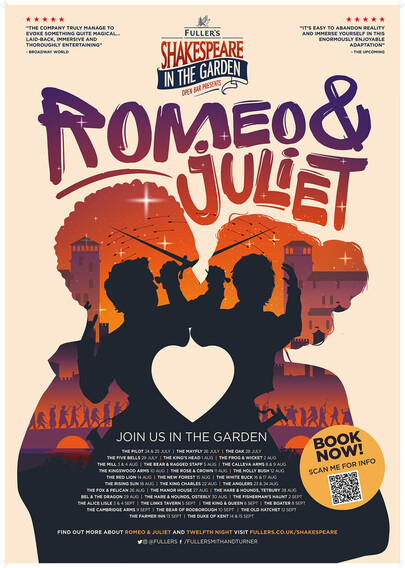
🆕 blog! “Theatre Review: Shakespeare in the Garden's Romeo and Juliet”

Everybody knows the story of Juliet and her Romeo. Everybody. It's a cultural touchstone unlike any other. It has been remixed, reinterpreted, reimagined, and probably remastered into 4K 3D. So what can a new production of it bring? Well, for a start, ukuleles. The …

👀 Read more: https://shkspr.mobi/blog/2023/07/theatre-review-shakespeare-in-the-gardens-romeo-and-juliet/

#review #ShakeRace #shakespeare #theatre

Theatre Review: Shakespeare in the Garden's Romeo and Juliet

Everybody knows the story of Juliet and her Romeo. Everybody. It's a cultural touchstone unlike any other. It has been remixed, reinterpreted, reimagined, and probably remastered into 4K 3D. So what can a new production of it bring? Well, for a start, ukuleles. The cast - all six of them - give the prologue in [...]

Terence Eden’s Blog
This news made my day: the incandescent Fat Ham is transferring to Broadway!! Congrats to James Ijames, Saheem Ali, the Public, and the National Black Theater! #ShakeRace https://criterionticketing.com/fat-ham
Queue-it