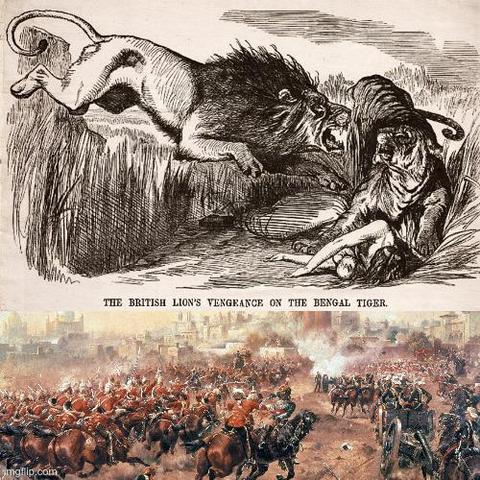
⚔️ #History books say the soldier-led 1857 rebellion ignited India’s fight for independence.

But upon closer examination, the #SepoyMutiny or the #IndianRebellion of 1857’s contributions to the freedom struggle were highly unusual: it led to the end of the #MughalEmpire, the onset of formal British rule, and Indians taking up arms against one another. Many still call the rebellion India’s First War of Independence. Was it?

https://www.thejuggernaut.com/sepoy-mutiny-indian-rebellion-1857-history?s=clzviov1q004ps601k34pakfd

The Sepoy Mutiny: Spark or Setback? | The Juggernaut

History books say the soldier-led 1857 rebellion ignited India’s fight for independence. Not everyone agrees.

The Juggernaut
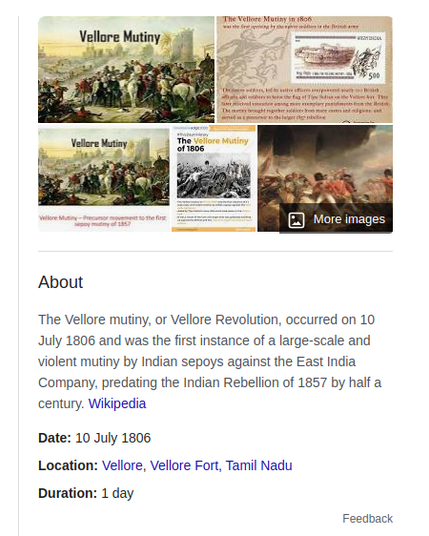
218th #Anniversary of #VelloreMutiny that sowed the seeds of #SepoyMutiny half a century later!

Florence Nightingale in Mike Davis's Late Victorian Holocausts:

.> The more one hears about this famine, the more one feels that such a hideous record of human suffering and destruction the world has never seen before..> — Florence Nightingale (1877).> The newly constructed railroads, lauded as institutional safeguards against famine, were instead used by merchants to ship grain inventories from outlying drought-stricken districts to central depots for hoarding (as well as protection from rioters). Likewise the telegraph ensured that price hikes were coordinated in a thousand towns at once, regardless of local supply trends..> Dissident journalists like William Digby in Madras... and the Bombay Statesman’s representative in the Deccan stirred troubling memories of the Irish famine as well as the #SepoyMutiny. In England, moreover, a group of old Indian hands and Radical reformers, including William Wedderburn, Sir Arthur Cotton, John Bright, Henry Hyndman and Florence Nightingale, kept The Times’s letters column full of complaints about #Calcutta’s callous policies..> Obdurate Bombay officials meanwhile continued to outrage Indians and incite charges of a cover-up in the press by refusing to publish any estimate of rural mortality. (Even Florence Nightingale was snubbed when she requested figures in early 1878.).> The bubonic plague came to Bombay in summer 1896 probably as a stowaway on a ship from Hong Kong. At the time, some scientists theorized that drought, as previously in southern China, was a critical factor in driving plague-carrying rats into more intimate commensality with human victims.36 Bombay, in any event, offered an ideal ecology for a pandemic: fetid, overcrowded slums (perhaps the densest in Asia) infested with a huge population of black rats. For years health officers had warned #British administrators that their refusal to expend anything on slum sanitation was preparing the way for an “epidemic apocalypse.” Florence Nightingale, in addition, had repeatedly crusaded against the city’s “phantasmagoria” of disease conditions, but the “European townspeople were united in blocking increased taxation to pay for new water and drainage schemes.”.> The railroad system, meanwhile, consumed (to 1880) thirteen times as much investment as all hydraulic works. As the pro-irrigation lobby led by Sir Arthur Cotton and Florence Nightingale protested during the 1876–77 famine: “Now we have before our eyes the sad and humiliating scene of magnificent Works... that have cost poor India 160 millions, which are so utterly worthless in the respect of the first want of India, that millions are dying by the side of them.” ( #Gandhi, echoing this critique, would later denounce the railroads that “depleted the countryside of its [food] stocks and killed the handicrafts” as an underlying cause of #famine.) #India #Madras #FlorenceNightingale #Bombay #BubonicPlague #IrishFamine #Railroads #Telegraph #TechWillSaveUs?

A sepoy was an Indian soldier in the armies of various states and European trading companies in the Indian subcontinent and then, from the second half of the 19th century, in the British Indian Army. Recruited from many different population and religious groups, sepoys came to dominate the British armed forces in the subcontinent, even if they were not permitted to become officers until the 20t... https://www.worldhistory.org/Sepoy/?utm_source=Mastodon&utm_medium=Zapier&utm_campaign=whencyclopedia #history #SepoyMutiny #Sepoy #EastIndiaCompany
Sepoy

A sepoy was an Indian soldier in the armies of various states and European trading companies in the Indian subcontinent and then, from the second half of the 19th century, in the British Indian Army...

World History Encyclopedia