the videos for stoc are out. i heartily recommend checking out ian's talk:
https://www.youtube.com/watch?v=pWT4krti5bM

the two of us work in different subfields of cs theory but we spent a long time chatting about ways to make paper talk videos more engaging. i made an attempt at this with my own video last year, but ian takes it to an enviable new level. absolutely knocked it out of the park


#cstheory #computerscience #STOC2024

STOC24 7 C 2 Tree Evaluation is in Space O(log n log log n)

YouTube

#STOC2024 recorded talks are online. My coauthor Ian Mertz did a bang-up job on our surprisingly low-space algorithm for the Tree Evaluation Problem: https://m.youtube.com/watch?v=pWT4krti5bM

The full list: https://m.youtube.com/playlist?list=PL2200vk1q4pnoZJZphNyvIFzB3UnUZEmj

STOC24 7 C 2 Tree Evaluation is in Space O(log n log log n)

YouTube
Day 1 of #STOC2024: an excellent talk by my recently deceased PhD advisor, Luca Trevisan, about spectral graph theory and his own experiences of being an outsider in three different ways: joining the field of theoretical CS from outside the normal pipeline, being gay, and most recently having a visible illness. Pravesh Kothari and Salil Vadhan did an amazing job presenting his final talk.

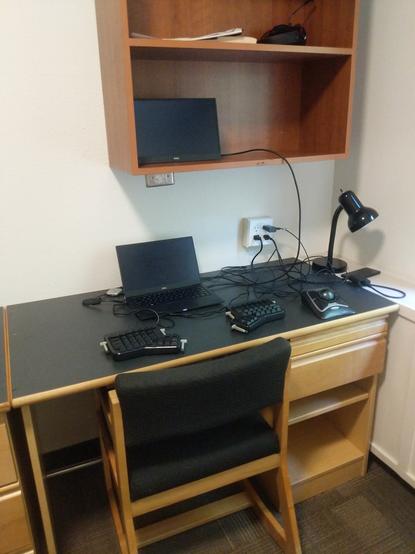
I'm settled in to my ho(s)tel room for the week for #STOC2024. I just wish I could get both screens into a reasonable position at eye level. With pillows on the chair, the monitor on the shelf is about right.

(I'm staying in a dorm room at the University of British Columbia marketed as a hostel for visitors over the summer. Much cheaper than a normal hotel. I was a bit worried, but so far I love the room.)

#STOC #STOC24

I'm proud to say "Tree Evaluation is in Space O(log n · log log n)", my paper with Ian Mertz, was accepted to #STOC2024.

Tree Evaluation [0] was supposed to require way more than O(log n) space. The problem was designed specifically in the hope that someone could prove that's the case, thus proving L ≠ P, i.e. that there are problems that can be solved in polynomial time but not with O(log n) space.

[0] https://arxiv.org/abs/1005.2642

(1/4)

Pebbles and Branching Programs for Tree Evaluation

We introduce the Tree Evaluation Problem, show that it is in logDCFL (and hence in P), and study its branching program complexity in the hope of eventually proving a superlogarithmic space lower bound. The input to the problem is a rooted, balanced d-ary tree of height h, whose internal nodes are labeled with d-ary functions on [k] = {1,...,k}, and whose leaves are labeled with elements of [k]. Each node obtains a value in [k] equal to its d-ary function applied to the values of its d children. The output is the value of the root. We show that the standard black pebbling algorithm applied to the binary tree of height h yields a deterministic k-way branching program with Theta(k^h) states solving this problem, and we prove that this upper bound is tight for h=2 and h=3. We introduce a simple semantic restriction called "thrifty" on k-way branching programs solving tree evaluation problems and show that the same state bound of Theta(k^h) is tight (up to a constant factor) for all h >= 2 for deterministic thrifty programs. We introduce fractional pebbling for trees and show that this yields nondeterministic thrifty programs with Theta(k^{h/2+1}) states solving the Boolean problem "determine whether the root has value 1". We prove that this bound is tight for h=2,3,4, and tight for unrestricted nondeterministic k-way branching programs for h=2,3.

arXiv.org