 Giuseppe Bilotta
When this post https://mastodon.social/@coreyspowell/113807316007617909 by @coreyspowell popped up in my feed just now my first thought was: «wait, I'm pretty sure I saw something similar at a recent #SPHERIC conference» so of course I checked the linked paper (<https://www.nature.com/articles/s41561-024-01612-0.epdf?sharing_token=9Q4L9YJs0dXIOXIb7dJ9F9RgN0jAjWel9jnR3ZoTv0NvCuY-CCmAUDS-e_nTUnvNU1gexpN1yz5LgFWb6OYeZtFJos0bQQeDtkY5TswjWh9TsZvZ6a44fcxf1Kw-c1KkueYZqv6G1Lx7wrnS7EBY4v1kIZ-srQuT1Md7nJKtojM%3D>) and lo and behold, they do use #SPH #SmoothedParticleHydrodynamics
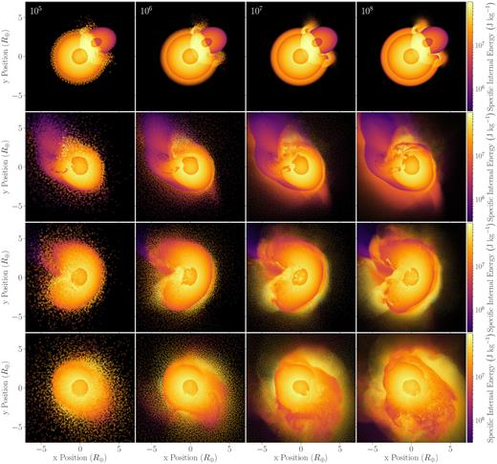
However, I had a feeling it wasn't exactly the same, and by digging deeper in my memory, I realized that indeed what I had seen wasn't (a preview of) this work, but a #SPHERIC2019 contribution about simulating impacts on planetary giants with #SWIFT (a well-known SPH code for #astrophysics, the field SPH was originally designed for, available from <https://www.swiftsim.com>) with Uranus as a test case. You can read the full article here:
https://doi.org/10.1093/mnras/stz1606
and see a high-resolution animation of the Uranus impact, as well as other simulations, at https://icc.dur.ac.uk/giant_impacts/
Capture of an ancient Charon around Pluto | Nature Geoscience
Pluto and Charon are the largest binary system in the known population of trans-Neptunian objects in the outer Solar System. Their shared external orbital axis suggests a linked evolutionary history and collisional origin. Their radii, ~1,200 km and ~600 km, respectively, and Charon’s wide circular orbit of about 16 Pluto radii require a formation mechanism that places a large mass fraction into orbit, with sufficient angular momentum to drive tidal orbital expansion. Here we numerically model the collisional capture of Charon by Pluto using simulations that include material strength. In our simulations, friction distributes impact momentum, leading Charon and Pluto to become temporarily connected, instead of merging, for impacts aligned with the target’s rotation. In this ‘kiss-and-capture’ regime, coalescence of the bodies is prevented by strength. For a prograde target rotation consistent with the system angular momentum, Charon is then tidally decoupled and raised into a near-circular orbit from which it migrates outwards to distances consistent with its present orbit. Charon is captured relatively intact in this scenario, retaining its core and most of its mantle, which implies that Charon could be as ancient as Pluto. Numerical simulations suggest that Pluto’s moon Charon was captured intact, in a scenario in which the two bodies temporarily merged in a collision but did not coalesce due to solid strength effects.