James‑Webb offre la vue la plus profonde de l’univers : SMACS 0723 révèle des milliers de galaxies invisibles jusqu’alors, records battus.
https://www.futura-sciences.com/sciences/actualites/astronomie-fin-enigme-mysterieuses-etoiles-s-autour-trou-noir-geant-voie-lactee-124276/
#Space #Astrophysics #DeepField #SMACS0723 #CosmicHorizon
Fin de l'énigme pour les mystérieuses étoiles « S » autour du trou noir géant de la Voie lactée ?

Les astrophysiciens ont mis à profit depuis longtemps l'étude d'étoiles orbitant parfois à une fraction de la vitesse de la lumière autour du trou noir supermassif de la Voie lactée, non seulement pour estimer sa masse, mais aussi pour tester la théorie de la relativité générale d'Einstein. Baptisées S, ces étoiles avaient cependant des caractéristiques inexplicables... jusqu'à aujourd'hui.
Futura

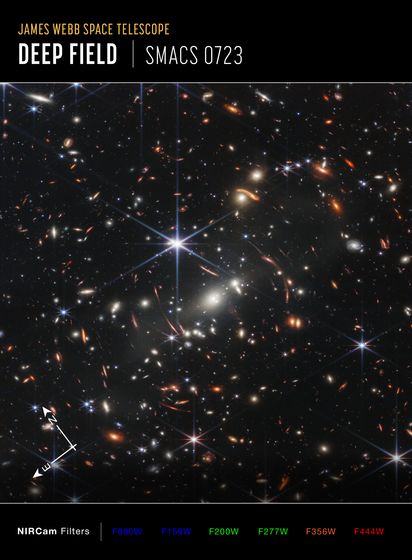
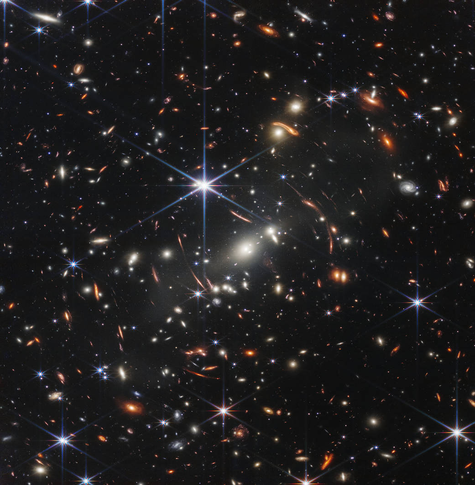
This deep field, taken by Webb’s NIRCam is a composite made from images at different wavelengths, totaling 12.5 hours –achieving depths at infrared wavelengths beyond the Hubble's deepest fields, which took weeks.

It shows the galaxy cluster #SMACS0723 as it appeared 4.6 billion yrs ago. The combined mass of this #SMACS0723 acts as a gravitational lens, magnifying much more distant galaxies behind it. Webb’s NIRCam has brought those distant galaxies into sharp focus.

https://webbtelescope.org/contents/media/images/2022/038/01G7JJTZJTA8BY731JS2S7P5SZ?news=true

Webb’s First Deep Field, This image of galaxy cluster #SMACS0723 is overflowing with detail as it appeared 4.6 billion years ago.

Thousands of galaxies {Most appear as fuzzy ovals, but a few have distinct spiral arms} – including the faintest objects ever observed in the infrared – have appeared in Webb’s view for the first time. This slice of the vast universe is approximately the size of a grain of sand held at arm’s length by someone on the ground.

#Space #Swaraj #STSI #jwst
1/2

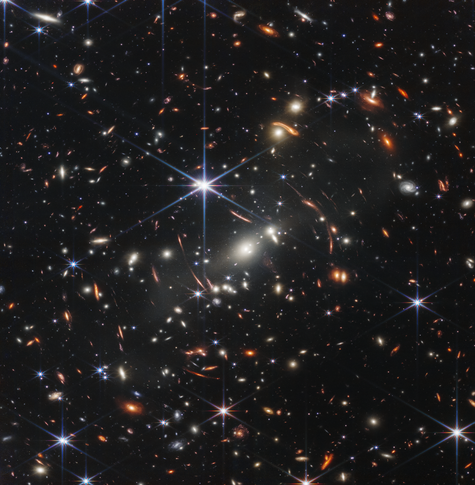
The #Webb's #FirstDeepField, centered on a #cluster of #galaxies named #SMACS0723 and containing no less than 7,000 galaxies.

This image has proven to be an important target for the study of #galaxyevolution as it contains a large number of very distant galaxies which shed light on how galaxies formed and evolved in the #earlyuniverse.

https://phys.org/news/2023-11-astronomers-earth-galaxies.html?utm_source=nwletter&utm_medium=email&utm_campaign=daily-nwletter

Astronomers now know how far the Earth is from 200 galaxies

On July 11, 2022, the very first image taken by the James Webb Space Telescope (JWST) was released to the general public. It's called Webb's First Deep Field, centered on a cluster of galaxies named SMACS 0723 and containing no less than 7,000 galaxies.

Phys.org

#SMACS0723, a previously understudied region of #Space, is being viewed through the #JamesWebbSpaceTelescope as it appeared 4.6 billion years ago, providing new insights into the early #Universe.

More information: https://webbtelescope.org/contents/media/images/2022/035/01G7DDDR3P8ZW10HD8MKXGV8MJ

More information about #JWST’s first images: https://www.nasa.gov/webbfirstimages

#SpaceMastodon #Spacedon #Space #Astronomy #Astrodon #ScienceMastodon #Sciencedon #Science #Webb #GalaxyClusters

Webb’s First Deep Field (MIRI and NIRCam Images Side by Side)

WebbTelescope.org

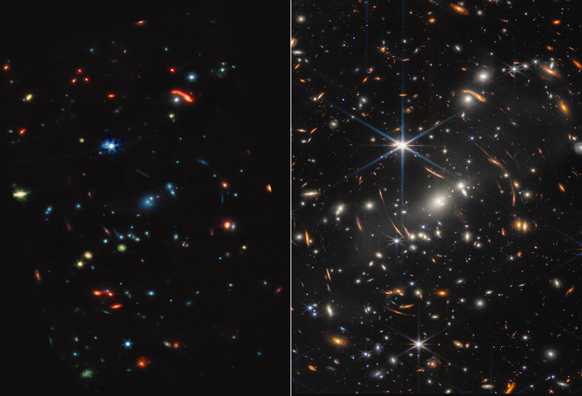
A side by side comparison of the #JamesWebbSpaceTelescope’s First Deep Field (MIRI and NIRCam).

#SMACS0723 is a cluster of #Galaxies located in the southern #Constellation #Volans that contains thousands of galaxies, including some of the faintest objects ever observed in infrared light. When viewed in mid-infrared light (L), the region appears with a range of new colors compared to the near-infrared image (R).

#SpaceMastodon #Space #Astronomy #Astrodon #ScienceMastodon #Science #JWST #Webb

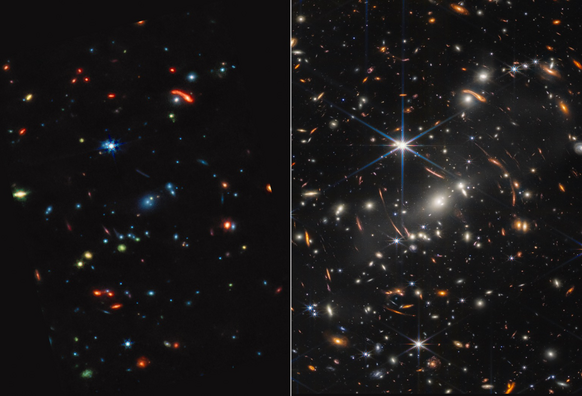
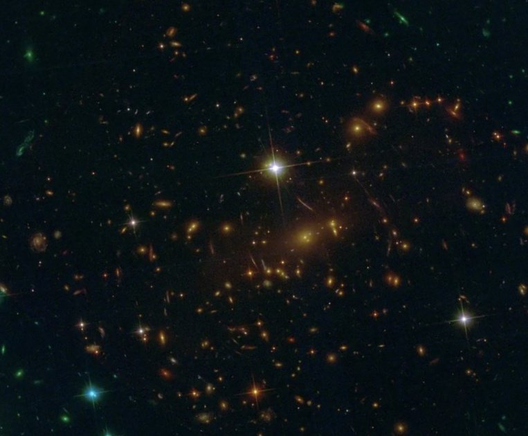
Two views of the galaxy cluster #SMACS0723—#HubbleSpaceTelescope on the left, #JamesWebbSpaceTelescope on the right. #Hubble’s image on the left shows many faint stars and galaxies, but the #Webb image absolutely pops with light, revealing many hidden structures.

Hubble vs Webb: https://webb.nasa.gov/content/about/comparisonWebbVsHubble.html

#SpaceMastodon #Spacedon #Space #Astronomy #Astrodon #ScienceMastodon #Sciencedon #Science #JWST #HST #Galaxies #GalaxyCluster

Comparison: Webb vs Hubble Telescope - Webb/NASA

The James Webb Space Telescope (sometimes called Webb or JWST) is a large infrared telescope with a 6.5-meter primary mirror. Webb is the premier observatory of the next decade, serving thousands of astronomers worldwide. It will study every phase in the history of our Universe, ranging from the first luminous glows after the Big Bang, to the formation of solar systems capable of supporting life on planets like Earth, to the evolution of our own Solar System.

Revisiting the first image of the #JamesWebbSpaceTelescope.

The image provides an unparalleled level of detail of the galaxy cluster #SMACS0723, showing it as it appeared 4.6 billion years ago. SMACS 0723 is a cluster of galaxies located in the southern constellation #Volans and has not been extensively studied in the past.

More information about #JWST’s first images: https://www.nasa.gov/webbfirstimages

#Webb #SpaceTelescopes #Space #Astronomy #Science

First Images from the James Webb Space Telescope

The dawn of a new era in astronomy has begun as the world gets its first look at the full capabilities of NASA’s James Webb Space Telescope, a partnership with ESA (European Space Agency) and CSA (Canadian Space Agency).

NASA

L'amas de galaxies #SMACS0723 tel qu'il est apparu il y a 4,6 milliards d'années

A gauche:
La même portion de ciel prise avec le télescope spatial Hubble en plusieurs semaines (~ 2 semaines ).

A droite:
Celle prise avec le James Webb en environ 12h30.

https://petapixel.com/2022/07/11/comparing-hubble-to-james-webb-the-difference-in-detail-is-astounding/

#JWST

Comparing Hubble to James Webb: The Difference in Detail is Astounding

A huge upgrade.

PetaPixel