2024 January 3

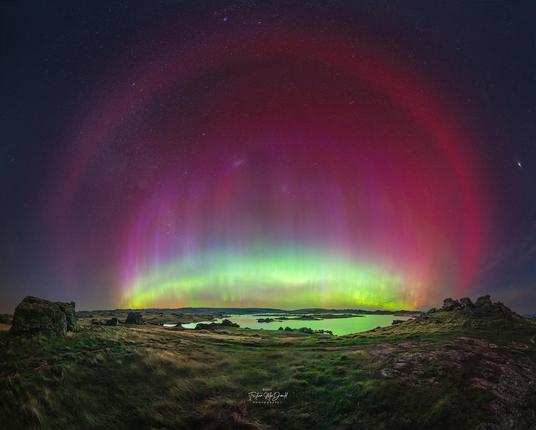
A SAR Arc from New Zealand
* Image Credit & Copyright: Tristian McDonald
https://www.instagram.com/tristianmcdonaldphotography/
Text: Tiffany Lewis (Michigan Tech U.)
https://www.mtu.edu/physics/department/faculty/lewis/
https://www.mtu.edu/physics/

Explanation:
What is that unusual red halo surrounding this aurora? It is a Stable Auroral Red (SAR) arc. SAR arcs are rare and have only been acknowledged and studied since 1954. The featured wide-angle photograph, capturing nearly an entire SAR arc surrounding more common green and red aurora, was taken earlier this month from Poolburn, New Zealand, during an especially energetic geomagnetic storm. Why SAR arcs form remains a topic of research, but is likely related to Earth's protective magnetic field, a field created by molten iron flowing deep inside the Earth. This magnetic field usually redirects incoming charged particles from the Sun's wind toward the Earth's poles. However, it also traps a ring of ions closer to the equator, where they can gain energy from the magnetosphere during high solar activity. The energetic electrons in this ion ring can collide with and excite oxygen higher in Earth's ionosphere than typical auroras, causing the oxygen to glow red. Ongoing research has uncovered evidence that a red SAR arc can even transform into a purple and green STEVE
https://www.windows2universe.org/glossary/aurora_SARARC.html
https://apod.nasa.gov/apod/ap231111.html
https://youtu.be/DLxQsUAXKag
https://en.wikipedia.org/wiki/Geomagnetic_storm
https://science.nasa.gov/science-research/planetary-science/earths-magnetosphere/
https://physics.stackexchange.com/questions/385388/even-if-molten-iron-is-ionized-spins-how-does-it-make-a-mag-field
https://spaceplace.nasa.gov/menu/earth/
https://apod.nasa.gov/apod/ap000318.html
https://en.wikipedia.org/wiki/Ring_current
https://science.nasa.gov/heliophysics/focus-areas/magnetosphere-ionosphere/
https://apod.nasa.gov/apod/ap160731.html
https://en.wikipedia.org/wiki/Ion
https://science.nasa.gov/earth/10-things-to-know-about-the-ionosphere/
https://apod.nasa.gov/apod/ap230730.html
https://agupubs.onlinelibrary.wiley.com/doi/full/10.1029/2022GL101205
https://apod.nasa.gov/apod/ap230927.htmlhttps://eos.org/research-spotlights/from-sar-arc-to-steve-an-atmospheric-evolution

https://apod.nasa.gov/apod/ap240103.html

#space #earth #SAR_arcs #astrophotography #photography #NASA #science #physics #nature #education
2023 November 11

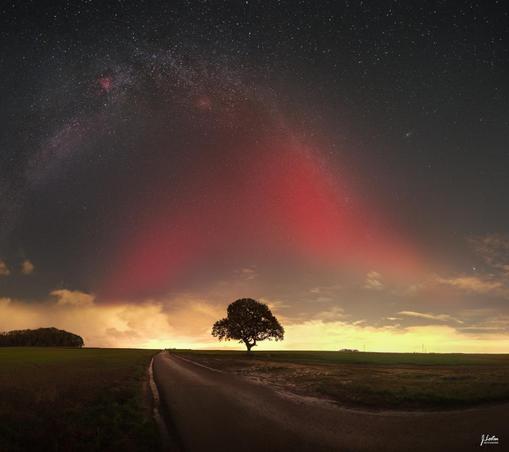
The SAR Arc and the Milky Way
* Image Credit & Copyright: Julien Looten
https://www.flickr.com/photos/julienlooten/

Explanation:
This broad, luminous red arc was a surprising visitor to partly cloudy evening skies over northern France. Captured extending toward the zenith in a west-to-east mosaic of images from November 5, the faint atmospheric ribbon of light is an example of a Stable Auroral Red (SAR) arc. The rare night sky phenomenon was also spotted at unusually low latitudes around world, along with more dynamic auroral displays during an intense geomagnetic storm. SAR arcs and their relation to auroral emission have been explored by citizen science and satellite investigations. From altitudes substantially above the normal auroral glow, the deep red SAR emission is thought to be caused by strong heating due to currents flowing in planet Earth's inner magnetosphere. Beyond this SAR, the Milky Way arcs above the cloud banks along the horizon, a regular visitor to night skies over northern France.
https://agupubs.onlinelibrary.wiley.com/doi/full/10.1029/2022GL098511
https://www.flickr.com/photos/julienlooten/53311294522/
https://agupubs.onlinelibrary.wiley.com/doi/full/10.1029/2022GL101205
https://spaceweather.com/archive.php?view=1&day=07&month=11&year=2023
https://eos.org/research-spotlights/from-sar-arc-to-steve-an-atmospheric-evolution
https://apod.nasa.gov/apod/ap230927.html

https://apod.nasa.gov/apod/ap231111.html

#space #earth #SAR_arcs #astrophotography #photography #NASA #science #physics #nature #education
From Spaceweatherarchive:

Earth’s Ring Current System Just Sprang a Leak

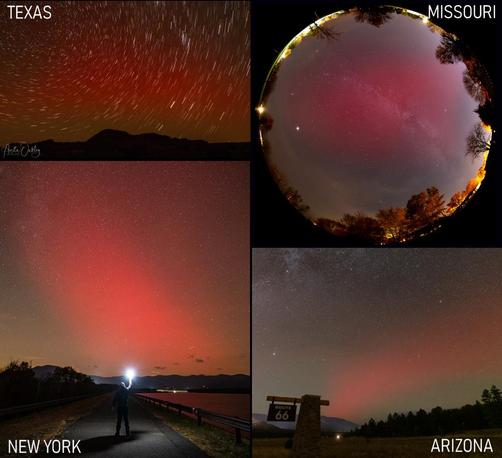
“This was a new phenomenon to me,” says Jeremy Perez, who took the Arizona picture. “I had never heard of SARs before, but I kept shooting anyway.”

SAR arcs were discovered in 1956 at the beginning of the Space Age. Researchers didn’t know what they were and unwittingly gave them a misleading name: “Stable Auroral Red arcs” or SAR arcs. In fact, SAR arcs are neither stable nor auroras.

Auroras appear when charged particles rain down from space, hitting the atmosphere and causing it to glow. SAR arcs form differently. They are a sign of heat energy leaking into the upper atmosphere from Earth’s ring current system–a donut-shaped circuit carrying millions of amps around our planet.

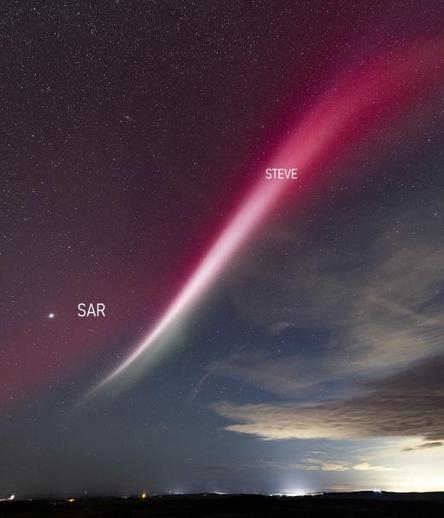
Recent research has linked SAR arcs to another phenomenon that is not an aurora: STEVE. The mauve ribbon in the sky was not originally thought to have anything to do with Earth’s ring current. Yet in 2015, observers in New Zealand caught a bright red SAR arc transforming itself into STEVE like a caterpillar into a butterfly.

“The connection is still elusive,” says Carlos Martinis, a leading researcher in the field at Boston University. “Sometimes SAR arcs evolve into STEVE–but not always. This is a very active field of research, involving citizen scientists and researchers.”

CREDITS
* Article Text: Dr.Tony Phillips
Spaceweather.com

* Artist Concept: Johns Hopkins APL
* Photos:
Anita Oakley, Dan Bush, James Perez-Rogers, Jeremy Perez, Mark Savage

https://spaceweatherarchive.com/2023/11/08/earths-ring-current-system-just-sprang-a-leak/

#space #earth #SAR_arcs #astrophotography #photography #NASA #science #physics #nature #education