RoboCop de retour : Amazon prépare une nouvelle série inspirée du film culte de science-fiction

Le célèbre policier cybernétique s’apprête à faire son grand retour. Selon plusieurs informations concordantes, Amazon MGM Studios a donné son feu vert à une nouvelle série consacrée à RoboCop, destinée à sa plateforme Prime Video. Ce projet, évoqué depuis plusieurs années, semble désormais entrer dans une phase concrète, ravivant l’intérêt autour d’une franchise emblématique de la science-fiction.

Une relance officielle d’un univers culte

Le développement de cette nouvelle série marque une étape importante pour une franchise qui n’a jamais totalement disparu du paysage culturel. En validant officiellement le projet, Amazon MGM Studios confirme sa volonté de capitaliser sur des univers connus tout en les adaptant aux attentes contemporaines.

Initialement annoncé en 2024, ce reboot télévisé avait suscité une certaine curiosité, sans pour autant donner lieu à des avancées concrètes immédiates. Aujourd’hui, les choses semblent évoluer de manière plus tangible. Le projet s’inscrit dans une stratégie globale visant à enrichir l’offre de Prime Video avec des contenus à forte identité.

À la tête de cette nouvelle adaptation, le nom de Peter Ocko avait été évoqué comme showrunner. Connu pour son travail sur des séries au ton singulier, il pourrait insuffler une approche différente à cet univers, traditionnellement marqué par une esthétique sombre et une critique sociale appuyée.

Par ailleurs, le producteur James Wan, figure reconnue du cinéma de genre, avait été associé au projet via sa société Atomic Monster. Si la composition définitive de l’équipe créative reste encore incertaine, ces premières pistes laissent entrevoir une orientation artistique ambitieuse.

Un récit ancré dans une thématique toujours actuelle

La série devrait reprendre les fondements narratifs qui ont fait le succès du premier film. L’intrigue repose sur une collaboration entre une puissante entreprise technologique et les forces de l’ordre, visant à créer une nouvelle génération d’agents chargés de lutter contre la criminalité.

Au cœur de ce dispositif : un policier transformé en entité hybride, à la fois humain et machine. Ce concept, qui mêle avancées technologiques et questionnements éthiques, conserve une résonance particulière à l’heure où les débats sur l’intelligence artificielle, la surveillance et l’influence des grandes entreprises occupent une place centrale dans la société.

Le projet pourrait ainsi trouver un écho contemporain en explorant ces problématiques sous un angle fictionnel. Toutefois, certains observateurs s’interrogent sur la capacité de cette nouvelle adaptation à se démarquer d’une histoire déjà largement connue.

L’enjeu sera donc de proposer une lecture renouvelée de cet univers, sans se limiter à une simple relecture du matériau d’origine. La richesse du monde de RoboCop offre en effet un terrain propice à des récits variés, au-delà de la trame initiale.

L’héritage d’un film devenu référence

Impossible d’évoquer ce retour sans rappeler l’importance du film original réalisé par Paul Verhoeven. Sorti en 1987, RoboCop s’était distingué par sa capacité à mêler action spectaculaire et satire sociale incisive.

Ce long métrage a donné naissance à une franchise composée de plusieurs suites, dont RoboCop 2 et RoboCop 3, ainsi qu’un remake sorti en 2014. Si ces productions ont suscité des réactions contrastées, l’impact du film original demeure intact.

Au fil des décennies, RoboCop s’est imposé comme une figure emblématique de la culture populaire, incarnant à la fois les dérives d’un monde dominé par les corporations et les interrogations liées à la déshumanisation.

La franchise a également connu plusieurs déclinaisons télévisées, avec notamment des séries animées et live-action diffusées entre la fin des années 1980 et le début des années 2000. Toutefois, aucune de ces adaptations n’a véritablement réussi à retrouver l’équilibre entre violence, humour noir et critique sociale qui caractérisait l’œuvre originale.

Entre attentes et interrogations du public

L’annonce de cette nouvelle série suscite à la fois enthousiasme et prudence. D’un côté, les amateurs de science-fiction voient dans ce projet l’opportunité de redécouvrir un univers riche, porté par des thématiques toujours pertinentes. De l’autre, la question de la fidélité à l’esprit du film original reste centrale.

Le succès de la série dépendra en grande partie de sa capacité à préserver l’identité de la franchise tout en proposant une vision adaptée aux enjeux actuels. L’équilibre entre modernisation et respect du matériau d’origine constitue un défi majeur pour les équipes créatives.

Le public, désormais habitué à des productions ambitieuses en matière de séries, attend une qualité d’écriture et de réalisation à la hauteur des standards actuels. Dans ce contexte, la marge d’erreur est réduite.

Ce que l’on peut attendre de cette nouvelle adaptation

Si les détails restent encore limités, plusieurs éléments permettent d’esquisser les contours de cette future série. Le choix de s’appuyer sur les fondamentaux narratifs laisse présager une certaine continuité avec l’œuvre originale, tout en ouvrant la voie à de nouvelles explorations.

Le format sériel offre également des possibilités inédites en termes de développement des personnages et d’approfondissement des enjeux. Contrairement à un film, une série permet d’installer une progression narrative plus étendue, susceptible de renforcer l’immersion.

Enfin, la plateforme Prime Video dispose des moyens nécessaires pour produire une œuvre ambitieuse sur le plan visuel et technique. Reste à savoir si cette ambition se traduira par une proposition artistique à la hauteur des attentes.

Le retour de RoboCop sous forme de série marque une nouvelle étape dans l’évolution d’une franchise emblématique. En validant ce projet, Amazon MGM Studios mise sur un univers reconnu pour séduire un public à la fois nostalgique et curieux. Entre héritage cinématographique et enjeux contemporains, cette adaptation devra trouver sa propre identité pour s’imposer durablement. À l’heure où les plateformes multiplient les reboots et adaptations, la réussite de RoboCop dépendra de sa capacité à dépasser le simple effet de nostalgie.

Ce qu’il faut retenir

  • Une nouvelle série RoboCop en développement chez Amazon MGM Studios
  • Une diffusion prévue sur Prime Video
  • Un projet lancé initialement en 2024 et désormais confirmé
  • Une intrigue centrée sur un policier mi-homme, mi-machine
  • Un univers toujours pertinent face aux enjeux technologiques actuels
  • Un héritage fort issu du film culte de 1987
  • De fortes attentes autour de la qualité et de l’originalité
#AmazonMGMStudios #IAFiction #PaulVerhoeven #PrimeVideoRoboCop #rebootRoboCop #RoboCop1987 #RoboCopSérie #sérieDystopique #scienceFictionSérie

![media-1]
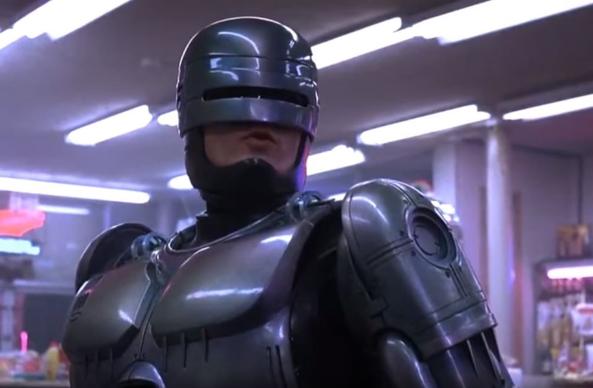
I think about this scene a lot.

He has just had his whole body turned against him by a company exec openly telling him he is a product, not a person, then been dehumanized, misgendered and nearly killed by a dozens of colleagues. His body is a mess and the grafted face under the armor is unnerving without the helmet.
He removes the helmet, and it's not a pretty sight. His face, his body movements, the deliberate harm done to his explicit memories to make him useful only as a company product, because the company owned his body, his skills, his memories of his wife and child, and did not value those and threw them away, along with the arm the doctors managed to save.
And he's still feeling that the next morning.
To Lewis' credit, she doesn't look away, despite what I think is obvious discomfort, and says something that must be true also: "It's good to see you, Murphy." Because she is glad of him, glad he's there.

There's a lot going on in this emotional nadir. When he says he's not hungry, perhaps it is because he's being offered baby food -- basically similar to the "nutrient paste" he was being fed for his "rudimentary" digestive system -- but I think it's because he feels sick. He has just been told his wife and child, who he had to learn about through investigating himself in police archives, moved away to start a new life elsewhere.
"I can feel them, but I can't remember them."
They own the way he twirls his pistol, they own the cheesy lines he says, they own his face that's stretched across his metal skull.

There are shortcomings to using this metaphor to describe gender dysphoria as I experience it -- one person responded to this by asking why RoboCop still considers himself a man if he doesn't have a dick anymore, which kinda ended that conversation -- but it's the best I've really got at present. That horrible sense that someone else has chosen the meaning of my body and self, that its meaning is not in fact mine to assert. That it has an inherent meaning, and that meaning is that I am a man.
It makes me nauseous when that happens too.


#robocop #robocop-1987 #officer-murphy #gender-dysphoria

Originally posted to Cohost @macksting

Full disclosure, this is gonna be fairly stream-of-consciousness, and is directly reposted from a rant I said in a venting channel. I genuinely don't think any of these takes are dogshit, but am prepared to be called out for dogshit takes from this because I in fact did not carefully think this through. There are also spoilers for RoboCop (1987) and Us (2019), which I can't figure out how to conceal except by warning you now.

Compared to everything else on my mind, it's really very minor, but I suppose after a rough day like today, it's no surprise I'd be thinking about it:

If it weren't so difficult, I don't think semantically I'd bother saying I'm not human. My feelings of kinship with machines, with robots and automata, including with unintelligent machines, wouldn't be so strong if I weren't going through some shit all my life.

It's kind of incredible to me, when I think about it, that there are folks who look at me as if I were unreal, even inhuman, just for having not grown up in the socio-economic situation they did.

It's a minor point, really, compared to all the other ways people are defined or described as inhuman, but that's kind of my point. The concept of human that most folks have is weirdly tight, just this small, rigid archetype with countless exceptions that are, to them, off-model.
It's kind of weird for me to be going on about this, in a way, but like… the question of what is human, with the answer being "more than you think, and yet easily taken away unjustly," comes up a lot in the media I'm fond of. I'm rewatching RoboCop, as I am wont to do, and a making-of I saw pointed out that something that Weller did for the character, demanded for the character in fact, was moving with a dancer's precision. If RoboCop, if Murphy the robocop, moved like most folks do, he wouldn't be uncanny.

That's it, isn't it. There's human, and then there's uncanny.

That comes up in Us, too. Red, Adelaide's double, is a dancer, and uses those same motions, standing on point, pivoting, isolations, etc., beautifully. And it is so beautiful. But she is so uncanny. And it's for the same purpose. Us is in fact incredibly direct about it. Both are, in a way. These are dehumanized characters, and the narrative is sympathetic whether it casts them as protagonist or antagonist.

(Shoutout to Lupita Nyong'o, whose acting in the roles of Adelaide and Red was absolutely captivating, and whose casting was absolutely perfect. All the actors in that film were amazing, the direction and writing were enthralling, and the visual metaphors and implicit historical references are not talked about enough. Folks are sleeping on this entire movie.)

I'm human, but I'm uncanny, so I am often dehumanized.

Well… I actually tend not to call myself human. It's not worth the trouble.

(At this point I would like to bring up a fascinating term, "Voidpunk." To quote a reddit community's description of voidpunk,

[blockquote] Voidpunk is a subculture for those who have been dehumanized to reclaim their dehumanization. Many are told that all humans experience romantic and/or sexual attraction, are binary cisgender, are neurotypical, are white etc. This subculture is for those who don't match that criteria of humanity and don't want to match it.
This may not be helpful or necessary for everyone, but I've had a few folks thank me for bringing the concept to their attention, and it seems relevant here.)[/blockquote]

Semantically it is a very personal thing, I don't expect anyone else to adhere to it. If I call myself inhuman, it's to breathe a sigh of relief, y'know? It's to worry less. It's to give myself permission not to meet expectations.

Maybe that's part of why I get bone-deep chills when I encounter antisemitism. It's not about me, but dehumanization is something I directly experience, so it doesn't take much imagination to see how it plays out, how it applies. And, of course, if it happens to me (not antisemitism but dehumanization), generally it's not that big a deal; it's what happens to others that hurts most.

I've thought about that sometimes, that unhealthy traumatized mindset that I sum up by saying, "if someone else falls down the stairs, it's a tragedy. If I do, it's a comedy." I think part of it is, I live with me. I live inside me. So I know what I can handle, and also know that if I can't handle it, that's okay too. Other people, I cannot know how they feel, I cannot know their limits. To me their pain is limitless, their durability unclear and potentially nil. There's no sense of relief, of "it's okay, I'm still here," because I do not know what they can handle. I have heard it said that laughter is a relief, a sign that everything's actually fine; that it often comes from a moment's distress or wrongness, that is responded to with the knowledge that no harm will come of it. A fellow monkey falls out of a tree. We worry. The monkey gets up and walks it off; we laugh because they're okay. (Sometimes, it is that we laugh because they aren't okay, but it happened to someone else, so it'll be okay for us. That's kind of horrible, but demonstrates the concept nevertheless.)

The last time I watched Us with somebody, I had to hold my tongue when they, not knowing the big reveals of the story, began theorizing that the Tethered weren't human, including Red herself. That Red is simply Tethered by circumstance rather than birth is the point. It's why there's that incredibly raw exchange: "What are you people?" "We're Americans." (Which is a whole fascinating conversation all its own; that's not liberation. It's a good point about rights unjustly denied, but -- I'm getting off the subject here.)

It's shocking how little it takes to be uncanny.

Me, performing humanity:
![media-1]
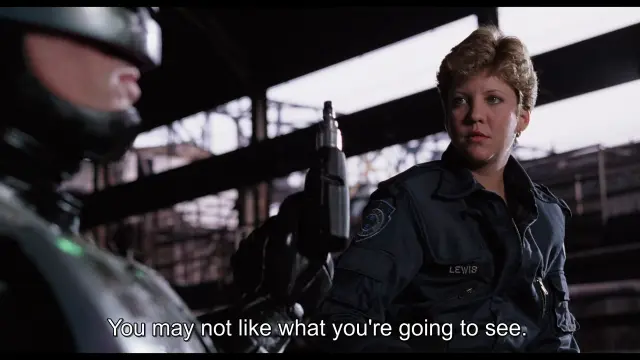
[ID: Scene from RoboCop. Murphy as RoboCop holds a drill. Looking away from Lewis as he prepares to remove his damaged exterior armor, he says to her, "You may not like what you're about to see." /end ID]

It's extremely significant to me that, as we are sold that these uncanny characters are in fact human, and deserving of human dignities that they are denied unjustly, they do not stop moving like dancers. They continue to isolate, to pivot, to move beautifully. When RoboCop realizes he is Murphy, even though he cannot remember who Murphy was, he does not suddenly, magically begin to move fluidly like Lewis and other humans do. He still moves with a dancer's grace, even after much of his armor is removed and his tightly stretched human face becomes the face people see.

Likewise, Red never exactly stops moving with a dancer's grace. It's far more deliberate on her part, not the result of her body being a prosthesis but rather because she is an artist, so it comes and goes, but she never stops being uncanny.

It would have really undermined the rehumanization of these characters if, upon their repatriation to humanity in the viewer's eyes, they suddenly became reliably fluid, no longer uncanny, no longer strange. In the end, they still move like dancers, with uncanny precision and isolation of motion, one voluntarily and one involuntarily.

I don't exactly know where I'm going with this. It's entirely possible I've gone out of my lane, which would not be ideal nor would it be my intention.

There's a whole unwritten chapter of this about Amalthea the unicorn in The Last Unicorn, by the way, about how her uncanniness gave her away to King Haggard and captivated Prince Lir, and how she became less uncanny as she lost more of herself to the enchantment of a human seeming. Or to the voices we put on when working at call centers, to warp ourselves into something acceptable to people on the other end of the phone line, a phenomenon apparently with overlap with White Voice, and played with to create a distressing, uncanny effect in Sorry To Bother You. I'm white, and I still had to warp my way of speaking in strange ways in that job, and that kind of masking makes me feel genuinely nauseous, as does when I see alienation that produces a self-hatred of one's natural body or of harmless distinctions, like when a friend of mine talked about their mother getting rhinoplasty decades ago to make her Persian nose more white because it was fashionable and considered desirable at the time.

A lot of Sorry To Bother You made me nauseous, actually. The second half was almost a relief, as it brought the satire around to its natural absurd conclusions.

(By the way, don't spare me such things; I can't fight what I can't see, and I can tank a little nausea if it helps me identify what needs destroyed.)

Honestly, other than encouraging everyone to read The Murderbot Diaries, particularly the first (and sufficiently standalone) novella "All Systems Red," I think I've said more than I should on this subject, so I'll close here by saying that my lovely wife took ballet when she was younger, and watching her in a boffer fight pivoting and gracefully flowingly dodging and parrying was always such a joy. She remains the light of my life, and always shall be.


#MurderBot-mention #Robocop #The-Last-Unicorn-mention #Sorry-To-Bother-You-mention #Us-2019 #RoboCop-1987 #PeterWeller #LupitaNyong'o #JordanPeele #PaulVerhoeven #shoutout-to-screenwriters-Edward-Neumeier-and-Michael-Miner #ARetreadFromMy #cohost #cohost-migration
“Stay out of trouble!”

All shot practically except the little sparks where Eds head used be be before Murphy blew it off.

#robocop1987 #robocop #toyphotography #miniaturephotography #ed209 #80sscifi #scifiart