📄 Limits on the 21 cm Power Spectrum at z = 6.5–7.0 from Murchison Wide…

Quicklook:
Nunhokee, C. D. et al. (2025) · The Astrophysical Journal
Reads: 284 · Citations: 19
DOI: 10.3847/1538-4357/adda45

🔗 https://ui.adsabs.harvard.edu/abs/2025ApJ...989...57N/abstract

#Astronomy #Astrophysics #Cosmology #Reionization #HILineEmission

Limits on the 21 cm Power Spectrum at z = 6.5–7.0 from Murchison Widefield Array Observations

This paper presents the spherically averaged 21 cm power spectrum derived from Epoch of Reionization (EoR) observations conducted with the Murchison Widefield Array (MWA). The analysis uses EoR0-field data, centered at (R.A. = 0h, decl. = ‑27<SUP>∘</SUP>), collected between 2013 and 2023. Building on the improved methodology described in C. M. Trott et al. (2024), we incorporate additional data quality control techniques introduced in C. D. Nunhokee (2020). We report the lowest-power-level limits on the EoR power spectrum at redshifts z = 6.5, z = 6.8, and z = 7.0. These power levels, measured in the east–west polarization, are (30.2)<SUP>2</SUP> mK<SUP>2</SUP> at k = 0.18 h Mpc<SUP>‑1</SUP>, (31.2)<SUP>2</SUP> mK<SUP>2</SUP> at k = 0.18 h Mpc<SUP>‑1</SUP>, and (39.1)<SUP>2</SUP> mK<SUP>2</SUP> at k = 0.21 h Mpc<SUP>‑1</SUP>, respectively. The total integration time amounts to 268 hr. These results represent the deepest upper limits achieved by the MWA to date and provide the first evidence of the heated intergalactic medium at redshifts z = 6.5 to 7.0.

ADS
Improved Limits on the 21 cm Signal at z = 6.5–7.0 (the Epoch of #Reionization) with the Murchison Widefield Array Using Gaussian Information: https://iopscience.iop.org/article/10.3847/1538-4357/adff80 -> Astronomers hunting for evidence of the light from the first stars and galaxies have found that the Universe was warm, rather than cold, before it “lit up”: https://www.icrar.org/eor-limit/
Radware Bot Manager Captcha

Weekly Update from the Open Journal of Astrophysics – 16/08/2025

It’s time once again for the usual update of papers published at the Open Journal of Astrophysics which I do every Saturday. Since the last update we have published two new papers, which brings the number in Volume 8 (2025) up to 116, and the total so far published by OJAp up to 351. The summer lull we always expected is now upon us, so this will be a shorter post than we have had of late.

The first paper to report this week is “The reflex instability: exponential growth of a large-scale mode in astrophysical discs” by Aurélien Crida (Université Côte d’Azur, France), Clément Baruteau (Université de Toulouse, France), Jean-François Gonzalez (Universite Claude Bernard Lyon 1, France), Frédéric Masset (Universidad Nacional Autonoma de México) and Paul Segretain, Philippine Griveaud, Héloïse Méheut & Elena Lega (Université Côte d’Azur).  This paper was published on Tuesday August 12th 2025 in the folder marked “Earth and Planetary Astrophysics“. It discusses a exponentially-growing instability in gas discs around stars caused by the motion of the central star in response to the disc.

The overlay – which you can make larger by clicking on it – is here:

You can find the officially accepted version on arXiv here.

The other paper this week, published in the folder Cosmology and Nongalactic Astrophysics, is “The galaxy-IGM connection in THESAN: the physics connecting the IGM Lyman-alpha opacity and galaxy density in the reionization epoch” by Enrico Garaldi (University of Tokyo, Japan), Verena Bellscheidt (Technical University of Munich, Germany), Aaron Smith (York University, Canada) and Rahul Kannan (University of Texas at Dallas, USA).  It presents a study of the relation between the Lyman-alpha effective optical depth of quasar sightlines and the distribution of galaxiesas as a probe of ionized regions around sources of photons. It was published on Wednesday August 13th 2025.

The overlay is here:


You can find the officially accepted version of the paper on arXiv here.

That concludes the papers for this week. I’ll do another update next weekend, though I expect things will remain relatively quiet until September.

#arXiv241002853v2 #arXiv250807859v1 #circumstellarDisks #CosmologyAndNonGalacticAstrophysics #DiamondOpenAccess #DiamondOpenAccessPublishing #EarthAndPlanetaryAstrophysics #LymanAlphaAbsorption #OpenJournalOfAstrophysics #quasars #reionization #TheOpenJournalOfAstrophysics #THESANSimulations

JWST discovers how we’re able to see the Universe at all It's only because all of the neutral atoms in intergalactic space became ionized that we can see so far away through space. JWST, at last, has found who the culprit is. bigthink.com/starts-with-... #space #astronomy #jwst #reionization

JWST discovers how we're able ...
JWST discovers how we're able to see the Universe at all

For hundreds of millions of years, a cosmic fog blocked all signs of starlight. At last, JWST found the galaxies that cleared that fog away.

Big Think

Tiny galaxies with massive impact—Webb reveals who really cleared the cosmic fog. #JamesWebb #Reionization #GalaxyPower

https://geekoo.news/tiny-galaxies-unmasked-as-cosmic-renovators-by-webb/

Tiny Galaxies Unmasked as Cosmic Renovators by Webb | Geekoo

They’re tiny, they’re ancient—and they cleared the cosmic fog. NASA’s Webb just uncovered the galaxies that gave the universe its light.

Geekoo

Weekly Update from the Open Journal of Astrophysics – 12/04/2025

Time for the weekly Saturday morning update of papers published at the Open Journal of Astrophysics. Since the last update we have published four new papers, which brings the number in Volume 8 (2025) up to 37 and the total so far published by OJAp up to 272.

In chronological order of publication, the four papers published this week, with their overlays, are as follows. You can click on the images of the overlays to make them larger should you wish to do so.

The first paper to report is “Searching for new physics using high precision absorption spectroscopy; continuum placement uncertainties and the fine structure constant in strong gravity” by Chung-Chi Lee (Big Questions Institute (BQI), Sydney, Australia), John K. Webb (Cambridge, UK), Darren Dougan (BQI), Vladimir A. Dzuba & Victor V. Flambaum (UNSW, Australia) and Dinko Milaković (Trieste, Italy).

This presents a discussion of the problem of continuum placement in high-resolution spectroscopy, which impacts significantly on fine structure constant measurements, and a method for mitigating its effects. The paper is in the folder Solar and Stellar Astrophysics and was published on Tuesday 8th April 2025. The overlay is here:

You can find the officially-accepted version of the paper on arXiv here.

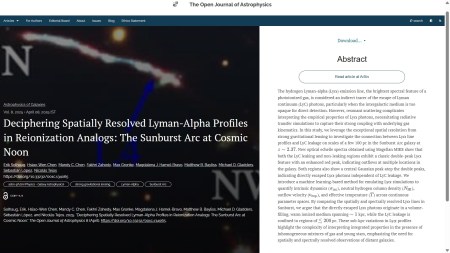
The second paper to announce, also published on 8th April 2025,  is “Deciphering Spatially Resolved Lyman-Alpha Profiles in Reionization Analogs: The Sunburst Arc at Cosmic Noon” by Erik Solhaug (Chicago, USA), Hsiao-Wen Chen (Chicago), Mandy C. Chen (Chicago),  Fakhri Zahedy (University of North Texas),  Max Gronke (MPA Garching, Germany),  Magdalena J. Hamel-Bravo (Swinburne, Australia), Matthew B. Bayliss (U. Cincinatti), Michael D. Gladders  (Chicago), Sebastián López (Universidad de Chile), Nicolás Tejos (Universidad Católica de Valparaíso, Chile).

This paper, which presents a study of the Lyman-alpha emission properties of a gravitationally-lensed galaxy at redshift z=2.37, appears in the folder Astrophysics of Galaxies. It was published


You can read the officially accepted version of this paper on arXiv here.

The third paper of the week  is “On the progenitor of the type Ia supernova remnant 0509-67.5” by Noam Soker (Technion, Haifa, Israel). This one was published on Wednesday 9th April 2025 in the folder High-Energy Astrophysical Phenomena. The author discusses possible ideas for the origin of a supernova that exploded inside a planetary nebula.

Here is the overlay:


You can find the officially accepted version of this paper on arXiv here.

Last (but certainly) not least for this week, published on April 11th 2025, we have “Are Models of Strong Gravitational Lensing by Clusters Converging or Diverging?” by Derek Perera (U. Minnesota), John H Miller Jr & Liliya L. R. Williams (U. Minnesota, USA), Jori Liesenborgs (Hasselt U., Belgium), Allison Keen (U. Minnesota), Sung Kei Li (Hong Kong University), Marceau Limousin (Aix Marseille Univ., France).  This papers study various models of a strong gravitational lensing system, the results suggesting that lens models are neither converging to nor diverging from a common solution for this system, regardless of method.

Here is the overlay:


The official published version can be found on the arXiv here.


That’s all the papers for this week. By way of a postscript I’ll just mention that the gremlins that have affected submissions to Crossref (which we rely on for registering the article metadata) have now been resolved and normal services have been restored.

#arXiv240910604v5 #arXiv241001849v2 #arXiv241105083v2 #arXiv250304709v2 #AstrophysicsOfGalaxies #CosmicNoon #DiamondOpenAccess #DiamondOpenAccessPublishing #fineStructureConstant #HighEnergyAstrophysicalPhenomena #HighResolutionSpectroscopy #PlanetaryNebula #reionization #SolarAndStellarAstrophysics #strongGravitationalLensing #SupernovaRemnant #TheOpenJournalOfAstrophysics
The Open Journal of Astrophysics

The Open Journal of Astrophysics is an arXiv overlay journal providing open access to peer-reviewed research in astrophysics and cosmology.

#astronomy #cosmology #JWST #galaxies #reionization

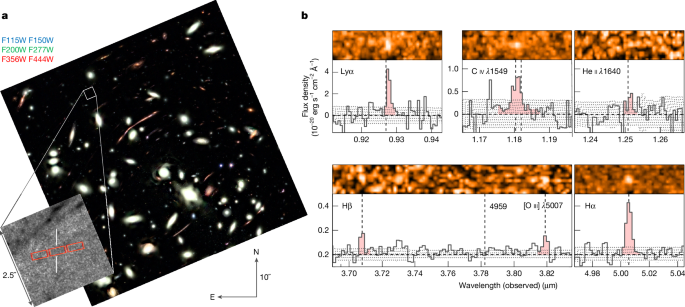
An article published in the journal "Nature" reports the results of observations of the primordial galaxy JADES-GS-z13-1. A team of researchers used the James Webb Space Telescope to examine this galaxy, estimating that it dates back to about 330 million years after the Big Bang. The surprise came from the so-called Lyman-alpha radiation because it was much stronger than expected from a galaxy of that era.

https://english.tachyonbeam.com/2025/03/27/an-intense-primordial-light-from-the-dark-ages-of-the-universe/

An intense primordial light from the dark ages of the universe

An article published in the journal 'Nature' reports the results of observations of the primordial galaxy cataloged as JADES-GS-z13-1. A team of researchers...

Witnessing the onset of #reionization through Lyman-α emission at redshift 13: https://www.nature.com/articles/s41586-025-08779-5 -> NASA's Webb Sees Galaxy Mysteriously Clearing Fog of Early Universe: https://webbtelescope.org/contents/news-releases/2025/news-2025-116
Witnessing the onset of reionization through Lyman-α emission at redshift 13 - Nature

Spectroscopy from the JWST Advanced Deep Extragalactic Survey of a galaxy at redshift 13 shows a singular, bright emission line identified as Lyman-α, suggesting the onset of reionization only 330 Myr after the Big Bang.

Nature

Weekly Update at the Open Journal of Astrophysics – 22/03/2025

It’s Satuday morning once again, and time for another update of papers published at the Open Journal of Astrophysics. Since the last update we have published two papers, which brings the number in Volume 8 (2025) up to 29 and the total so far published by OJAp up to 264.

The papers we have published this week are connected by the theme of black holes and their role in galaxy formation, which is a very hot topic nowadays!

The first paper to report is “Hawking Radiation from non-evaporating primordial black holes cannot enable the formation of direct collapse black holes” by Jonathan Regan, Marios Kalomenopoulos and Kelly Kosmo O’Neil of the University of Nevada, USA. This paper, which is based on an undergraduate thesis, is a study of the irradiating effects of primordial black holes and a discussion of whether these might influence the subsequent formation of supermassive black holes. It is in the section marked Astrophysics of Galaxies, and was published on Tuesday  18th March.

The overlay is here:

and you can find the final accepted version on arXiv here.

The second paper, which was published on Wednesday 19th March and is also in the folder Astrophysics of Galaxies, is “First Light and Reionization Epoch Simulations (FLARES) – XV: The physical properties of super-massive black holes and their impact on galaxies in the early universe” by Stephen Wilkins & Jussi K. Kuusisto (U. Sussex, UK), Dimitrios Irodotou (Institute of Cancer Research, UK), Shihong Liao (Beijing, China) Christopher C. Lovell (Portsmouth, UK), Sonja Soininen (Insitute of Cancer Research), Sabrina C. Berger (Melbourne, Australia), Sophie L. Newman (Portsmouth, UK), William J. Roper (Sussex), Louise T. C. Seeyave (Sussex), Peter A. Thomas (Sussex) and Aswin P. Vijayan Sussex). This paper uses cosmological hydrodynamical zoom simulations to study the formation of supermassive black holes and their impact on star formation in the early Universe.

Here is the overlay, which you can click on to make larger if you wish:


You can read the officially accepted version of this paper on arXiv here.

That’s all for this week. It’s been a bit frustrating for me as Managing Ediutor, because we have built up a backlog of several papers that were accepted for publication some time ago, but are still waiting for the authors to place the final version on arXiv. I hope these won’t take too long to appear, not least because I would like to clear my workflow on the Scholastica platform!

#arXiv240402815v3 #arXiv241109081v2 #AstrophysicsOfGalaxies #DiamondOpenAccess #FirstLight #FLARES #galaxyFormation #HawkingRadiation #OpenAccessPublishing #OpenJournalOfAstrophysics #primordialBlackHoles #reionization #supermassiveBlackHoles

The Open Journal of Astrophysics

The Open Journal of Astrophysics is an arXiv overlay journal providing open access to peer-reviewed research in astrophysics and cosmology.