Waveshare RP2350B-Plus-W – A Raspberry Pi Pico 2 W-sized board with 41 GPIOs, 16MB flash, USB-C port

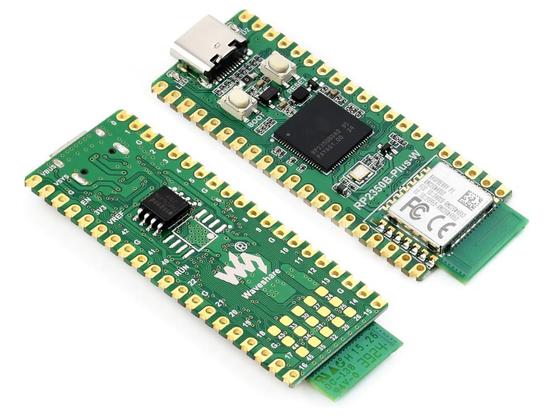
Waveshare RP2350B-Plus-W is a development board that follows the Raspberry Pi Pico 2 W form factor, but offers 41 GPIOs thanks to the RP2350B MCU, integrates 16 MB of flash, and includes a USB-C port. So, in several ways, it's an upgrade over the RP2350A-based official board, which offers only 26 GPIOs via two 13-pin GPIO headers, 4MB of flash, and a micro USB port. Since it's the same size, where do the extra GPIOs come from? Answer: The company simply added 15 pads to the bottom of the board, not quite as convenient since it's requires soldering, but it does the job.   Waveshare RP2350B-Plus-W specifications: SoC – Raspberry Pi RP2350B CPU Dual-core Arm Cortex-M33 @ 150 MHz with Arm Trustzone Dual-core RISC-V Hazard3 @ 150 MHz Only two cores can be used at any given time Memory – 520 KB on-chip SRAM Package – QFN-80 Memory - Footprint

CNX Software - Embedded Systems News
Flipper One – A Rockchip RK3576-powered portable Arm Linux computer and networking multi-tool

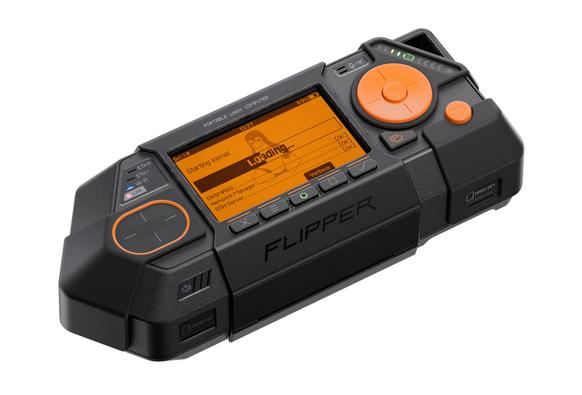
Flipper Devices has officially introduced the Flipper One open-source hardware portable Arm Linux platform and networking and Edge AI multi-tool powered by a Rockchip RK3576 octa-core Arm Cortex-A72/A53 SoC, and featuring a Raspberry Pi RP2350 for low-level control. You may think of it as a successor to the popular STM32-based Flipper Zero hardware and wireless hacking tool, but the company stresses that the Flipper One is NOT a replacement for the Flipper Zero. It is a different product with mainline Linux kernel support, no binary blobs (probably not 100% true), and open-source drivers, and operating at a different level of the networking and wireless stacks with dual Gigabit Ethernet, Wi-Fi 6E, and optional 5G or 4G LTE modem. Flipper One specifications: SoC – Rockchip RK3576 CPU 4x Cortex-A72 cores @ 2.2GHz, 4x Cortex-A53 cores @ 1.8GHz Arm Cortex-M0 MCU at 400MHz GPU – ARM Mali-G52 MC3 GPU with support for

CNX Software - Embedded Systems News
Raspberry Pi RP2350 board offers NB-IoT cellular connectivity, GNSS, and Wi-Fi indoor location

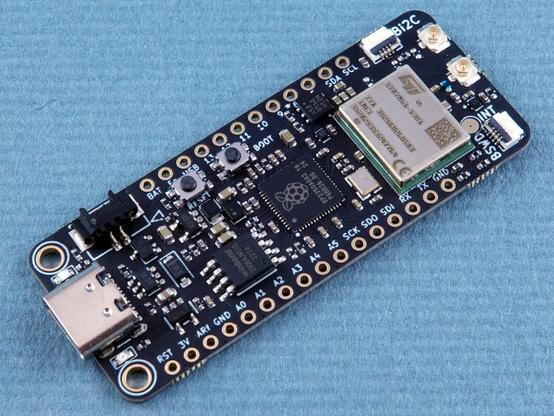
Challenger+ RP2350 NB-IoT is a Feather-compatible board pairing a Raspberry Pi RP2350 microcontroller and a certified NB-IoT cellular module with built-in GNSS, suitable for long-range, low-power connectivity. It looks to be a variant of the earlier Challenger+ RP2350 WiFi6/BLE5 board that replaces an ESP32-C6 WiFi 6, BLE, and 802.15.4 module with an STMicroelectronics ST87M01 NB-IoT and GNSS module. It still offers Challenger+ RP2350 NB-IoT specifications: Microcontroller – Raspberry Pi RP2350A MCU CPU Dual-core Arm Cortex-M33 processor @ 150MHz Dual-core 32-bit RISC-V processor @ 150MHz Up to two cores can be used at a given time Memory – 520KB internal RAM 8KB OTP Storage Package – QFN-60; 7×7 mm Memory – 8MB PSRAM Storage – 8MB SPI flash Cellular connectivity Module – STMicro ST87M01-1301 LTE Cat NB2 (NB-IoT), 3GPP Release 15 Worldwide regional bands coverage - B1, B3, B5, B8, B20, and B28 Single-tone / Multi-tone / Extended TBS and 2

CNX Software - Embedded Systems News

Clintech Pico – The first Raspberry Pi RP2354B board offers 48 GPIOs in Raspberry Pi Pico form factor

https://fed.brid.gy/r/https://www.cnx-software.com/2026/03/19/clintech-pico-raspberry-pi-rp2354b-board-raspberry-pi-pico-form-factor/

Clintech Pico – The first Raspberry Pi RP2354B board offers 48 GPIOs in Raspberry Pi Pico form factor

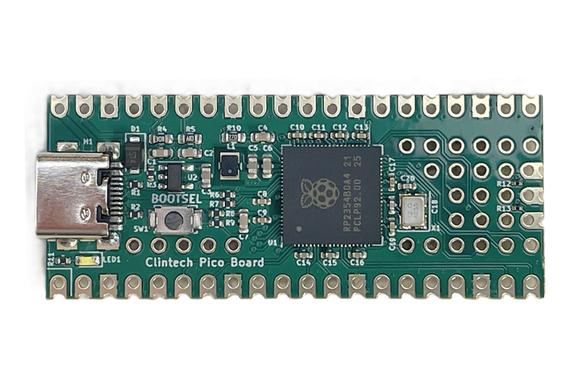
Designed by Clintech Ltd. in Bulgaria, the Clintech Pico Board appears to be the first development board based on the Raspberry Pi RP2354B chip with 2MB on-chip memory. It retains the same form factor as a Raspberry Pi Pico 2 but adds extra GPIOs to make use of the 48 general-purpose GPIOs provided by the RP2354B chip. Like the Raspberry Pi Pico 2, this board features 40 castellated and through holes on the sides, exposing GPIOs 0–22 and 26–28, along with 3 debug pins. Additionally, the board includes 27 extra on-board through holes that break out the remaining GPIOs (23–25 and 29–47) as well as the QSPI interface (SD0–SD3 and SCLK) for external memory. Clintech Pico specifications: SoC - Raspberry Pi RP2354B  CPU Dual-core Arm Cortex-M33 @ 150 MHz with Arm Trustzone, Secure boot Dual-core 32-bit RISC-V Hazard3 @ 150 MHz (3-stage in-order pipeline; RV32IMAC with Zba, Zbb, Zbs, Zbkb, Zcb, Zcmp, and

CNX Software - Embedded Systems News
PycoClaw – A MicroPython-based OpenClaw implementation for ESP32 and other microcontrollers

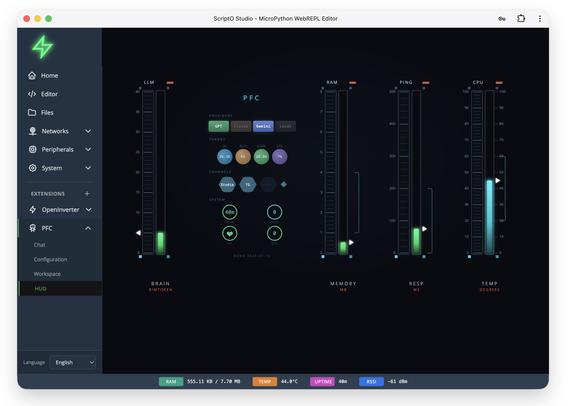
PycoClaw is a MicroPython-based platform for running AI agents on ESP32 and other microcontrollers that brings OpenClaw workspace-compatible intelligence to resource-constrained embedded devices. We had already covered the C-based Miniclaw for ESP32-S3 SoCs, the PycoClaw's developer (Jonathan Peace) told CNX Software that it is a "full OpenClaw-compliant agent" that supports more LLM providers (OpenAI, Gemini, Ollama, etc.), interfaces with not only Telegram, but also ScriptO Studio and WebRTC, and offers features like OTA updates, extensions, and battery-optimized operation. The table below compares PycoClaw to OpenClaw, Nanobot, PicoClaw, NullClaw, and MimiClaw. MimiClaw still offers the lowest footprint and highest efficiency, but PycoClaw appears to offer many more features, including improved GPIO support. It works on ESP32-S3 with at least 8MB flash and PSRAM, ESP32-P4, and should soon support Raspberry Pi RP2350 boards with PSRAM as well. PycoClaw can be installed on supported hardware through a "one-click install" using a compatible web

CNX Software - Embedded Systems News

PicoIDE: emulación abierta de discos duros y CD-ROM para equipos clásicos

Ya hace bastantes días que publicamos esta noticia en nuestras redes sociales pero hemos creído interesante detallar las especificaciones de este proyecto.

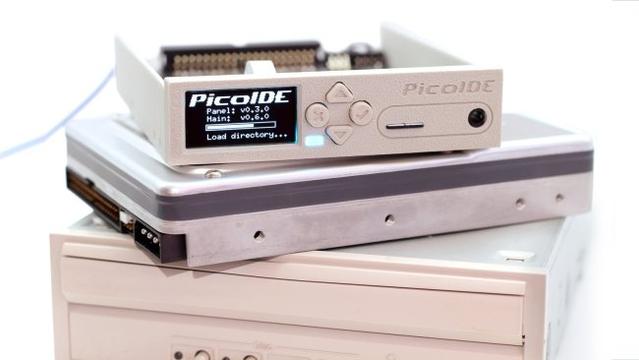
PicoIDE es un emulador abierto de unidades IDE y ATAPI diseñado para sustituir discos duros y lectores CD-ROM en ordenadores clásicos mediante almacenamiento sólido en tarjetas microSD. El sistema permite almacenar imágenes de discos y CDs y alternar entre ellas según se necesite, mientras el ordenador anfitrión las reconoce como unidades físicas reales. Con ello se eliminan problemas habituales como sectores defectuosos, fallos mecánicos o la necesidad de grabar discos ópticos.

Basado en el microcontrolador Raspberry Pi RP2350, PicoIDE ofrece dos variantes. La versión Base integra emulación completa de disco duro y CD-ROM, almacenamiento microSD, salida de audio CD y configuración mediante utilidad host o archivo de configuración. La versión Deluxe añade un panel frontal con pantalla OLED, botones de navegación y conectividad Wi-Fi gestionada por un ESP32, lo que permite administrar imágenes de forma remota y cambiar contenidos sin abrir el equipo.

El dispositivo presta especial atención al audio de CD, un elemento clave en numerosos títulos multimedia. Su DAC TI PCM5100A proporciona salida analógica de alta calidad mediante conector MPC-2 para enlazar con la entrada de audio de la tarjeta de sonido y jack de 3,5 mm, permitiendo escuchar bandas sonoras y pistas “redbook” exactamente como en el hardware original. Las imágenes en formato .bin/.cue mantienen la estructura mixta de datos y audio, algo que muchas soluciones virtuales modernas no reproducen correctamente.

PicoIDE también funciona como reemplazo completo de discos duros IDE. Puede emular geometrías específicas definidas en imágenes .vhd o mediante configuración, lo que facilita su uso en sistemas con BIOS antiguas o limitaciones CHS. Es posible mantener múltiples instalaciones de DOS, Windows 3.x u otros sistemas en una única microSD y seleccionar la imagen a cargar en el arranque. La capacidad de definir cadenas de fabricante y modelo mejora la compatibilidad con equipos que esperan hardware concreto.

Las imágenes pueden crearse y modificarse en sistemas modernos mediante emuladores como 86Box o WinUAE y transferirse después al dispositivo, simplificando la gestión del software. PicoIDE admite formatos .img, .hda, .vhd y .hdf, así como modos LBA y CHS para maximizar la compatibilidad.

El proyecto es completamente open source. El hardware se publica bajo licencia CERN-OHL-S-v2, el firmware bajo GPLv2 y la documentación incluye guías de montaje, configuración y desarrollo. Todos los archivos de diseño y código estarán disponibles en GitHub, fomentando la adaptación del dispositivo a usos específicos y garantizando su evolución a largo plazo.

El equipo se comercializará mediante crowdfunding con fabricación a cargo de Soldered Electronics, que se encargará del ensamblaje, pruebas y producción del chasis moldeado por inyección. Tras la financiación, se prevé el inicio de envíos en un plazo aproximado de uno a dos meses, con firmware preinstalado y verificación funcional de cada unidad.

https://www.youtube.com/watch?v=QmApt9ooVes

#almacenamientoMicroSD #almacenamientoSólido #ATAPICDAudio #ATAPIEmulator #audioCDATAPI #audioCDRedbook #CDAudioRedbook #CDROMEmulator #CHSLBACompatibility #compatibilidadCHSLBA #diskImageMounting #DOSGaming #emuladorATAPI #emuladorCDROM #emuladorIDE #firmwareOpenSource #gestiónInalámbricaDeImágenes #hardwareOpenSource #IDEEmulator #IDEHardDriveReplacement #informáticaRetro #juegosDOS #microSDStorage #montajeDeImágenesDeDisco #OLEDFrontPanel #openSourceFirmware #openSourceHardware #ordenadoresClásicos #panelOLEDFrontal #PicoIDE #RaspberryPiRP2350 #retroComputing #solidStateStorage #sustitutoDeDiscoDuroIDE #vintageComputers #WiFiImageManagement

PicoIDE – An open-source hardware IDE/ATAPI drive emulator for vintage computers (Crowdfunding)

https://fed.brid.gy/r/https://www.cnx-software.com/2026/02/02/picoide-an-open-source-hardware-ide-atapi-drive-emulator-for-vintage-computers/

PicoIDE – An open-source hardware IDE/ATAPI drive emulator for vintage computers (Crowdfunding)

PicoIDE is an open-source hardware IDE/ATAPI drive emulator based on a Raspberry Pi RP2350 board and designed to replace hard drives and CD-ROM drives in vintage computers with microSD card storage. Users don't need to burn optical discs or deal with old IDE hard drives with bad blocks, and instead, they can simply put their disk images on a microSD card and swap between them as needed. Two versions are offered, namely the PicoIDE Base featuring full IDE/ATAPI emulation in a standard 3.5-inch enclosure with a microSD card slot, and CD audio output, and the PicoIDE Deluxe, adding an ESP32-C3-based front panel with WiFi connectivity, an OLED, and navigation buttons. PicoIDE specifications: MCU - Raspberry Pi RP2350 microcontroller CPU 2x Arm Cortex-M33 cores @ 150 MHz 2x Hazard3 RISC-V cores @ 150 MHz Up to two cores can be used at any time (configured at boot) Memory – 520KB SRAM

CNX Software - Embedded Systems News
Raspberry Pi RP2350 devkit features 1.85-inch round touch display, microphone, optional speaker and battery box

Waveshare RP2350-Touch-LCD-1.85C is a Raspberry Pi RP2350 devkit with a 1.85-inch round touchscreen display with 360×360 resolution, a built-in microphone, a 28-pin GPIO header, and a USB-C port. The ESP32-S3-Touch-LCD-1.85C-BOX model builds on the platform to add a box with a speaker and a 3.7V battery. Both models also come with 16MB SPI flash, a microSD card slot, a 6-axis IMU, a few buttons and LEDs, and UART and I2C expansion connectors. They can be used for HMI solutions using touch, button, and voice recognition inputs, as well as display and audio outputs. RP2350-Touch-LCD-1.85C specifications: Microcontroller – Raspberry Pi RP2350A MCU CPU 2x Arm Cortex-M33 cores @ 150 MHz 2x Hazard3 RISC-V cores @ 150 MHz Up to two cores can be used at any time (configured at boot) Memory – 520KB SRAM Storage – 8KB OTP Package – QFN-60; 7×7 mm Storage – 16MB SPI NOR flash, microSD card slot Display

CNX Software - Embedded Systems News