 Alan J. Cain
In later antiquity and the middle ages, a ‘circular number’ was one that reappeared in its own powers: 5 and 6 were circular number since their powers (25, 125, 625, ...; 36, 216, 1296, ...) always end in 5 or 6.
Nicomachus (fl. c.100 CE), Proclus (410/12–485 CE), and Boethius (c.480–c.524 CE) discussed them. In an educational textbook, Cassiodorus (c.485–c.585 CE) gave this definition:
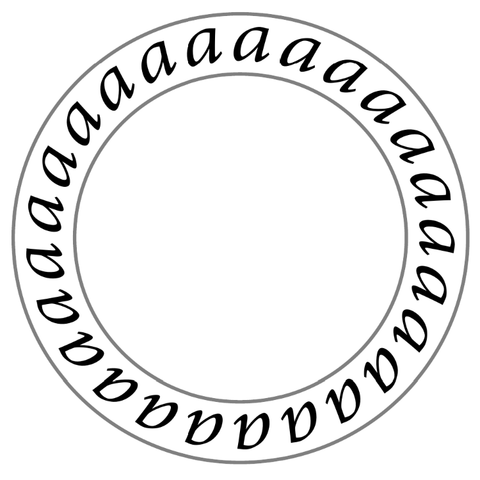
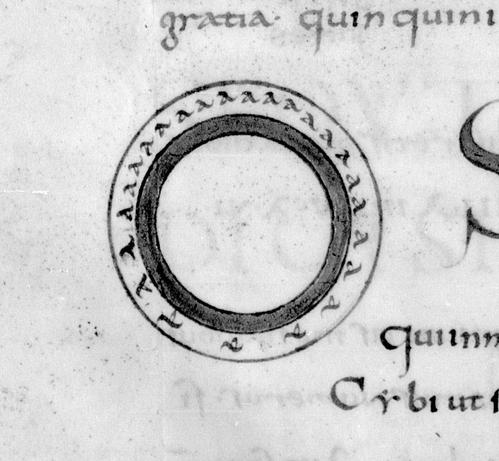
‘A circular number is one that when it is multiplied by itself, beginning from itself turns back to itself, for example 5 times 5 is 25 *as the diagram indicates*’. (emphasis added; see 1st+2nd attached images)
So circular numbers seem to have been a connection between number symbolism and a geometrical aesthetic admiration of circles and spheres (more on this in a later post).
5 being a circular number crops up in the in the late mediaeval poem ‘Sir Gawain and the Green Knight’ (c. late 13th century). 5 was used as symbol of perfection and eternity: Gawain's virtues were five and many times five, and they were linked to the pentagram, the five-pointed star, which was his emblem. At line $625 = 5 \times 5 \times 5 \times 5$, the poet says that the pentagram was a symbol set up by Solomon; it was known as ‘þe endeles knot’. This name presumably refers to how the pentagram can be drawn in a single unbroken stroke (see 3rd attached image)
Very subtly, the circularity is hinted at by the first line of the poem (‘Siþen þe sege and þe assaut watz sesed at Troye’) being echoed at line 2525 — or 25-25 — (‘After þe segge and þe asaute watz sesed at Troye’).
1/2
#NumberSymbolism #arithmology #Nicomachus #Proclus #Boethius #Cassiodorus #poetry

 porrima
 Lamhfada
 Tierfreund
 Pellicierbooks